Build Smart, Not Fast: A Tool Buying Guide for New Automotive Techs
You don’t need everything on day one. You need the right things – bought in the right order, at the right price. Here’s how to build a professional toolbox without breaking your budget.
What Tools Does a New Automotive Tech Actually Need?
One of the first financial shocks students in technical education encounter is the tool requirement. Many shops expect you to arrive with your own tools on day one – and if you’ve ever browsed a Snap-on truck, you know the full setup can run tens of thousands of dollars. For a student on an apprentice wage, that number feels impossible.
Here’s the reality: you don’t need a master tech’s toolbox to start working. You need a solid foundation of quality hand tools, a basic scan tool and multimeter, and a plan for building the rest over time. This guide is designed to help you spend money where it counts, avoid the common buying mistakes that waste money, and build a professional toolbox at a pace your budget can handle.
Start with the tools you’ll use every single day. Add the rest when the work demands it. A small set of quality tools outperforms a large set of junk every time.
The Golden Rules of Tool Buying for New Techs
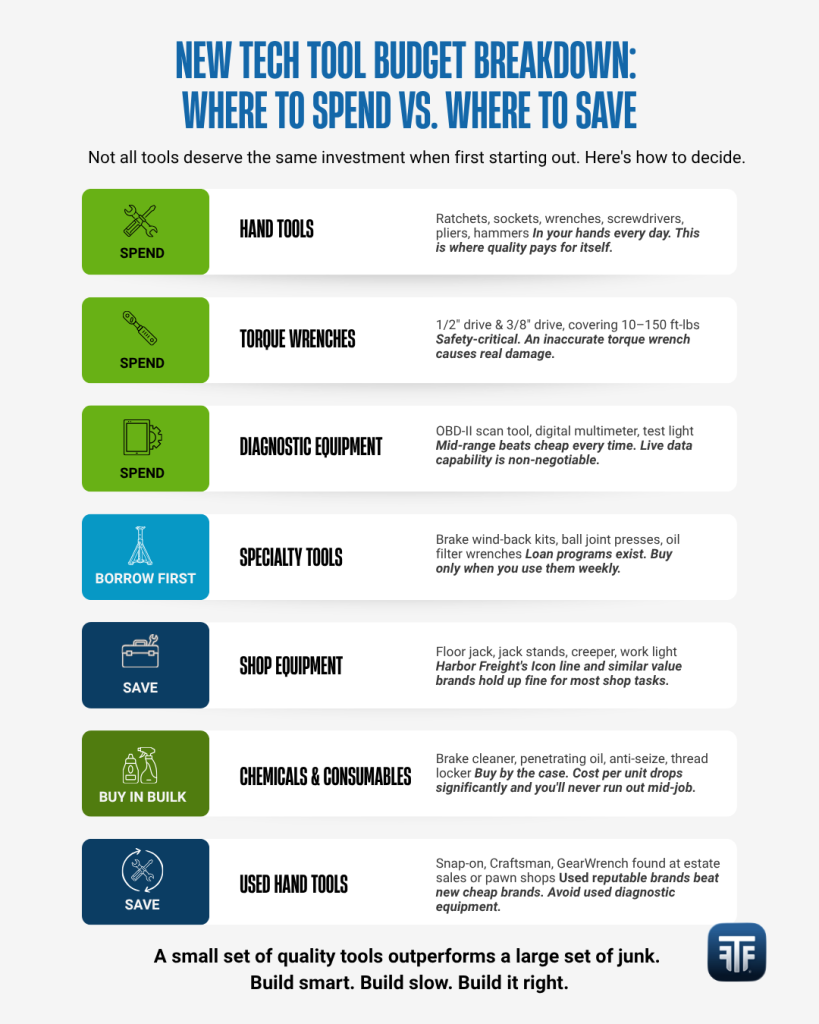
- Buy quality for tools you use daily. Ratchets, sockets, wrenches, and screwdrivers are in your hands all day every day. This is where quality pays for itself in durability, warranty, and feel. Brands like Snap-on, GearWrench, and Carlyle set the standard.
- Buy value on tools you use occasionally. Specialty tools, pullers, and single-use items don’t need to be top-shelf. Harbor Freight’s Icon and Pittsburgh Pro lines are solid options for tools that won’t see daily abuse.
- Never buy cheap safety-critical tools. Torque wrenches, jack stands, and electrical test equipment are not the place to cut corners. An inaccurate torque wrench or unreliable multimeter creates real risk.
- Use loaner programs before you buy specialty tools. AutoZone, Advance Auto Parts, and NAPA all offer free tool loaner programs for specialty items like brake caliper wind-back kits and ball joint presses. Use these until you know you’ll need the tool regularly enough to own it.
- Buy used hand tools strategically. Used hand tools from reputable brands often outlast new budget tools. Estate sales, pawn shops, and online marketplaces can yield Snap-on or Craftsman pieces at a fraction of new prices. Avoid used diagnostic equipment unless you can verify calibration and function.
- Avoid jumping into tool truck financing too quickly. Payment plans can be convenient, but financing tools over time can raise the total cost significantly. Make sure you understand the full price and interest before you sign.
The Starter Toolbox: What to Buy and When
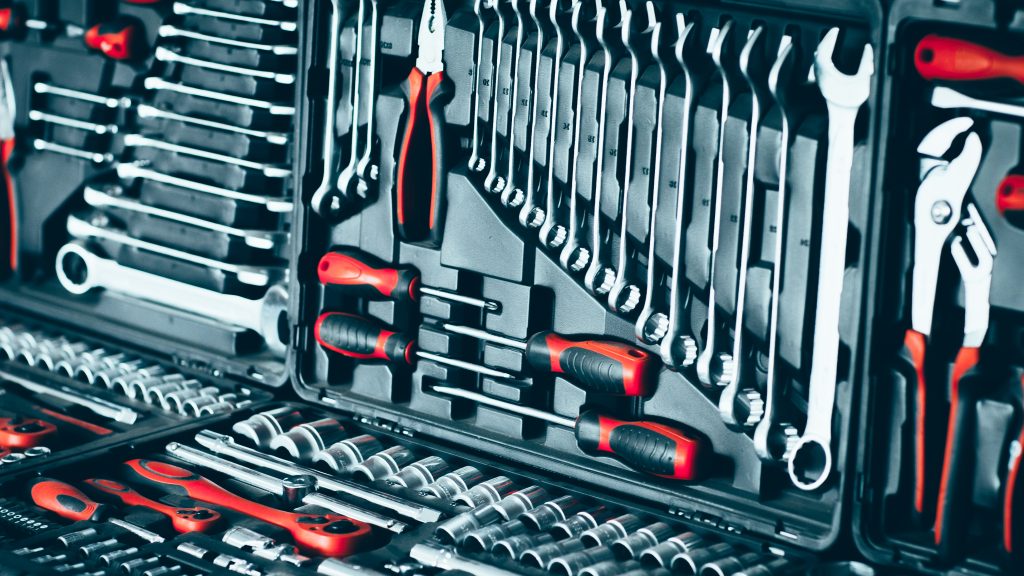
The table below is a practical starter guide organized by category and buying priority. It is built for an automotive tech entering the field – many items also apply to diesel, collision, and other sectors. Use it as a checklist and buying roadmap, not a one-time shopping list.
| Tool | Notes & Buying Guidance |
| HAND TOOLS | Priority: Day One | |
| 3/8″ drive ratchet and socket set (metric and SAE) | Snap-on, GearWrench, or Carlyle are strong quality options. Harbor Freight’s Icon and Pittsburgh Pro lines offer solid value for a tight budget. |
| 1/4″ drive ratchet and socket set | Essential for tight spaces. Metric and SAE both needed. |
| Combination wrench set (metric and SAE, 8mm-19mm) | Open-end and box-end in one tool. GearWrench flex-head ratcheting wrenches are worth the extra cost. |
| Screwdriver set (flathead and Phillips, multiple sizes) | A quality set with comfortable handles pays off on long days. Magnetic tips are a bonus. |
| Pliers set (needle-nose, slip-joint, locking, diagonal) | Snap-on, GearWrench, or comparable quality. These get used constantly. |
| Torque wrench (1/2″ drive, 20-150 ft-lbs) | Accurate torque is non-negotiable for fasteners. Don’t skip this for cost. |
| Torque wrench (3/8″ drive, 10-80 ft-lbs) | For smaller fasteners and sensors. Two torque wrenches cover most applications. |
| Breaker bar (1/2″ drive) | For stubborn fasteners. A 1/2″ breaker bar with a 24″ or longer handle handles most stuck bolts. |
| Dead blow hammer and ball-peen hammer | Plastic-faced dead blow for components. Ball-peen for general shop work. |
| Pry bar set | Flat pry bars in multiple sizes. Used constantly on suspension, body, and drivetrain work. |
| DIAGNOSTIC & ELECTRICAL | Priority: First 3 Months | |
| OBD-II scan tool (basic to mid-range) | A quality entry-level scan tool is a must. TopDon offers solid value at entry-level price points. Avoid the cheapest readers – they miss live data. |
| Digital multimeter (DMM) | An absolute essential for electrical diagnosis. Fluke is the industry standard; AutoZone and NAPA carry several reliable options at lower price points. |
| Test light | Simple, fast, inexpensive. Used constantly for basic circuit checks. Every tech needs one. |
| Electrical terminal kit and wire connectors | Deutsch, Weather-Pack, and metri-pack connectors cover most domestic applications. NAPA and AutoZone carry assorted kits. |
| Fuse puller and assorted fuse kit | Cheap insurance. Keep a variety of blade and mini fuses in stock. |
| SPECIALTY & SHOP TOOLS | Priority: Build Over Time | |
| Oil filter wrench set | A variety of cap-style and strap-style wrenches handles most makes. AutoZone and NAPA loan versions for free – buy your own once you know what you use most. |
| Brake caliper wind-back tool set | Required for rear disc brake service. Most sets cover domestic and import applications. |
| Ball joint separator / pickle fork set | Heavy-duty forks for suspension work. Buy quality here – cheap forks bend and damage boots. |
| Thread repair kit (Helicoil or equivalent) | Stripped threads happen. A basic M6, M8, M10, M12 kit handles most common fasteners. |
| Magnetic parts tray and telescoping magnet | Inexpensive and invaluable for dropped fasteners in tight spaces. |
| Creeper and floor mat | Your back will thank you. Harbor Freight sells solid options at low cost. |
| Shop towels and nitrile gloves (in bulk) | CRC, Old World Industries, and WD-40 products pair well here for cleaning and lubrication alongside your consumables supply. |
| CHEMICALS & CONSUMABLES | Priority: Stock Continuously | |
| Penetrating oil (PB Blaster or equivalent) | For stuck fasteners. Apply the night before when possible. WD-40 Specialist Penetrant is a strong option. |
| Anti-seize compound | Applies to spark plugs, O2 sensors, and any fastener that sees heat. Prevents the stuck fastener problem before it starts. |
| Brake cleaner (non-chlorinated) | The most-used aerosol in any shop. Buy by the case. CRC and similar brands are widely available through NAPA and AutoZone. |
| Contact cleaner | For electrical connectors and throttle bodies. Non-conductive formula is essential. |
| Dielectric grease | Protects electrical connectors from corrosion. A small tube lasts a long time. |
| Thread-locking compound (blue and red) | Blue for serviceable fasteners, red for permanent. Both are needed in a fully stocked toolbox. |
Building Your Toolbox Over Time
The goal in your first year is not to have everything – it’s to have what you need for the jobs in front of you. Here’s a realistic phased approach:
Month 1-3: The Foundation
Hand tools, basic sockets and wrenches, a multimeter, a test light, and a basic OBD-II scan tool. This covers the vast majority of entry-level and maintenance work and gets you productive from day one.
Month 3-12: Fill the Gaps
Add tools as specific jobs require them. When you encounter a repair you can’t complete because of a missing tool, that’s the signal to add it. This organic approach prevents buying tools you’ll never use.
Year 2 and Beyond: Invest in Diagnostics
As your work gets more complex, your diagnostic equipment needs to keep pace. A professional-grade scan tool with bi-directional controls, a lab scope, and component-specific testers become valuable as you move into driveability and electrical diagnosis.
Organizing and Protecting Your Investment
Tools are a significant financial investment – treat them accordingly:
- Label and engrave. Mark your tools with your name or a unique identifier. Tool theft in shops happens, and identifiable tools are both a deterrent and a recovery aid.
- Clean tools before putting them away. Dirt and grime accelerate wear on ratchet mechanisms and moving parts. A quick wipe-down takes 30 seconds and extends tool life significantly.
- Keep a tool inventory. A simple list or photo record of what you own matters for insurance purposes and helps you track what’s been borrowed or misplaced.
- Invest in a quality toolbox early. A rolling cabinet with a lock protects your investment and keeps you organized. It doesn’t need to be top-of-the-line to start – it needs to be lockable and large enough to grow into.
Tool Support Through TechForce
Tools represent one of the biggest upfront costs for students entering the skilled trades – and TechForce Foundation recognizes that. Through partnerships with leading tool brands and suppliers, TechForce connects students to tool grants, vouchers, and discounts that reduce the financial barrier to getting started.
TechForce partners include NAPA, AutoZone, Advance Auto Parts, Snap-on, GearWrench, Carlyle, TopDon, Harbor Freight, and others who support students entering technical careers. Check TechForce.org for current tool support opportunities available to students in your sector and region.
The Bottom Line
Your toolbox is a career-long investment that grows with you. The techs who build it strategically – spending on quality where it matters, using loaners and used tools where it doesn’t, and adding tools as the work demands them – end up with better equipment and less debt than the ones who try to buy everything at once.
Start with the foundation. Do the work. Let the toolbox grow with your career.
Sources & Further Reading
For more information on the topics covered in this article, we recommend the following resources:
- NAPA Auto Parts: napaonline.com – hand tools, diagnostic equipment, chemicals, and free tool loaner program for specialty items
- AutoZone: autozone.com – tool loaner program (Loan-A-Tool), hand tools, and diagnostic equipment for entry-level techs
- Advance Auto Parts: advanceautoparts.com – tool loaner program, hand tools, and consumables
- TopDon: topdon.com – entry-level to professional OBD-II scan tools and diagnostic equipment at accessible price points
- GearWrench: gearwrench.com – professional-grade hand tools and ratcheting wrench sets used widely in automotive and diesel shops