Know Who You’re Working For: Employer Insights for Skilled Trade Students

Not all shops are created equal. Here’s how to evaluate employers, understand different shop cultures, and find the kind of workplace where your career can actually grow.

female auto mechanic tutor with students

Why Employer Quality Matters as Much as the Job Offer

In a market with 3 to 7 job openings per graduate across skilled trade sectors, new technicians have more options than they often realize. The question is not just whether you can get a job – it’s whether you get the right one.

The shop you start in shapes your first years in the trade more than almost any other factor. A great employer invests in your training, gives you a clear path to advance, pays fairly, and treats you like a professional. A poor employer burns through new techs, offers no growth, and can erode enthusiasm for a career that took real effort to enter.

Knowing what to look for – and what to walk away from – is one of the most important skills a new technician can develop.

What makes a great employer in the skilled trades is not complicated: fair pay, real training, honest communication, and a culture where people are treated with respect. The shops that get all four tend to have the same techs for 10 to 20 years.

What Makes a Great Employer in the Skilled Trades?

TechForce evaluates employer quality using criteria informed by the Good Jobs Institute framework, which defines a good job as one that provides economic stability, growth opportunity, and a sense of dignity and purpose at work. In the skilled trades, that translates to:

  • Fair and transparent pay. A great employer can explain clearly how you’ll be compensated, what the path to higher earnings looks like, and what you need to do to get there. Vague or evasive answers about pay are a warning sign.
  • Investment in training and certifications. The best shops pay for or subsidize ASE testing, OEM training, and continuing education. They see technician development as a business investment, not a cost.
  • Clear advancement pathways. Good employers can tell you what a 1-year, 3-year, and 5-year tech looks like at their shop – in terms of responsibility, title, and pay. If there’s no answer to that question, there may be no path.
  • A culture of respect. This is harder to measure but easy to observe. Watch how the shop lead talks to the newest tech. Watch how mistakes are handled. Watch whether people seem genuinely engaged or just counting the hours.
  • Low voluntary turnover. Shops where people stay for years are almost always better employers than shops with constant turnover. Ask how long the current team has been there.

Understanding Different Shop Types and Cultures

The skilled trades offer employment across several different shop environments, each with its own culture, structure, and trade-offs. Here’s how they compare:

Shop TypeStrengthsConsiderations
Franchise DealershipStructured training, OEM certifications, consistent workflow, benefits packagesHigher volume pressure, less flexibility, corporate culture may not suit everyone
Independent ShopMore autonomy, broader repair variety, closer team relationshipsBenefits and training support vary widely – vet carefully before accepting an offer
Fleet OperationConsistent hours, predictable work, often strong benefits and union representationLess variety, may be brand or system specific, less customer interaction
Specialty ShopDeep expertise in a niche (performance, diesel, European imports, EV), passionate team cultureSmaller teams, fewer advancement layers, business stability depends on niche demand

None of these shop types is universally better than the others. The right fit depends on what you value at each stage of your career – structured training early on, autonomy and variety later, or depth of specialization in a niche you’re passionate about.

How to Evaluate a Job Offer

A job offer is more than a number. Here’s what to look at before you accept:

Total Compensation, Not Just Base Pay

Factor in health insurance, paid time off, tool allowances, uniform programs, and any training reimbursement. A shop offering $18/hour with full benefits may be worth more than $22/hour with nothing else – depending on the cost of benefits in your area.

The Pay Progression Timeline

Ask what the path from your starting rate to flat rate or senior tech pay looks like – and over what timeline. Get specific. “We’ll see how it goes” is not an answer. A shop with a clear answer to this question has thought about retaining its people.

The Training Commitment

Ask directly: does the shop pay for ASE testing? Are there OEM training programs available? Is there time built into the schedule for continuing education? These answers tell you how serious the employer is about your long-term development.

The First 90 Days

Ask what onboarding looks like. Will you be paired with a mentor or senior tech? What will your first months of work actually involve? A shop with a real answer to this has a real onboarding process. A shop that shrugs probably doesn’t.

Red Flags That Are Worth Walking Away From

The technician shortage means you have leverage. Use it to avoid situations that will hurt your career:

  • High turnover with no explanation. If multiple techs have left in the past year and nobody will tell you why, assume the worst and keep looking.
  • Pressure to skip the onboarding process. “We need you to start immediately” combined with no structured introduction to the shop is a sign of disorganization that will affect your daily experience.
  • Vague or shifting answers about compensation. If the pay structure keeps changing through the interview process, expect the same pattern after you’re hired.
  • No answer on advancement. If a shop cannot tell you what growth looks like for a tech who performs well, there is no growth path. That’s a ceiling, not a starting point.
  • A dismissive attitude toward training. Shops that view certifications as unnecessary or “something you do on your own time” are telling you exactly how much they value your professional development.

TechForce Tools for Finding the Right Employer

TechForce Foundation’s platform connects students to employers through a job board with tens of thousands of positions, direct employer partnerships, and events where students and hiring managers meet in person. The platform also provides career path maps and salary data that help students evaluate offers with real information rather than guesswork.

With the technician shortage at historically high levels, the right employer is out there. The tools to find them are at TechForce.org.

The Bottom Line

The trade you choose is only half the decision. The employer you choose shapes everything that comes after – your training, your advancement speed, your daily experience, and your long-term earning potential. Take the evaluation seriously.

A great shop and a skilled technician who shows up every day ready to work is one of the most productive relationships in the skilled trades. That relationship starts with choosing well on both sides.

Sources & Further Reading

For more information on the topics covered in this article, we recommend the following resources:

  • Good Jobs Institute: goodjobsinstitute.org – research and criteria defining high-quality employment, used as a framework for evaluating employer quality in the skilled trades
  • U.S. Bureau of Labor Statistics (BLS): bls.gov – wage data, benefits information, and labor market conditions for skilled trade occupations
  • National Institute for Automotive Service Excellence (ASE): ase.com – employer training investment standards and certification programs used to evaluate technician development

The Future of the Trades: Industry Trends Every Tech Needs to Know

Electric vehicles, smart buildings, autonomous systems, and advanced materials are changing every skilled trade. Here’s what’s coming, what it means for your career, and how to stay ahead of it.

Are the Skilled Trades Being Replaced by Technology?

This is the question a lot of students ask, and it deserves a direct answer: no. Technology is changing the skilled trades – dramatically, in some sectors – but it is not replacing the technicians who understand it. If anything, the gap between what technology can do and what humans are needed to install, maintain, diagnose, and repair it is growing faster than the workforce can keep up.

America already needs nearly 1 million new entry-level technicians by 2028. That shortage exists right now, before the full wave of EV adoption, smart building automation, and autonomous systems hits the mainstream. The techs who combine foundational trade skills with knowledge of emerging technology will be among the most valuable workers in the country.

This article breaks down the most important trends in each of the six major skilled trade sectors – and what they mean for your career trajectory.

The skilled trades are not disappearing. They are evolving. The technician who understands both the old system and the new one is irreplaceable.

Key Trends by Sector

Here’s a sector-by-sector overview of the technologies and trends shaping the future of skilled technical work:

SectorKey Technologies and Trends to Watch
AutomotiveEV and hybrid systems, ADAS calibration, over-the-air software updates, connected vehicle diagnostics
DieselEmissions technology (DEF, DPF, EGR), alternative fuels (hydrogen, CNG), telematics and fleet management software
AviationAdvanced composite materials, unmanned aerial systems (UAS/drones), electric aircraft propulsion, digital avionics
CollisionADAS recalibration after every structural repair, OEM-certified repair procedures, aluminum and mixed-material construction
HVACSmart building automation, heat pump technology, low-GWP refrigerants, energy efficiency compliance
WeldingRobotic welding integration, laser and friction stir welding, advanced alloys (titanium, Inconel), NDT inspection

Electric Vehicles and What They Mean for Automotive Techs

EV and hybrid technology is the biggest shift the automotive sector has seen since the introduction of electronic fuel injection. It does not eliminate the need for automotive technicians – but it changes the skills required and creates a significant premium for techs who have high-voltage system training.

  • High-voltage safety is non-negotiable. Working on HV systems without proper training is genuinely dangerous. OEM certification programs and courses through organizations like the Electric Vehicle Infrastructure Training Program (EVITP) are increasingly valuable.
  • Diagnostics are shifting toward software. EV diagnostics rely heavily on software tools, data logging, and battery management system analysis rather than traditional mechanical inspection. Techs comfortable with digital tools have a significant advantage.
  • ICE vehicles aren’t going away immediately. The existing fleet of internal combustion engine vehicles will need service and repair for decades. Hybrid competency bridges both worlds and is the most practical near-term investment for most automotive techs.
  • ADAS is already here. Advanced driver assistance systems – lane keep assist, automatic emergency braking, adaptive cruise control – are on vehicles in service right now and require calibration after any structural or windshield repair. Every automotive and collision tech needs to understand them.

Diesel and the Future of Heavy Equipment

Diesel is not going away – but it is getting cleaner and smarter. Emissions regulations are driving significant changes in engine technology, and fleet operators are increasingly relying on telematics data to predict maintenance needs before failures occur.

  • Emissions systems are complex and require specialized knowledge. DEF (diesel exhaust fluid), DPF (diesel particulate filter), and EGR (exhaust gas recirculation) systems are now standard on commercial diesel engines and are a major source of diagnostic work.
  • Alternative fuels are gaining ground. Compressed natural gas (CNG), liquefied natural gas (LNG), and hydrogen fuel cell technology are growing in fleet applications. Diesel techs with alternative fuel training have expanding opportunities in transportation and logistics.
  • Telematics creates new diagnostic workflows. Fleet management software now provides real-time data on vehicle performance, fault codes, and maintenance intervals. Diesel techs who can interpret this data and act on it proactively are valuable to fleet operators.

Aviation: Digital Systems and New Aircraft Technology

Aviation maintenance is already one of the most technology-intensive skilled trades, and the pace of change is accelerating. Two trends stand out as particularly significant for students entering the field now:

  • Unmanned Aerial Systems (UAS/drones) are creating new career paths. Commercial drone operations require FAA-licensed maintenance technicians. This is a growing sector within aviation maintenance that didn’t meaningfully exist a decade ago.
  • Electric aircraft propulsion is moving from concept to reality. Short-haul electric aircraft are in development and early deployment at several manufacturers. A&P mechanics with high-voltage and electric propulsion training will be positioned at the front of a major industry shift.

Collision Repair and the ADAS Calibration Requirement

ADAS calibration is the single biggest change to collision repair in the past decade. Virtually every modern vehicle with advanced safety systems requires camera and sensor recalibration after any repair that affects the vehicle’s geometry – including windshield replacement, wheel alignment, and structural work.

Shops that cannot perform ADAS calibration in-house are already turning away work or subcontracting it out. Collision techs with calibration training and equipment access are among the most in-demand workers in the sector right now.

HVAC: Smart Buildings and the Refrigerant Transition

Two regulatory shifts are reshaping the HVAC industry simultaneously. First, the phasedown of high-global-warming-potential (GWP) refrigerants under EPA regulations is forcing equipment manufacturers to transition to new refrigerant blends – requiring updated training and handling procedures. Second, smart building automation systems are becoming standard in commercial construction, creating demand for HVAC techs who understand building controls and IoT integration.

Heat pump technology is also growing rapidly as a more energy-efficient alternative to traditional heating systems in residential and light commercial applications. Techs with heat pump expertise are seeing strong demand across much of the country.

Welding: Robotics, Advanced Materials, and NDT

Robotic welding has been part of manufacturing for decades – but the role of human welders alongside robotic systems is evolving, not disappearing. Humans are needed to program, maintain, and quality-check robotic systems, and to perform the complex, non-repetitive welds that robots still cannot reliably execute.

The fastest-growing specializations in welding involve advanced alloys (titanium, Inconel, duplex stainless steel) used in aerospace, energy, and chemical processing – sectors where precision is non-negotiable and certified welders command significant pay premiums. Non-destructive testing (NDT) skills complement welding expertise and open additional career pathways.

How to Stay Relevant and Keep Learning

The common thread across every sector is this: the skilled trades reward people who keep learning. Here’s how to build a habit of staying current:

  • Pursue certifications proactively. Don’t wait for your employer to send you to training. Research the certifications that are gaining value in your sector and pursue them on your own timeline.
  • Follow the industry publications. Automotive Body Repair News (ABRN), Fleet Owner, Aviation Week, ACHR News, and the American Welding Society all publish free industry updates. Spending 15 minutes a week with relevant publications keeps you ahead of most of your peers.
  • Pay attention to what OEMs are investing in. The technology priorities of major manufacturers – Ford, GM, Boeing, Carrier, Lincoln Electric – signal where the skilled trades are heading. What they’re building today is what techs will be servicing in 5 years.
  • Engage with the TechForce community. TechForce AMA sessions regularly feature industry professionals discussing where their sectors are heading. These conversations are among the most direct ways to hear what skills will be in demand from the people doing the hiring.

TechForce and Career Readiness for the Future

TechForce Foundation supports students across multiple sectors of the skilled trades – not just in getting started, but in staying current as the industry evolves. The platform includes continuing education resources, industry trend content, and connections to employers who are actively investing in technology training for their teams.

Scholarships, grants, and other financial support through TechForce help students invest in the advanced training that emerging technology requires. Visit TechForce.org to explore what’s available in your sector.

The Bottom Line

The future of the skilled trades is not a threat to the people who do this work. It’s an opportunity. Every new technology that enters a shop, a fleet, a building, or an aircraft creates demand for a human being who understands it – how it works, what it needs, and what to do when it fails.

Start with the fundamentals. Build the certifications. Pay attention to where your sector is heading. The techs who do those three things will never struggle to find work.

Sources & Further Reading

For more information on the topics covered in this article, we recommend the following resources:

  • U.S. Bureau of Labor Statistics (BLS) Occupational Outlook Handbook: bls.gov – job outlook and skills projections for automotive technicians, diesel mechanics, HVAC technicians, welders, and aircraft mechanics
  • U.S. Department of Energy (DOE) Alternative Fuels Data Center: afdc.energy.gov – data and trends on EV adoption, alternative fuels, and fleet electrification
  • Federal Aviation Administration (FAA): faa.gov – UAS regulations, electric aircraft developments, and aviation maintenance certification updates
  • U.S. Environmental Protection Agency (EPA): epa.gov – refrigerant phasedown regulations and HVAC compliance information
  • American Welding Society (AWS): aws.org – welding technology trends, certification updates, and workforce development resources
  • I-CAR (Inter-Industry Conference on Auto Collision Repair): i-car.com – ADAS calibration training, OEM repair procedures, and collision industry technology updates

Everyone Starts Somewhere: Setting Realistic Expectations for Your First Years in the Trade

The gap between what new techs expect and what the first year actually looks like is where a lot of careers end before they begin. Here’s what to actually expect – and how to make the most of it.

What Do New Technicians Actually Expect?

One of the most consistent conversations TechForce has with industry partners comes down to this: students graduate from technical school expecting to walk into a shop and immediately do the advanced work they trained for. The reality is almost always different – and that gap catches a lot of new techs off guard.

That’s not a criticism of students. It’s a flaw in how the skilled trades are sometimes presented. Technical education does a good job of teaching the skills. It doesn’t always do a good job of preparing students for the culture, pace, and hierarchy of a real working shop.

This article is the honest conversation most new techs wish they’d had before their first day.

“They want to come out of school making $100,000 without starting at the bottom. Our solution is going to be who talks to them in gaming language about how to level up.” – TechForce industry partner, describing the expectation gap and what it takes to bridge it.

The Expectation vs. Reality Gap

Here are the five most common expectation gaps new techs and trade students encounter in their first year – and what’s actually true:

The ExpectationThe Reality
“I’ll be doing real repairs right away.”Most shops start new techs on oil changes, tire rotations, and basic maintenance. That’s not a slight – it’s how you prove you’re trustworthy with a customer’s vehicle.
“I’ll be making good money from day one.”Entry-level pay is real pay, but master-tech earnings come later. The path to strong wages is clear – it just takes time and certifications to get there.
“My instructor said I was one of the best in class.”School and shop are different environments. Being a strong student means you have a foundation to build on. It doesn’t mean you skip the beginner stage.
“I know more than some of the older techs here.”Maybe true on specific topics. Irrelevant right now. Watch, listen, and prove yourself with your work before forming opinions about others.
“If I’m not advancing in 6 months, something is wrong.”Real advancement in a skilled trade takes 1-3 years of consistent performance. Six months is barely enough time to learn the shop’s systems and earn trust.

The Mopping the Floor Reality

There’s a story that gets told in skilled trades circles – usually by a master tech looking back on their early days. It goes something like this: on their first week, they were handed a mop and told to clean the shop floor. Not a scan tool. Not a work order. A mop.

The point isn’t that new techs should expect to be mistreated or underutilized indefinitely. The point is that trust in a shop is earned through small things first. Showing up on time. Being the last one to leave. Keeping the bay clean without being asked. Asking good questions. Being reliable on the simple jobs before being given the complex ones.

The techs who resent that process tend to leave early. The ones who understand it as a passage tend to advance faster because they build genuine trust instead of demanding it.

What Employers Actually Expect from New Techs

Here’s what hiring managers and shop leads consistently say they want from a first-year tech – and it has almost nothing to do with technical skill:

  • Show up. Reliability is the single most valued quality in a new hire. A tech who is always on time, rarely calls out, and communicates proactively when something comes up is rare and noticed immediately.
  • Be coachable. New techs who accept feedback without defensiveness and apply it quickly are the ones who get more responsibility. New techs who argue with every correction get fewer opportunities.
  • Ask good questions. Not constant questions about things you could figure out yourself – but thoughtful questions that show you’ve already done some thinking. There’s a difference.
  • Take care of the vehicle. A customer’s car or truck is often their most valuable possession and the thing that gets them to work. Treating it with respect – every time, not just when someone is watching – builds the kind of reputation that leads to advancement.
  • Stay curious. The new techs who advance fastest are the ones who are genuinely interested in the work. They hang around after hours to watch a repair. They look up things they didn’t know. The curiosity shows.

How to Show Up, Prove Yourself, and Advance

The path from entry-level tech to trusted team member isn’t complicated. It’s just not fast. Here’s what it actually takes:

Master the Basics Before Asking for More

Every shop has a set of foundational services: oil changes, tire rotations, fluid checks, basic inspections. Get so good at these that the service advisor never has to think twice about sending you a car. Speed and accuracy on the basics is what opens the door to more complex work.

Make Your Intentions Known

Most shop leads don’t automatically track who wants to advance and who is content where they are. Tell your lead or mentor directly: “I’m working toward my ASE certifications and I want to be doing more diagnostic work in the next year. What do I need to demonstrate to get there?” That conversation changes how people see you.

Find a Mentor

The fastest path to advancement in any skilled trade runs through someone who has already made it. Find a tech in your shop who is willing to answer questions, let you watch their work, and give you honest feedback. TechForce also connects students to mentors outside their immediate shop through the platform’s community and mentorship networks.

Pursue Certifications Systematically

ASE certifications, manufacturer training programs, and sector-specific credentials are the clearest signal to any employer that you are serious about your career. Don’t wait for your shop to send you – start studying on your own time and schedule tests as soon as you’re eligible.

A Note on Pay Expectations

The skilled trades offer some of the strongest earning potential of any career that doesn’t require a four-year degree. A master automotive technician, diesel specialist, or senior HVAC tech can earn $50 to $85+ per hour. But that earning level is the destination of a 10 to 15 year career, not the starting point.

Entry-level and apprentice pay in most sectors runs $14 to $22 per hour. That’s real money, especially compared to the debt that often comes with a four-year degree. The trajectory is steep if you put in the work. The key is not to judge the career by where it starts.

TechForce and the Level Up Mentality

TechForce Foundation was built around a simple idea: students in technical education deserve the same quality of support, resources, and career guidance that students in four-year programs get. That includes being honest about what the path looks like.

The platform connects students to career path maps with clear milestones, mentors who have been where they are, community circles of peers navigating the same challenges, and scholarships and other financial support that makes it possible to stay the course during the early years.

The technician shortage is real. The career opportunity is real. The path requires starting at the bottom – just like it always has. Visit TechForce.org to access the tools that help you move through it faster.

The Bottom Line

The techs who make it to master level are not the ones who skipped the hard early years. They’re the ones who understood what those years were for: building a foundation of trust, skill, and reputation that everything else is built on.

Start where you are. Do the small things exceptionally well. Keep your eyes on where the path leads. The level up is earned – and it’s absolutely within reach.

Sources & Further Reading

For more information on the topics covered in this article, we recommend the following resources:

  • U.S. Bureau of Labor Statistics (BLS) Occupational Outlook Handbook: bls.gov – median wages, job outlook, and career progression data for automotive technicians, diesel mechanics, and other skilled trade occupations
  • National Institute for Automotive Service Excellence (ASE): ase.com – certification pathways and professional development resources for automotive and diesel technicians

Level Up: Career Path Maps for Auto, Diesel, Aviation, Collision, HVAC, and Welding

Every skilled trade has a clear progression from entry level to master. Here’s what that path looks like across six sectors – with real timelines, pay ranges, and milestones.

What Does a Skilled Trade Career Path Actually Look Like?

One of the biggest misconceptions students bring into technical education is expecting to graduate and immediately earn top dollar. The reality is more nuanced – and actually more exciting. Every skilled trade follows a clear progression: you start at entry level, build speed and competency, earn certifications, and advance through defined stages toward master-level work and the earning power that comes with it.

America needs nearly 1 million new entry-level technicians by 2028 across automotive, diesel, aviation, collision, HVAC, and welding. Schools are graduating only a fraction of that number. That gap means the demand for what you’re training to do is at an all-time high – and the career path in front of you has never had more runway.

Below is a breakdown of the career progression in each of the six major skilled trade sectors TechForce supports. Use it as a roadmap, not a guarantee – actual pay and timeline vary by region, employer, and individual performance.

“My dream is to become a level 3, master diesel technician. I wish to make good money and provide great service to my customers.” – TechForce student. That path is real, and it starts at the beginning – just like it did for every master tech working today.

Automotive Technician Career Path

Automotive is the largest sector in the skilled trades, covering passenger vehicles, light trucks, and specialty vehicles. The path from lube tech to master technician typically takes 5 to 10 years of consistent work and certification-building.

StageTimelineTypical Pay RangeWhat You’re Doing
Lube Tech / Detail0-6 months$14-$17/hrOil changes, tire rotations, basic inspections. Learning shop workflow and customer interaction.
Entry-Level Tech6 months – 2 years$16-$22/hrBasic repairs, brakes, suspension, exhaust. Building speed and consistency.
Mid-Level Tech2-5 years$22-$32/hrDiagnostics, electrical, engine work. Pursuing ASE certifications.
Senior / A-Tech5-10 years$30-$45/hr+Complex diagnostics, driveability, all systems. ASE Master Technician pursuit.
Master Tech / Specialist10+ years$45-$80/hr+Full diagnostics, team leadership, specialty certifications (EV, hybrid, OEM).

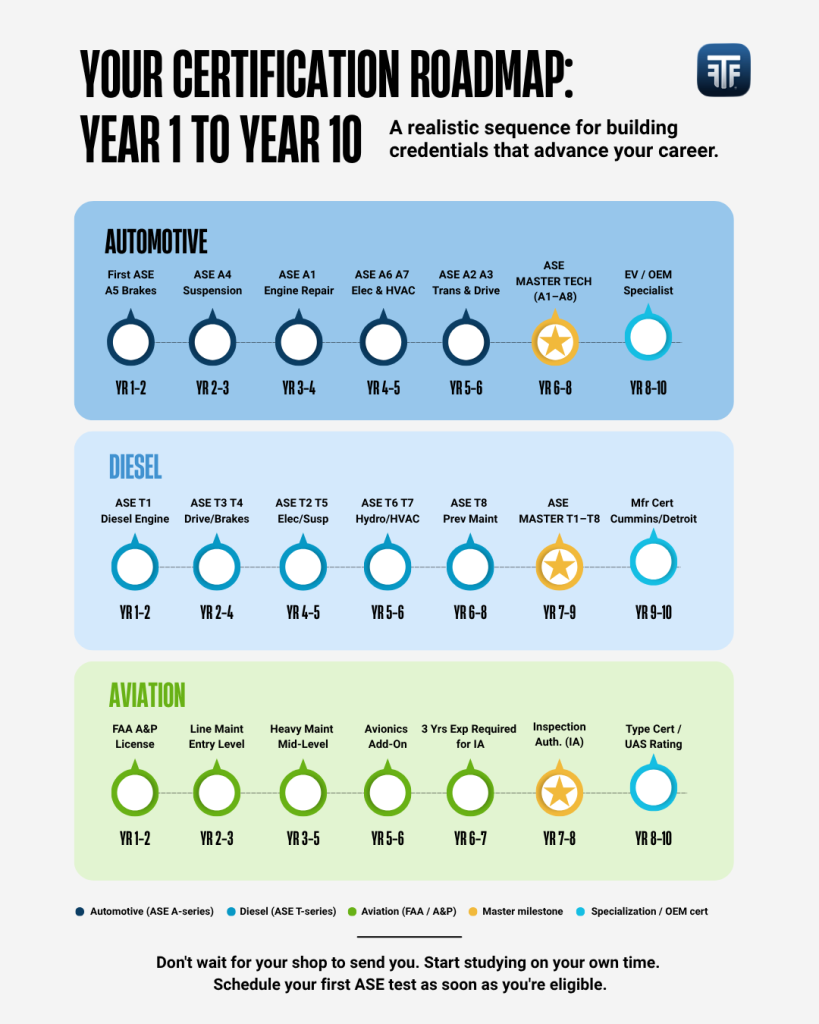
Key certifications: ASE A1-A8 for Master Technician status, OEM-specific certifications (Ford, GM, Toyota, etc.), EV and hybrid specialist credentials as the market shifts.

Diesel Mechanic / Technician Career Path

Diesel technicians work on heavy trucks, commercial vehicles, construction equipment, agricultural machinery, and marine engines. The sector commands strong wages and has some of the most severe technician shortages in the skilled trades.

StageTimelineTypical Pay RangeWhat You’re Doing
Lube / Service Tech0-6 months$15-$18/hrFluid services, filters, basic PM work on diesel equipment.
Entry-Level Diesel Tech6 months – 2 years$18-$24/hrBasic engine repairs, brake systems, electrical fundamentals on heavy equipment.
Mid-Level Diesel Tech2-5 years$24-$36/hrEngine overhauls, advanced electrical, emissions systems, diagnostics.
Senior Diesel Tech5-10 years$34-$50/hrComplex diagnostics, injection systems, turbochargers, fleet management support.
Master Diesel Tech / Specialist10+ years$48-$85/hr+Full system mastery, manufacturer certifications, team lead or shop foreman roles.

Key certifications: ASE T1-T8 for Medium/Heavy Truck, ASE C1 for service consultant track, manufacturer-specific programs (Cummins, Detroit, Caterpillar, Duramax).

Aviation Mechanic / Technician Career Path

Aviation maintenance is one of the most regulated and credential-driven skilled trades. The FAA Airframe and Powerplant (A&P) license is the foundation of the career, and the path from student to senior technician is structured and well-defined.

StageTimelineTypical Pay RangeWhat You’re Doing
AMT Student / Trainee0-2 years (school)$12-$16/hr (training)Technical school focused on FAA-approved curriculum. Airframe and Powerplant coursework.
A&P Mechanic (Entry)0-3 years post-cert$20-$28/hrLine maintenance, routine inspections, basic component repair under supervision.
A&P Mechanic (Mid)3-7 years$28-$42/hrHeavy maintenance, avionics support, complex inspections, independent sign-offs.
Senior A&P / IA7-15 years$40-$60/hrInspection Authorization (IA) certification. Sign-off authority on major repairs and alterations.
Lead Tech / Director of Maintenance15+ years$55-$90/hr+Team leadership, regulatory compliance oversight, MRO management.

Key certifications: FAA A&P License (required to work), Inspection Authorization (IA), avionics add-on ratings, manufacturer type certifications. Aviation is one of the few skilled trades where federal licensing is mandatory at entry.

Collision Repair Technician Career Path

Collision repair technicians restore vehicles after accidents, working with body panels, frames, paint, and increasingly with advanced driver assistance systems (ADAS) that require precise calibration after any structural repair.

StageTimelineTypical Pay RangeWhat You’re Doing
Prep Tech / Detail0-6 months$13-$17/hrSurface prep, masking, basic bodywork assistance. Learning shop flow and paint safety.
Entry Collision Tech6 months – 2 years$16-$22/hrPanel replacement, basic dent repair, unibody inspection fundamentals.
Body Tech / Painter2-6 years$22-$38/hrFrame straightening, welding, full refinishing, color matching. I-CAR training pursuit.
Senior Collision Tech6-12 years$36-$55/hrComplex structural repair, ADAS calibration, estimating, OEM repair procedures.
Master Collision Tech / Estimator12+ years$50-$80/hr+Full shop capability, insurance negotiation, team oversight, damage analysis.

Key certifications: I-CAR Gold Class (industry standard), ASE B2-B6 for collision specialists, OEM certification programs (Tesla, Rivian, and other manufacturers with proprietary repair requirements), ADAS calibration training.

HVAC Technician Career Path

HVAC technicians install, maintain, and repair heating, ventilation, air conditioning, and refrigeration systems in residential, commercial, and industrial settings. The sector has strong year-round demand and a clear apprenticeship-to-journeyman progression.

StageTimelineTypical Pay RangeWhat You’re Doing
HVAC Helper / Apprentice0-1 year$14-$18/hrAssisting experienced techs, learning system components, basic installation tasks.
HVAC Installer / Service Tech I1-3 years$18-$26/hrResidential installation and basic service, EPA 608 certification, ductwork.
HVAC Tech II / Journeyman3-7 years$26-$40/hrCommercial systems, complex diagnostics, refrigerant handling, controls.
Senior HVAC Tech7-12 years$38-$55/hrIndustrial systems, building automation, full diagnostic capability, team lead.
Master HVAC / Project Manager12+ years$52-$85/hr+System design, large commercial and industrial projects, contractor licensing.

Key certifications: EPA 608 (required to handle refrigerants), NATE certification (industry standard), state contractor license (required for independent work in most states), manufacturer-specific training (Carrier, Trane, Lennox).

Welder / Welding Technician Career Path

Welding is one of the most versatile skilled trades, with applications across automotive, construction, manufacturing, pipelines, aerospace, and shipbuilding. The career path varies significantly by industry sector and welding process specialty.

StageTimelineTypical Pay RangeWhat You’re Doing
Welding Student / Helper0-1 year$13-$17/hrLearning core processes (MIG, TIG, Stick), safety fundamentals, basic joint types.
Entry Welder1-3 years$17-$24/hrProduction welding, structural work, reading blueprints and weld symbols.
Certified Welder3-7 years$24-$40/hrAWS or API certifications, specialty processes, quality inspection basics.
Senior Welder / Weld Inspector7-15 years$38-$60/hrCWI certification pursuit, complex structural and pressure vessel work.
Certified Welding Inspector / Engineer15+ years$55-$100/hr+AWS CWI, quality assurance, weld engineering, project management.

Key certifications: AWS D1.1 Structural Welding, API 1104 Pipeline Welding, AWS Certified Welding Inspector (CWI), ASME pressure vessel certifications. Specialty processes like TIG on exotic metals (titanium, Inconel) command significant pay premiums.

The Level Up Mindset: How to Move Through the Stages

Every career path above has one thing in common: progression is earned through time, certifications, and demonstrated competency – not just seniority. The techs who advance fastest are the ones who treat each stage as preparation for the next one, not just a job to get through.

  • Certifications are non-negotiable. In every sector, certifications are the clearest signal to employers that you’ve invested in your own growth. Pursue them systematically, not eventually.
  • Speed comes from repetition. On flat rate or production pay, your income is directly tied to how efficiently you work. The only way to get faster is to do the work – a lot.
  • Specialization creates leverage. Generalists are valuable. Specialists are in demand. Once you have a foundation, identify an area of the trade that interests you and go deep.
  • Ask where the market is going. EV and hybrid in auto, ADAS in collision, automation in welding and HVAC – the techs building skills in emerging technology today are the ones with the most options in 10 years.

How TechForce Supports Your Career Path

TechForce Foundation connects students across all six sectors to the resources they need to move through the career path with less friction. 

For students just starting out, TechForce offers millions of dollars in scholarships every year to reduce the financial barrier to entry. For students further along, apprenticeship connections, job listings, and community networks support the transition from school into a working career.

With 3 to 7 job openings per graduate across multiple sectors, the path forward is clear. The support to get there is at TechForce.org.

The Bottom Line

Every master technician in automotive, diesel, aviation, collision, HVAC, and welding started exactly where you are right now. The path is laid out. The demand is real. The only question is how you want to move through it.

Start at the entry point for your sector. Build the certifications. Put in the repetitions. Find your specialization. The level up is waiting – and TechForce is here to help you get there.

Sources & Further Reading

For more information on the topics covered in this article, we recommend the following resources:

  • U.S. Bureau of Labor Statistics (BLS) Occupational Outlook Handbook: bls.gov – median pay, job outlook, and entry requirements for automotive technicians, diesel mechanics, HVAC technicians, welders, and aircraft mechanics
  • National Institute for Automotive Service Excellence (ASE): ase.com – certification pathways, testing requirements, and industry standards for automotive and diesel technicians
  • Federal Aviation Administration (FAA): faa.gov – Airframe and Powerplant (A&P) licensing requirements, regulations, and career guidance for aviation mechanics
  • American Welding Society (AWS): aws.org – welding certification pathways, wage data, and industry standards
  • Air Conditioning Contractors of America (ACCA): acca.org – HVAC industry career information, standards, and technician resources
  • I-CAR (Inter-Industry Conference on Auto Collision Repair):i-car.com – collision repair training, certification programs, and career development resources

Land the Job, Choose the Right Shop: Interview and Job Search Skills for Techs

The technician shortage means jobs are available. The skill is finding the right one and making a strong first impression. Here’s how to do both.

How to Find Skilled Trade Jobs

There are currently tens of thousands of job locations loading through TechForce alone – and the broader market has 3 to 7 open positions for every technical school graduate across automotive, diesel, aviation, and collision sectors. Finding a job in the skilled trades is not the hard part right now. Finding the right job, and presenting yourself well, is where the real work is.

For students coming out of technical education, job search resources include:

  • TechForce job board: Tens of thousands of positions available at TechForce.org, directly connected to employers actively seeking graduates
  • School placement offices: Many technical schools have employer relationships and can connect students directly with hiring shops
  • Dealer group career pages: Large dealer groups post frequently and often have structured apprenticeship programs for new techs
  • Industry job boards: iATN, Indeed, and sector-specific boards post automotive technician, diesel mechanic, and aviation tech openings regularly

Writing a Resume as a New Tech

Most hiring managers in the skilled trades spend about 30 seconds on a resume before deciding whether to call someone in. Here’s what they’re looking for from a new tech or recent graduate:

Keep It to One Page

You’re early in your career. One clean, scannable page beats two pages of padding. Use clear headings, consistent formatting, and plenty of white space.

Lead with Your Training and Certifications

Your technical education and any certifications (ASE, OEM, manufacturer-specific) go near the top. Include the program name, school, and graduation date or expected completion. If you have any certifications in progress, list them with an expected date.

Include Relevant Experience – Even If It’s Informal

Worked on your own vehicles? Helped a family member with repairs? Completed school projects that involved real diagnostics or repair work? Include it. Frame it specifically: what you did, what tools you used, what result you achieved.

List Your Tools

Many automotive and diesel shops want to know what you’re coming in with. A brief line noting your current toolset shows you’re serious about the trade and have made an investment.

How to Prepare for a Shop Interview

A shop interview is different from a corporate job interview. It’s often informal, sometimes happening right in the bay, and heavily focused on what you actually know and how you carry yourself.

Research the Shop Before You Go

Know whether it’s a dealership, independent, fleet, or specialty shop. Know what brands or sectors they focus on. Look at their reviews – both customer reviews and any employee reviews you can find. Showing up informed tells the interviewer you’re serious.

Be Ready to Talk Through a Repair

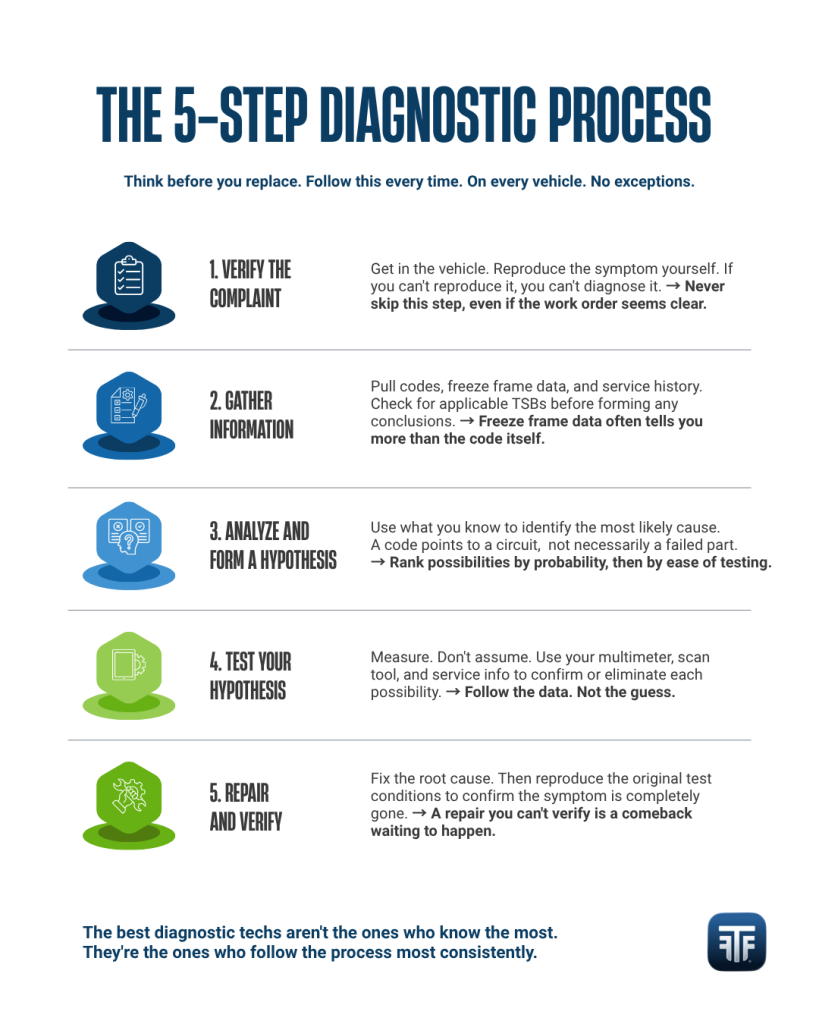
Many shop interviews include a technical question or a walk-through scenario. You don’t need to know everything – but be prepared to think out loud. Walk through your diagnostic process clearly: gather information, identify possibilities, test systematically, confirm the fix. The 3 C’s (Concern, Cause, Correction) are a clean framework to fall back on.

Show Up on Time and Dressed Right

Dress for the position you are applying for. Clean clothes, punctuality, and a firm handshake still matter in a shop interview. You don’t need a suit – but you do need to look like someone who takes the opportunity seriously. Shop-appropriate means clean and professional, not formal.

Questions to Ask the Employer

An interview is not one-sided. The questions you ask an employer reveal as much about you as your answers do – and they help you avoid landing in a shop that’s wrong for your career. Here are seven questions worth asking, and why each one matters:

Question to AskWhy It Matters
What does a typical first-year tech’s schedule look like here?Shows you’re realistic about starting at the bottom and planning ahead.
How are technicians evaluated and how often?Tells you how feedback and advancement actually work in this shop.
What does the tool situation look like for new techs – is there any support?Practical and shows awareness of what the job actually requires.
How would you describe the culture in the shop?Opens the door for them to reveal red flags voluntarily.
What does the path to flat rate or to a lead tech role look like here?Shows ambition and long-term thinking without being pushy.
Why do technicians typically leave this shop?A direct question that good employers answer confidently and bad ones dodge.
Is there support for continuing education or ASE certifications?Shows you’re invested in growing your skills – which good shops want.

Pay attention to how these questions are answered, not just what is said. Hesitation, vague answers, or dismissiveness on questions about culture and retention are worth noting.

Red Flags to Watch for in a Shop

Not every employer in the skilled trades is worth working for. The technician shortage means you have more leverage than you might think – use it. Here are warning signs worth taking seriously:

  • High turnover with no clear explanation. If a shop has had 6 techs in 3 years, find out why before accepting an offer.
  • Vague or evasive answers about pay structure. A legitimate shop can tell you clearly how you’ll be paid and what the path to higher earnings looks like.
  • No answer on training or advancement. Shops that don’t invest in their techs’ growth tend to use them up and move on.
  • Pressure to start immediately without a clear offer. Urgency that skips proper onboarding is a sign of disorganization at best.
  • A shop culture that feels dismissive or hostile in the interview. If they treat you poorly when they’re trying to hire you, it doesn’t improve after you start.

Negotiating Pay and Benefits

Many new techs accept the first number they’re offered because they don’t know it can be negotiable. In most cases, it is – especially when the market has 3 to 7 openings for every graduate.

  • Know the market rate. Research what entry-level techs earn in your sector and region before negotiating. TechForce career path maps include pay progression data by sector.
  • Consider the total package. Base pay, flat rate potential, tool allowances, training reimbursement, health benefits, and paid time off all have real dollar value. A lower base with strong benefits may outperform a higher base without them.
  • Ask about the path, not just the starting point. “What does pay typically look like at 1 year and 3 years for a tech who performs well?” gives you more useful information than haggling over your starting hourly rate.

How TechForce Connects Students to Jobs

TechForce Foundation connects students in technical education directly to employers through the platform’s job board, apprenticeship listings, and employer partner network. With tens of thousands of job locations available and direct relationships with employers who are actively hiring, TechForce is one of the most direct paths from technical school to a skilled career.

Students can also access career readiness tools, resume guidance, and job search support through the platform. Log in to TechForce.org to access the job board and connect with employers in your sector.

The Bottom Line

The technician shortage is real and the demand for skilled techs is at an all-time high. You have more options than you might think coming out of technical school. The goal isn’t to take any job – it’s to find the right shop, negotiate fairly, and start building a career that has real runway.

Prepare for the interview like you’d prepare for a difficult diagnostic. Do your research, know your process, ask the right questions, and trust what you find.

Sources & Further Reading

For more information on the topics covered in this article, we recommend the following resources:

  • U.S. Bureau of Labor Statistics (BLS) Occupational Outlook Handbook: bls.gov – job outlook, median wages, and hiring data for automotive technicians, diesel mechanics, and other skilled trade occupations
  • National Institute for Automotive Service Excellence (ASE): ase.com – certification information and professional standards used by employers when evaluating technician candidates
  • Good Jobs Institute: goodjobsinstitute.org – research and criteria for evaluating employer quality, job stability, and workplace culture

More Than Wrenches: Communication Skills Every Tech Needs

Technical skill gets you in the door. Communication skill keeps you there and moves you up. Here’s how to develop both.

Why Communication Skills Matter in a Technical Career

Ask any shop foreman or service manager what separates a good tech from a great one, and communication comes up almost every time. The ability to explain a complex repair in plain language, write a clear work order, ask the right question without seeming clueless, and handle a frustrated customer professionally – these are skills that directly affect your career trajectory.

Technical competency gets you hired. Communication skills determine how fast you advance, how much trust you earn, and how long customers keep coming back to your bay.

Talking to Customers: The Basics

Most new techs dread customer interactions, especially early in their career when they’re still building confidence in their technical knowledge. But effective customer communication isn’t about knowing everything – it’s about being clear, honest, and respectful.

Lead with What You Know, Not What You Don’t

Instead of starting with uncertainty, lead with what you’ve confirmed. “I’ve checked the brakes and found the front pads are at 2mm – they need to be replaced” is more reassuring than “I’m not sure, but I think the brakes might be a problem.”

Translate Tech Talk into Plain Language

Customers don’t know what a camshaft position sensor is – and they don’t need to. What they need to know is what it affects, what happens if it’s not fixed, and what it costs. Practice giving 30-second plain-language explanations of common repairs. It’s a skill that builds fast with repetition.

Handle Difficult Customers with a Simple Formula

When a customer is upset, use this three-step approach: acknowledge their frustration without arguing, explain what you know factually, and offer a clear next step. You don’t have to accept abuse, but staying calm and factual almost always de-escalates the situation faster than matching their energy.

Communicating with Service Advisors

Your relationship with the service advisor is one of the most important in the shop. They’re the link between you and the customer – and if that communication breaks down, everyone loses.

  • Be specific, not vague. “The noise is a metallic grinding from the front left wheel while braking above 30 mph” is useful. “It makes a noise sometimes” is not.
  • Flag problems early. If a job is going to take longer than estimated or you’ve found an additional concern, tell the advisor before the customer calls asking about their car.
  • Document everything. If you told the advisor something verbally, note it in the system too. Paper trails protect you and the shop.
  • Ask about customer preferences. Some customers want every detail. Others just want it fixed and a total. Advisors usually know which is which – use that information.

How to Ask Questions Without Seeming Inexperienced

This is one of the most common concerns for new techs and trade students – and it’s worth addressing directly. Asking questions is not a sign of weakness. Not asking questions is how expensive mistakes happen.

The key is how you ask, not whether you ask. There’s a big difference between “I have no idea what I’m doing” and a well-framed question that shows you’ve already done some thinking.

Instead of…Try saying…
“I don’t know how to do this.”“I haven’t run into this exact issue before – can you point me toward where I should start?”
“What does this mean?”“I’m seeing this code and I’ve checked X and Y. Does that match what you’d expect?”
“Is this right?”“I completed the repair and torqued to spec. Would you mind doing a quick check before I button it up?”
“I messed this up.”“I ran into a problem on this job and want to flag it before going further. Here’s what happened.”

Notice the pattern: each “try saying” version shows that you’ve already thought about the problem, taken some action, or are being proactive. That framing changes how the question lands completely.

Written Communication: Work Orders and Documentation

In a professional shop, if it isn’t written down, it didn’t happen. Work orders, inspection sheets, and digital documentation are legal and financial records – and they reflect directly on your professionalism.

What Makes a Good Work Order Entry

A clear work order entry answers four questions: What was the complaint? What did you find? What did you do? What should the customer know? It doesn’t need to be long – it needs to be accurate, specific, and legible.

Handwriting Still Matters in the Trades

Many shops still use paper inspection forms, service tickets, and parts requests – especially smaller independents and fleet operations. Illegible handwriting creates real problems: wrong parts ordered, missed services, miscommunication with advisors and customers.

If your handwriting is hard to read, it’s worth practicing. Write clearly, print if cursive is messy, and slow down on key numbers like part numbers, VINs, and labor times. One misread digit on a parts order costs everyone time and money.

Written Communication Beyond the Bay

As you advance in your career, written communication expands: emails to customers, digital inspection reports with photos, text updates on vehicle status, and eventually team communication if you move into a lead or management role. Building clean, professional writing habits early pays off for years.

Reading Service Requests and Technical Documentation

A significant part of shop communication runs in the other direction – from the written page to you. Technical service bulletins, factory repair procedures, work orders from advisors, and inspection checklists all require careful reading.

Skimming is a habit that causes errors in technical work. Develop the discipline to read work orders completely before starting a job. Verify the complaint, confirm the vehicle, check for any flags or customer notes. Two minutes of careful reading at the start of a job prevents hours of rework.

TechForce Communication Resources

TechForce Foundation’s platform includes life skills trainings covering professional communication, customer service fundamentals, and workplace communication – all student-ranked and available to students in technical education at no cost.

Developing good communications skills early is one of the best investments you can make in your professional future. Visit TechForce.org to access training resources.

The Bottom Line

Every skill in this article can be learned. None of it requires a specific personality type or natural talent for talking to people. It requires practice, awareness, and the willingness to get a little uncomfortable in order to get better.

The techs who advance fastest in the skilled trades are not always the most technically gifted. They’re the ones who can fix the car and explain it clearly, document it accurately, and make the customer feel heard. That combination is hard to beat.

Sources & Further Reading

For more information on the topics covered in this article, we recommend the following resources:

  • National Institute for Automotive Service Excellence (ASE): ase.com – professional standards and certification pathways for automotive and diesel technicians
  • I-CAR (Inter-Industry Conference on Auto Collision Repair): i-car.com – technical training and communication standards for collision repair professionals

Toastmasters International: toastmasters.org – free and low-cost resources for building professional communication and public speaking skills

Making Time Work for You: Time Management for Trade Students

Balancing school, work, and life in a technical program isn’t easy. These strategies are built for the reality of a student in the skilled trades.

Why Is Time Management So Hard for Trade Students?

Most time management advice is written for people with a fairly predictable schedule. Trade students rarely have that luxury. A typical week might look like: class in the morning, a part-time job in the afternoon, a long commute in between, family obligations in the evening, and studying squeezed in wherever it fits.

Nearly every TechForce student entry about daily life mentions some version of this. Waking up at 5 a.m. Going to school at 6. Starting work at 9. Not getting home until 7 p.m. It’s a real load – and it requires real strategy, not generic productivity tips.

The good news is that time management is a skill, just like technical diagnostics. It can be learned, practiced, and improved. Here’s how to build it.

“I wake up at 5 a.m., go to school at 6, start work at 9, and don’t get home until around 7 p.m.” – TechForce student, describing a schedule that is far more common than most people realize.

The Foundation: Know Where Your Time Actually Goes

Before you can manage your time better, you need an honest picture of where it’s going now. For one week, track how you spend each hour. Not how you think you spend it – how you actually spend it.

Most people are surprised by two things: how much time disappears into their phone without producing anything, and how much time is lost to transitions – commuting, waiting, getting started on things. Both of those are recoverable time once you see them.

Prioritization: The Most Important Skill You’re Not Teaching Yourself

Not all tasks are equal, and treating them as if they are is one of the fastest ways to feel constantly busy while falling behind on the things that matter. The Eisenhower Matrix is a simple framework that trade students and working techs can use to sort what actually deserves your time:

URGENT + IMPORTANTDo it now.Failing a class, a car needed for work breaking down, a missed shiftNOT URGENT + IMPORTANTSchedule it.Studying for an upcoming test, saving for tools, health appointmentsURGENT + NOT IMPORTANTDelegate or limit it.Most texts and social notifications, minor favors others ask of youNOT URGENT + NOT IMPORTANTCut it or do it last.Endless scrolling, TV reruns, low-value time fillers

Most stress comes from spending too much time in the bottom two quadrants – urgent but unimportant tasks, or neither urgent nor important – while the important-but-not-yet-urgent things (studying, savings, health) quietly become crises.

Each week, look at your task list and ask: which of these is genuinely urgent AND important? Start there. Everything else gets scheduled, delegated, or cut.

Study Strategies That Actually Work for Technical Students

Studying for a technical program is different from studying for a traditional academic course. You’re learning hands-on skills alongside technical theory, and cramming doesn’t work well for either.

Study in Short Blocks, Not Long Sessions

45 to 60 minute focused sessions with a short break outperform 3-hour marathon study blocks almost every time. Your brain consolidates information during rest. Use the commute or lunch break for quick review rather than saving everything for one long night.

Connect Theory to What You Did That Day

After every shop session, spend 10 minutes writing down what you worked on and what the theory behind it was. This active recall locks in the learning far more effectively than re-reading your notes.

Use Your Commute

Long commutes are a significant time drain for many trade students – but they’re also recoverable time. Audio content (podcasts about the trade, recorded notes, technical explanations) can turn a 45-minute drive into productive review. Some students even record their own notes and listen back.

Balancing Work, School, and Life

The honest truth is that something usually has to give when you’re working and going to school at the same time. The goal isn’t perfect balance – it’s intentional trade-offs that protect your highest priorities.

  • Define your non-negotiables. What absolutely cannot slip? For most trade students it’s: showing up to school, showing up to work, and keeping commitments to family. Everything else is negotiable.
  • Communicate with your employer. If your school schedule changes or a major assessment is coming up, most employers in the skilled trades will work with students who communicate proactively rather than just calling out.
  • Protect at least one full rest day per week. Running at 100% capacity 7 days a week isn’t sustainable. One genuine recovery day per week extends how long you can keep going at high intensity.
  • Batch similar tasks together. Errands, emails, and admin tasks take less mental energy when grouped. Switching between a technical task and an administrative one costs more time than people realize.

Managing Long Commutes

Long commutes are one of the most common time challenges TechForce students mention. If your commute is more than 30 minutes each way, here are ways to make it work for you rather than against you:

  • Use audio content for passive review of technical material
  • Make phone calls for personal or family communication during drive time to protect evenings
  • If you take public transit, use it for active study or planning your next day
  • If commute time is genuinely unsustainable, explore whether your school or employer offers any flexibility in schedule or location
  • TechForce’s Wraparound Services include transportation support resources for students facing significant commute barriers

A Simple Weekly Planning System

You don’t need an elaborate system. You need a consistent one. Here’s a bare-minimum approach that works for busy trade students:

  • Sunday evening (15 minutes): Look at the week ahead. Identify the 3 most important things that must happen. Block time for them first.
  • Each morning (5 minutes): Confirm your top 3 for the day. Know your schedule before the day starts.
  • Each evening (5 minutes): Note what got done, what got moved, and what tomorrow looks like. This 5-minute debrief prevents things from falling through the cracks.

That’s 25 minutes a week of planning that replaces hours of reactive scrambling. It’s one of the highest-return habits a trade student can build.

TechForce Resources to Help You Manage the Load

TechForce Foundation’s platform includes more than 350 life skills trainings available to students in technical education – many of them focused on exactly the challenges covered in this article. Time management, financial literacy, communication skills, and career readiness are all available and student-ranked.

If the load feels unmanageable because of financial pressure, transportation barriers, or family obligations, TechForce’s Wraparound Services can connect you to resources that address the root causes – not just the symptoms. Visit TechForce.org to access your support network.

The Bottom Line

Time is the one resource you can’t get more of. The trade students who make it through technical school while working and managing real life aren’t superhuman – they’re strategic. They know their priorities, protect their time deliberately, and build systems that work with their actual schedule, not an ideal one.

Start small. Pick one strategy from this article and use it this week. That’s how the habit gets built.

Sources & Further Reading

For more information on the topics covered in this article, we recommend the following resources:

  • American Psychological Association (APA): apa.org – research on cognitive load, study strategies, and effective learning for skill-based training
  • National Career Development Association (NCDA):ncda.org – career readiness, work-life balance resources, and professional development guidance

Money in the Shop: Financial Literacy for Automotive and Trade Students

Learning to manage money on an apprentice wage is one of the most important skills you’ll develop in a technical career. Here’s where to start.

Focused young African American woman in eyeglasses looking through paper documents, managing business affairs, summarizing taxes, planning future investments, accounting alone at home office.

Why Financial Literacy Matters in a Skilled Career

One of the most common challenges students in technical education face has nothing to do with diagnostics or shop skills. It’s money. Covering rent, tuition, food, and tools on an apprentice or entry-level wage while going to school is genuinely hard – and most trade programs don’t teach you how to manage it.

Financial stress is one of the leading reasons students leave technical school before finishing. Getting your finances under control isn’t just a life skill. It’s a career survival skill.

This article covers the basics: how to budget on a tight income, how to understand your pay structure, how to build credit, how to manage debt, and how to save for tools without falling behind on bills.

“I have to work to cover rent, tuition, food for myself, my girlfriend, and our 1-year-old son.” – TechForce student, describing the financial reality many trade students navigate daily.

Understanding Your Pay: Flat Rate vs. Hourly

Before you can budget, you need to understand how you get paid. In the automotive and diesel industries, there are two main pay structures – and knowing the difference matters a lot for your financial planning.

Hourly Pay

You get paid for every hour you’re at work, regardless of how many jobs you complete. This is more common for apprentices and entry-level techs. It’s predictable, which makes budgeting easier – but the ceiling is lower.

Flat Rate Pay

You get paid per job based on a standard time estimate, not the actual time it takes. If a job is flagged at 2 hours and you finish it in 1.5, you still get paid for 2. If it takes you 3 hours, you still only get 2. Experienced techs can earn significantly more on flat rate. Newer techs often earn less until their speed improves.

When you’re starting out, flat rate can feel like a penalty for being new. It’s not – it’s an incentive system. The faster and more accurate you get, the more you earn. Budget conservatively when you’re new to flat rate and adjust as your efficiency improves.

How to Budget on an Apprentice Salary

Budgeting on a tight income isn’t about cutting everything fun. It’s about making intentional choices so the important things are covered. Entry-level and apprentice tech pay typically ranges from $14 to $22 per hour depending on your sector, region, and shop type – that works out to roughly $2,200 to $3,400 per month take-home for a full-time schedule. Here’s a starting framework based on $2,500 per month take-home, which is a reasonable mid-range estimate for an apprentice or first-year tech:

Category% of Take-HomeEst. on $2,500/mo
Housing (rent/utilities)30-35%$750-$875
Food & groceries10-15%$250-$375
Transportation10-15%$250-$375
Tuition/school costs10-15%$250-$375
Tools (savings fund)5-10%$125-$250
Personal/miscellaneous5-10%$125-$250
Emergency savings5%$125

These are starting points, not rules. Your actual take-home will vary based on your hourly rate, whether you’re on flat rate, the hours available at your shop, and whether you’re also working part-time while in school. The goal is to know where every dollar is going before it leaves your account – regardless of the exact number.

Saving for Tools While Paying Bills

Tools are one of the biggest financial challenges for new techs. A basic starter set can run anywhere from a few hundred to several thousand dollars, and shops often expect you to show up with your own. Here’s how to build your toolbox without wrecking your budget:

  • Start with the essentials only. You don’t need a full rollaway on day one. Research the top tools your specific sector requires and build from there. 
  • Use a dedicated tools fund. Even $50 a month set aside adds up to $600 in a year. Treat it like a bill you pay yourself first.
  • Buy used strategically. Used hand tools from reputable brands often outlast cheap new ones. Avoid used diagnostic equipment unless you can verify it works.
  • Look into tool financing carefully. Snap-on and Matco offer payment plans, but interest adds up fast on small paychecks. Know the total cost before you sign.
  • Ask about tool scholarships. TechForce partners with tool companies to provide tool vouchers and giveaways for students and working techs who qualify. Check TechForce.org for current opportunities.

Managing Student Loans and Tuition Debt

If you took out loans for technical school, understanding your repayment options before you graduate saves you money and stress. A few key things to know:

  • Federal student loans have income-driven repayment options that cap your monthly payment based on what you earn
  • Grace periods (usually 6 months after graduation) give you time to get employed before payments start
  • Defaulting on student loans damages your credit and can affect your ability to get financing for tools, vehicles, or housing
  • Some employers in the skilled trades offer tuition reimbursement or loan assistance as a benefit – ask about this during job interviews

If your debt feels unmanageable, contact your loan servicer before you miss a payment. There are deferment and forbearance options available, but you have to ask for them.

Building Credit and Financial Foundations

A strong credit score opens doors: better rates on vehicle loans, easier approval for housing, access to financing when you need it. Here’s how to build credit from scratch or rebuild it after a rough patch:

  • Get a secured credit card. Put a small recurring charge on it (like a streaming service) and pay it off in full every month. This builds a positive payment history with no risk of overspending.
  • Never miss a payment. Payment history is the single biggest factor in your credit score. Set up autopay for at least the minimum on every account.
  • Keep utilization low. Try to use less than 30% of your available credit limit at any time. High utilization tanks your score even if you pay on time.
  • Check your credit report annually. You’re entitled to a free report at annualcreditreport.com. Errors are common and can drag your score down without you knowing.

Financial Support Available Through TechForce

You don’t have to figure all of this out alone. TechForce Foundation offers financial support specifically for students in automotive, diesel, aviation, and other technical careers:

  • Scholarships for automotive students and technical school scholarships to reduce tuition debt
  • Emergency grants for unexpected financial hardship that threatens your ability to stay in school
  • Tool vouchers and tool grants through partnerships with leading tool brands
  • Housing and transportation resources for students facing housing instability or transportation barriers
  • Financial literacy trainings available through the TechForce platform, student-ranked and free to access

Visit TechForce.org to see what support is currently available to you.

The Bottom Line

Financial literacy is a technical skill, same as reading a wiring diagram or running a diagnostic. You can learn it, you can get better at it, and the earlier you start, the bigger the payoff. Managing your money well on a tight income now builds the habits that create real financial stability over a long career in the skilled trades.

The automotive technician shortage means the demand for what you’re training to do is at an all-time high. Three to seven job openings exist for every graduate in multiple sectors. The earning potential is real. Build the financial foundation to take full advantage of it.

Sources & Further Reading

For more information on the topics covered in this article, we recommend the following resources:

  • U.S. Bureau of Labor Statistics (BLS): bls.gov – wage data for automotive technicians, diesel mechanics, and other skilled trade occupations
  • Consumer Financial Protection Bureau (CFPB): consumerfinance.gov – free tools and guides for budgeting, building credit, and managing debt
  • AnnualCreditReport.com: annualcreditreport.com – free annual credit reports from all three major bureaus
  • Federal Student Aid (FAFSA): studentaid.gov – federal student loan information, repayment options, and income-driven repayment plans

Pressure Makes Diamonds: Building Determination in a Skilled Career

The techs who make it aren’t the ones who had it easy. They’re the ones who figured out how to keep going. Here’s how to build that kind of resilience.

What Does Resilience Mean in a Technical Career?

Resilience in a skilled trade isn’t about being tough or never breaking down. It’s the ability to take a hit – a failed test, a rough shift, a setback you didn’t see coming – and keep moving forward anyway. It’s a skill, not a personality trait. And like every skill in a technical career, it can be learned and built over time.

The students who finish technical school and go on to build strong careers in automotive, diesel, collision repair, and HVAC are not the ones who had it easy. They’re the ones who developed the ability to get back up. Every single time.

“Pressure makes diamonds.” – A phrase that shows up again and again when TechForce students and working techs talk about what got them through the hardest parts of their training.

Why the Skilled Trades Test Your Resilience

A career in the skilled trades puts you in situations designed to push your limits. That’s not an accident – it’s how technical competency gets built. But it also means the road has real obstacles:

  • The learning curve is steep, especially in the first year of technical education
  • Mistakes have consequences – a wrong diagnosis, a missed step, a failed inspection
  • Physical fatigue compounds mental fatigue over long shifts and semesters
  • Financial pressure from tuition, tools, and living on an apprentice wage
  • Shop culture that doesn’t always reward vulnerability or asking for help
  • The gap between textbook learning and the real-world chaos of a busy bay

None of this means you’re in the wrong place. It means you’re in the right place, doing something hard. And hard is where growth lives.

How to Respond to Common Setbacks

Resilience isn’t just a buzzword. It’s a series of choices made in specific moments. Here’s how to respond to the setbacks most techs and trade students face:

The SetbackThe Resilient Response
Failed a test or courseThis is data, not destiny. Find out what went wrong and address that specific thing. Every master tech has a failure story.
Got passed over for a raise or promotionAsk directly what it would take to get there. Turn the disappointment into a roadmap.
Made a costly mistake on the jobOwn it, learn from it, move forward. The techs who grow fastest are the ones who can face their mistakes honestly.
Got negative feedback from an instructor or shop leadFeedback is free coaching. It stings. Use it anyway.
Thought about quittingAlmost every tech has been there. The ones who stayed usually say the hardest stretch was right before it started clicking.

How to Build Perseverance for the Long Game

Technical careers are not sprints. Becoming a master technician in automotive, aviation, motorsports, or any skilled trade takes years. The students who get there are the ones who figured out how to play the long game. Here’s how:

Know Your Why

When things get hard – and they will – the clearest path through is knowing exactly why you started. Write it down. A specific reason (“I want to provide for my family,” “I want to be the best diesel tech in my state,” “I want to prove it’s possible”) is more powerful than a vague one. Come back to it on the hard days.

Reframe Failure as Data

In technical diagnostics, a wrong first guess isn’t failure – it’s information. You eliminated one possibility and moved closer to the answer. Approach setbacks in your career the same way. What did you learn? What do you eliminate next time? What gets you closer to the diagnosis?

Build a Short Memory for Setbacks

Resilient techs don’t dwell. They debrief – understand what happened and why – and then they move on. Carrying the weight of every mistake slows you down. Process it, extract the lesson, and put it down.

Set Small Targets Inside the Big Goal

A 2-year technical program is hard to see to the end when you’re in month three. Break it into quarters, months, weeks. Celebrate passing a certification. Celebrate completing a repair you’ve never done before. Small wins compound into big careers.

Surround Yourself with People Who Are Still Going

Your environment shapes your persistence. Find the students who are still showing up, the techs who are still growing, the mentors who still love the trade after 20 years. Their energy is contagious in the best way.

Overcoming Adversity: Stories from Real Techs

The most powerful evidence that resilience is learnable comes from the people who’ve done it. TechForce connects students to working techs through AMA sessions and mentorship programs – and the stories of struggle and recovery are consistent across every sector.

The pattern is almost always the same: a point where quitting felt like the only reasonable option, a decision to stay anyway, and a turning point that came shortly after. Not always because things got easier – but because the tech got better at handling hard things.

“The hardest stretch was right before it started clicking. I almost left two weeks before everything changed.” – A sentiment shared by multiple TechForce-connected technicians when talking to students about perseverance.

You don’t know where your turning point is. The only way to find it is to stay in the game.

How to Deal with Failure and Setbacks Without Losing Momentum

Failure is part of every skilled career. The goal isn’t to avoid it – it’s to process it faster and use it better. Here’s a simple framework:

  • Step back. Give yourself a moment before reacting. Knee-jerk responses to failure are rarely useful.
  • Get honest. What actually happened? Not the story you’re telling yourself – the facts. What went wrong and why?
  • Separate the mistake from your identity. You made an error. YOU are NOT an error. These are different things.
  • Ask one person you trust. Getting an outside perspective cuts through the distorted thinking that follows a setback.
  • Make one concrete change. Take one specific action based on what you learned. That action transforms failure into progress.

TechForce Helps You Stay in the Game

TechForce Foundation’s Wraparound Services exist because the data is clear: the students who leave technical education often don’t leave because they lack talent. They leave because of compounding pressure with no support system in place. Here’s how TechForce helps you build resilience:

  • Mentorship: Direct connections to techs who stayed in the game and built careers worth having
  • Financial support: Scholarships, emergency grants, and other financial resources that reduce the financial pressure driving dropout
  • AMA sessions: Open, honest conversations with industry professionals about the real challenges of a technical career
  • Career readiness tools: Job connections, career path maps, and life skills trainings that keep the finish line visible

Thousands of students are on the TechForce platform. You are not doing this alone. Visit TechForce.org to connect.

The Bottom Line

Resilience is not a personality type. It is a practice. Every challenge you work through in technical school is building the muscle you’ll use for the rest of your career – the ability to face a problem, stay in it, and find the answer.Pressure makes diamonds. You are in the pressure. Keep going.


Sources & Further Reading

For more information on the topics covered in this article, we recommend the following resources:

  • American Psychological Association (APA): apa.org – research on resilience, perseverance, and psychological hardiness in high-demand careers
  • National Institute for Occupational Safety and Health (NIOSH): cdc.gov/niosh – workplace stress and resilience resources for skilled trade workers

It’s Okay to Not Be Okay: Mental Health Support for Skilled Trade Students

Anxiety, depression, and stress are more common in technical careers than most people admit. Here’s how to recognize what you’re dealing with and where to get real help.

A worried woman entrepreneur in a car service shop, facing business difficulties. Bankruptcy of a small business.

Do Skilled Trade Students Struggle with Mental Health?

Yes – and more than most industries acknowledge. Students pursuing automotive, diesel, aviation, and other technical careers often carry a heavy load: tuition debt, long hours, physically demanding work, financial pressure, and the challenge of performing in a high-stakes learning environment. Mental health struggles are common, real, and nothing to be ashamed of.

The stigma around mental health in skilled trades runs deep. Shops and schools don’t always make it easy to say “I’m struggling.” But staying silent doesn’t make it better. It makes it harder to finish school, stay in the trade, and build the career you came here for.

This article is a no-judgment starting point. Whether you’re dealing with everyday stress, persistent anxiety, or something that feels much heavier, there’s support available – and you deserve to use it.

“What is the hardest part of your job, physically or mentally?” – One of the top questions TechForce students have submitted to working techs during live AMA sessions. The answer is almost never about the wrenches.

What Does Anxiety Look Like in a Technical Career?

Anxiety isn’t always dramatic. In skilled trades and technical education, it often shows up quietly:

  • Constant worry about making a mistake on the job or failing a course
  • Dreading going to school or work even when things are going reasonably well
  • Difficulty concentrating on diagnostics or technical procedures you normally know
  • Physical symptoms like tension headaches, tight chest, upset stomach, or trouble sleeping
  • Avoiding asking questions or speaking up because of fear of judgment
  • Replaying interactions with instructors, coworkers, or customers over and over

High-pressure situations are built into a skilled career. Tight deadlines, complex repairs, demanding customers, and the constant expectation to perform can keep your nervous system in overdrive. For some students, that pressure becomes chronic anxiety that affects everything.

What About Depression?

Depression in students pursuing technical education often looks different from what people expect. It’s not always sadness. It can look like:

  • Losing interest in the trade you used to be excited about
  • Feeling flat or numb rather than visibly sad
  • Low energy that sleep doesn’t fix
  • Struggling to complete assignments or show up consistently
  • Withdrawing from classmates, friends, or family
  • Feeling like finishing school or building a career doesn’t matter anymore

These symptoms are not laziness, lack of motivation, or a sign that you chose the wrong career. They are signs that your brain needs support – the same way a misfiring engine needs a diagnostic, not a lecture.

Financial Stress Is a Mental Health Issue

Nearly every TechForce student entry mentions financial pressure. Paying tuition out of pocket, covering living expenses on an apprentice wage, supporting a family while going to school – this kind of sustained financial stress has real mental health consequences.

Chronic financial stress elevates cortisol, disrupts sleep, impairs focus, and increases the risk of anxiety and depression. It’s not weakness to struggle under that kind of pressure. It’s biology.

If financial stress is a major driver of what you’re feeling, there are direct resources available. TechForce offers scholarships, emergency grants, and other financial support specifically for students in technical education. Reducing the financial pressure is one of the most impactful things you can do for your mental health right now.

When Should You Seek Professional Help?

A good rule of thumb: if what you’re experiencing is interfering with your ability to function – at school, at work, or in your relationships – it’s time to talk to someone. You don’t have to be in crisis to deserve support.

Reach out to a professional if you are experiencing:

  • Anxiety or depression that has lasted more than two weeks
  • Thoughts of harming yourself or others
  • Substance use that is increasing or feels out of control
  • Panic attacks or physical symptoms with no clear medical cause
  • An inability to get through your day without significant struggle

Reaching out is not giving up. It is the smartest diagnostic move you can make.

Mental Health Resources for Trade Students

These resources are free, confidential, and available to you right now. You do not need to be in immediate crisis to use them.

ResourceHow to ReachWhat It Offers
988 Suicide and Crisis LifelineCall or text 988Free, confidential, 24/7 support for anyone in crisis or emotional distress
Crisis Text LineText HOME to 741741Text-based crisis support, available 24/7
SAMHSA Helpline1-800-662-4357Free mental health and substance use referrals and information
School CounselingVisit your school’s student services officeMost technical schools have counselors available at no cost to enrolled students
TechForce Wraparound ServicesTechForce.orgCommunity, mentorship, financial support, and connections to resources for students in technical careers

Practical Ways to Manage Anxiety Day to Day

Professional support is the most important step for serious mental health concerns. For everyday anxiety and stress, these strategies help many techs stay grounded:

Name It

Identifying what you’re feeling – “I’m anxious about this diagnostic” or “I’m overwhelmed by my schedule” – takes power away from the feeling. Naming it is the first step to managing it.

Control What You Can

Anxiety feeds on uncertainty. Focus your energy on the things within your control: your preparation, your attitude, your effort. Let go, as much as possible, of what you can’t control.

Build One Consistent Routine

Consistency is calming to a stressed nervous system. A reliable sleep schedule, a regular meal, a short walk between school and work – even one predictable anchor in your day makes a difference.

Lean on Your Community

Isolation makes anxiety worse. Connecting with other students in skilled trades, finding a mentor through TechForce, or simply talking to one person you trust can break the cycle faster than trying to manage everything alone.

TechForce Support for Your Mental Health

TechForce Foundation’s Wraparound Services include resources that directly address the conditions that contribute to mental health struggles in technical education:

  • Financial relief: Scholarships, emergency grants, and other financial resources to reduce financial pressure
  • Mentorship: Connections to working techs who understand the real pressures of a technical career
  • Life skills trainings: Sessions covering stress management, time management, and mental health awareness – all ranked by students
  • AMA sessions: Open conversations with industry professionals about the hard parts of a skilled career

TechForce is not a mental health provider, but we are part of your support system. Visit TechForce.org to connect with the resources and community available to you.

The Bottom Line

Mental health support is not separate from career success. It is part of it. The students who finish technical school and build lasting skilled careers are not the ones who never struggled. They are the ones who got help when they needed it, stayed connected to their community, and kept showing up.

You are allowed to not be okay sometimes. You are also allowed to ask for help. Both of those things are true at the same time.

Sources & Further Reading

For more information on the topics covered in this article, we recommend the following resources:

  • 988 Suicide and Crisis Lifeline: 988lifeline.org – free, confidential crisis support available 24/7 by call or text
  • Crisis Text Line: crisistextline.org – free, confidential text-based crisis support, text HOME to 741741
  • SAMHSA National Helpline: samhsa.gov – free mental health and substance use referrals, 1-800-662-4357
  • National Alliance on Mental Illness (NAMI): nami.org – mental health education, support, and resources for individuals and families

American Psychiatric Association:psychiatry.org – clinical information on anxiety, depression, and when to seek professional help

Please share your contact details and a TechForce team member will contact you.


"By connecting students, instructors, industry pros and working techs, the TechForce Foundation provides unilateral support to the transportation industry’s technician recruiting needs… The administration of our Scholarships by the TechForce team has been instrumental in delivering us with a successful method to gain interest from qualified candidates as well as provide our students with additional assistance to complete their education."
Tony Farr
Ford Technical Programs Manager