
The techs who keep learning are the techs who keep advancing. Here’s a complete guide to ASE certifications, OEM training programs, industry credentials, and free resources available to you right now.

Why Continuing Education Matters in the Skilled Trades
Graduating from technical school is the beginning of your education, not the end of it. The skilled trades are evolving faster than at any point in their history – new vehicle platforms, new diagnostic systems, new materials, new regulations. The technicians who keep pace with that change through ongoing training and certification are the ones who advance, earn more, and stay employed in the roles they want.
Continuing education in the skilled trades takes several forms: industry certifications like ASE, OEM-specific training programs from manufacturers, sector certifications like I-CAR or NATE, and the informal but equally important daily learning that comes from service information, peer knowledge, and platform resources like TechForce’s training library.
This article covers the most important certifications and programs across automotive, diesel, aviation, collision, HVAC, and welding – and how to build a continuing education plan that moves your career forward.
Certifications are the clearest signal to any employer that you have invested in your own growth. In the skilled trades, they also directly affect what you get paid and what work you’re trusted to do.
How to Think About Certifications Strategically
Not every certification is equally valuable at every stage of your career. Here’s how to prioritize:
- Start with the foundational credential in your sector. For automotive and diesel techs, that’s ASE. For aviation, it’s the FAA A&P license. For HVAC, it’s EPA 608. For collision, it’s I-CAR. For welding, it’s AWS D1.1. These are the baseline requirements – pursue them as early as you’re eligible.
- Layer in OEM training after your foundation is established. Manufacturer certifications increase your value at specific dealers or with specific makes – but they build on a solid general foundation, not instead of one.
- Target your specialization. Once you know what area of your trade you want to go deep in, identify the certification that signals that expertise and pursue it deliberately. EV specialist, pipeline welder, ADAS calibration tech – specializations command pay premiums.
- Ask your employer to invest in your training. Many shops pay for testing fees, study materials, and time off to test. If yours doesn’t have a formal policy, ask directly. The worst answer is no – and many employers say yes to techs who demonstrate initiative.
- Check with local unions. Unions offer training multiple times throughout the year.
Certifications and Programs by Sector
The table below covers the most recognized certifications and training programs across six major skilled trade sectors. Use it as a planning reference for your continuing education roadmap.
| Certification | What It Covers and Why It Matters |
| ASE CERTIFICATIONS | Automotive & Diesel | |
| ASE A1-A8 | Automotive Master Technician series covering Engine Repair, Automatic Transmission, Manual Drivetrain, Suspension & Steering, Brakes, Electrical, HVAC, and Engine Performance. Passing all 8 earns Master Technician status. |
| ASE A9 | Light Vehicle Diesel Engines – for techs working on light trucks with diesel powerplants. |
| ASE T1-T8 | Medium/Heavy Truck series – the diesel equivalent of the A-series. Covers all major systems on Class 4-8 vehicles. |
| ASE L1 & L2 | Advanced Engine Performance Specialist and Diesel Advanced Specialist. Prerequisites require existing A or T certifications – these are senior-level credentials. |
| ASE C1 | Service Consultant certification – valuable for techs moving into advisor or management roles. |
| ASE B2-B6 | Collision Repair series covering Painting & Refinishing, Non-Structural Analysis, Structural Analysis, Mechanical & Electrical, and Damage Analysis & Estimating. |
| ASE F1 | Exhaust Systems – relevant to techs working in emissions repair and specialty exhaust. |
| OEM & MANUFACTURER TRAINING PROGRAMS | Automotive | |
| Ford FACT / Ford PRO | Ford’s Automotive Career Technology program – offered through community colleges and technical schools with Ford partnerships. Structured curriculum with OEM certification levels. |
| GM ASEP | General Motors Automotive Service Educational Program – similar structured school-to-dealer pathway with tiered GM certifications. |
| Toyota T-TEN / TTC | Toyota Technical Education Network and Toyota Technical Center – widely regarded as one of the strongest OEM training programs in the industry. |
| Stellantis CAP | Chrysler/Dodge/Jeep/Ram Automotive Program – structured training with Stellantis dealer placement. |
| Honda PACT | Professional Automotive Career Training – Honda’s school partnership program with tiered dealer-level certification. |
| Hyundai/Kia HMT | Hyundai Motor Tech program offered through partner schools and continuing education for working technicians. |
| EV & Hybrid Specialist (OEM) | Most major OEMs now offer EV-specific certification tracks for working technicians. Ford EV, GM Ultium, Toyota Hybrid, and Tesla’s own certification program are among the most recognized. |
| AVIATION CERTIFICATIONS | FAA & Industry | |
| FAA A&P License | Airframe and Powerplant – the foundational federal license required to work as an aviation mechanic. Earned through an FAA-approved school or 30 months of documented work experience. |
| FAA Inspection Authorization (IA) | Advanced credential allowing the holder to inspect and approve major repairs and alterations. Requires an active A&P plus 3 years of practical experience. |
| FAA UAS Remote Pilot Certificate | For techs entering the drone/unmanned aircraft sector. Growing demand in commercial inspection, agriculture, and logistics. |
| COLLISION REPAIR | I-CAR & OEM | |
| I-CAR Gold Class | The collision industry’s most recognized quality standard. Requires ongoing annual training for all roles in a certified shop. Individual Platinum status is the highest I-CAR credential for technicians. |
| I-CAR Welding Certification | Validates welding competency to OEM standards – required by many insurers and OEM certification programs. |
| OEM Collision Certifications | Tesla, Rivian, BMW, Mercedes, and others operate proprietary collision certification programs that restrict which shops can perform structural repairs on their vehicles. High value, limited supply. |
| HVAC CERTIFICATIONS | EPA, NATE & Industry | |
| EPA Section 608 | Federal certification required by law to purchase and handle refrigerants. Four types: Type I (small appliances), Type II (high-pressure), Type III (low-pressure), Universal (all). Universal certification is the standard for most HVAC techs. |
| NATE Certification | North American Technician Excellence – the HVAC industry’s most widely recognized third-party certification. Covers installation, service, and senior technician levels across multiple HVAC specialty areas. |
| ACCA Quality Assured Contractor | Company-level designation, but individual techs benefit from working in ACCA-certified shops that maintain training standards. |
| Building Automation & Controls (BAS) | Certifications from Honeywell, Johnson Controls, Siemens, and others for smart building system integration – a growing specialty in commercial HVAC. |
| WELDING CERTIFICATIONS | AWS & ASME | |
| AWS D1.1 Structural Welding | American Welding Society structural welding certification – the foundational credential for structural steel work in construction and manufacturing. |
| API 1104 Pipeline Welding | Required for pipeline and energy sector welding. One of the highest-paying welding specializations. Strict testing and recertification requirements. |
| ASME Section IX | Pressure vessel and boiler welding certification – required in power generation, chemical processing, and industrial manufacturing. |
| AWS Certified Welding Inspector (CWI) | Senior credential for welders moving into quality assurance and inspection roles. Requires documented work experience and a comprehensive exam. |
| AWS Certified Welding Educator (CWE) | For experienced welders transitioning into training and instruction roles. |
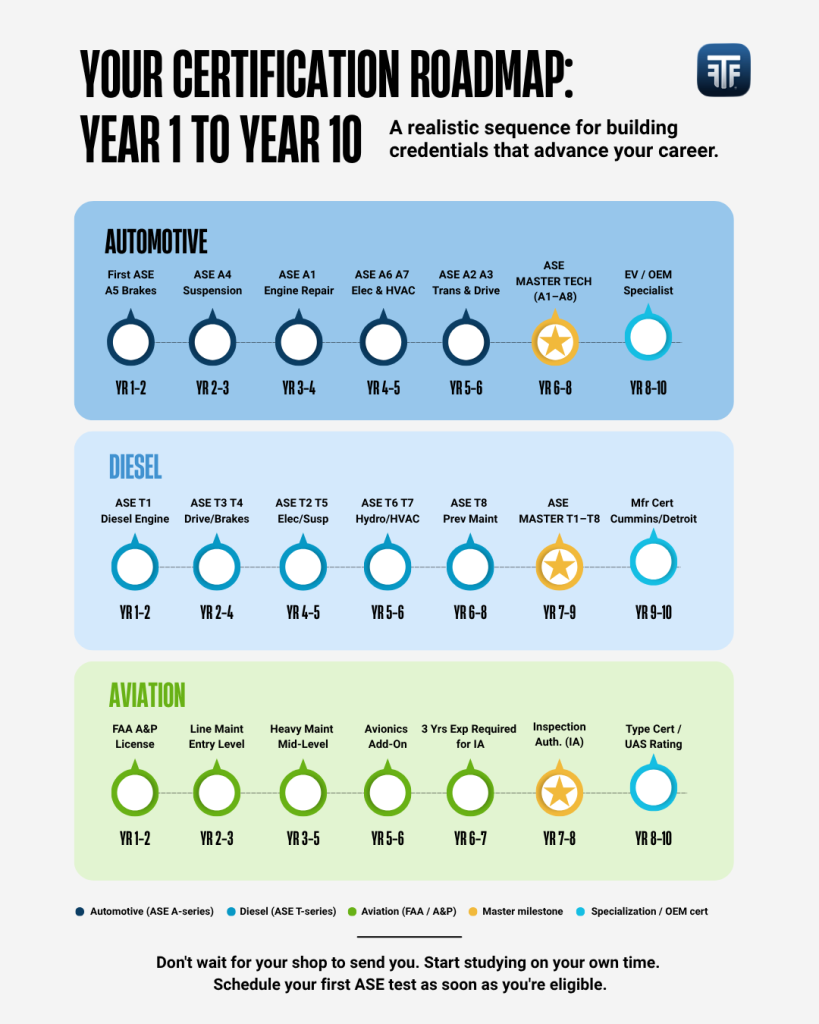
How to Prepare for ASE Certifications
ASE tests are challenging. Pass rates vary by test, but many hover around 60 to 70 percent for first-time test takers – which means preparation matters significantly. Here’s how to approach it:
- Study the task list, not just the content. ASE publishes a task list for every certification that outlines exactly what is covered and how heavily each area is weighted. This is your study roadmap. Find it at ase.com before you open a single study guide.
- Use purpose-built study materials. ASE study guides, Delmar’s test prep books, and online practice test platforms like Pocket Prep are purpose-built for ASE preparation. Generic automotive textbooks cover similar content but aren’t structured around the test format.
- Test with experience behind you. ASE recommends at least two years of hands-on experience before testing for most certifications. That recommendation exists because test questions are scenario-based and require practical context to answer correctly. Studying without shop experience is significantly harder.
- Schedule your test strategically. ASE tests are offered in two windows per year. Schedule when you have time to prepare properly, not just when it’s convenient. A failed test requires a waiting period and a retesting fee.
- Retake without shame. Many strong technicians fail their first ASE attempt. The test is comprehensive and the format takes getting used to. A fail is information – it tells you exactly which areas need more work.
Building a Personal Continuing Education Plan
A continuing education plan doesn’t need to be elaborate. It needs to be written down and revisited regularly. Here’s a simple framework:
- Identify your next certification target. Be specific: not ‘I want to get certified’ but ‘I am taking the ASE A6 Electrical test in the spring window.’ A specific goal with a deadline is the difference between planning and wishing.
- Set a weekly study commitment. Even 30 minutes three times a week adds up to over 75 hours of study in six months. Consistency beats intensity for retention of technical content.
- Track what you complete. A simple log of courses completed, tests taken, and certifications earned is useful for resume updates, performance reviews, and your own sense of progress.
- Review and update annually. At least once a year, look at where your sector is heading and ask whether your certification roadmap still reflects the skills that will be in demand. Adjust accordingly.
Financial Support for Continuing Education
The cost of certifications, testing fees, and study materials adds up – and for students on an apprentice wage, it can feel like a barrier. A few resources worth knowing:
- Employer reimbursement is available at many shops that invest in technician development.
- ASE’s own resources include information on available scholarships, reduced testing fees for students, and study material discounts. Check ase.com for current offerings.
The Bottom Line
A career in the skilled trades is not a static thing. The vehicle, equipment, and systems you will work on in year 10 of your career will be significantly different from what you work on today. The technicians who treat continuing education as a career-long habit rather than a one-time credential are the ones who stay relevant, stay employable, and keep advancing.
Pick your next certification. Set a study schedule. Use the resources available to you through TechForce, your employer, and the industry. Then do it again.

Sources & Further Reading
For more information on the topics covered in this article, we recommend the following resources:
- National Institute for Automotive Service Excellence (ASE): ase.com – full certification catalog, task lists, testing schedules, and study resources for automotive and diesel technicians
- Federal Aviation Administration (FAA): faa.gov – A&P licensing requirements, Inspection Authorization, and UAS certification information
- I-CAR (Inter-Industry Conference on Auto Collision Repair): i-car.com – Gold Class, Platinum individual certification, welding certification, and OEM collision training programs
- NATE (North American Technician Excellence): natex.org – HVAC technician certification catalog, testing locations, and continuing education requirements
- American Welding Society (AWS): aws.org – structural, pipeline, and inspector certification programs, testing procedures, and welding education resources
- EPA Section 608 Certification: epa.gov – refrigerant handling certification requirements and approved testing organizations