
The gap between what new techs expect and what the first year actually looks like is where a lot of careers end before they begin. Here’s what to actually expect – and how to make the most of it.
What Do New Technicians Actually Expect?
One of the most consistent conversations TechForce has with industry partners comes down to this: students graduate from technical school expecting to walk into a shop and immediately do the advanced work they trained for. The reality is almost always different – and that gap catches a lot of new techs off guard.
That’s not a criticism of students. It’s a flaw in how the skilled trades are sometimes presented. Technical education does a good job of teaching the skills. It doesn’t always do a good job of preparing students for the culture, pace, and hierarchy of a real working shop.
This article is the honest conversation most new techs wish they’d had before their first day.
“They want to come out of school making $100,000 without starting at the bottom. Our solution is going to be who talks to them in gaming language about how to level up.” – TechForce industry partner, describing the expectation gap and what it takes to bridge it.
The Expectation vs. Reality Gap
Here are the five most common expectation gaps new techs and trade students encounter in their first year – and what’s actually true:
| The Expectation | The Reality |
| “I’ll be doing real repairs right away.” | Most shops start new techs on oil changes, tire rotations, and basic maintenance. That’s not a slight – it’s how you prove you’re trustworthy with a customer’s vehicle. |
| “I’ll be making good money from day one.” | Entry-level pay is real pay, but master-tech earnings come later. The path to strong wages is clear – it just takes time and certifications to get there. |
| “My instructor said I was one of the best in class.” | School and shop are different environments. Being a strong student means you have a foundation to build on. It doesn’t mean you skip the beginner stage. |
| “I know more than some of the older techs here.” | Maybe true on specific topics. Irrelevant right now. Watch, listen, and prove yourself with your work before forming opinions about others. |
| “If I’m not advancing in 6 months, something is wrong.” | Real advancement in a skilled trade takes 1-3 years of consistent performance. Six months is barely enough time to learn the shop’s systems and earn trust. |
The Mopping the Floor Reality
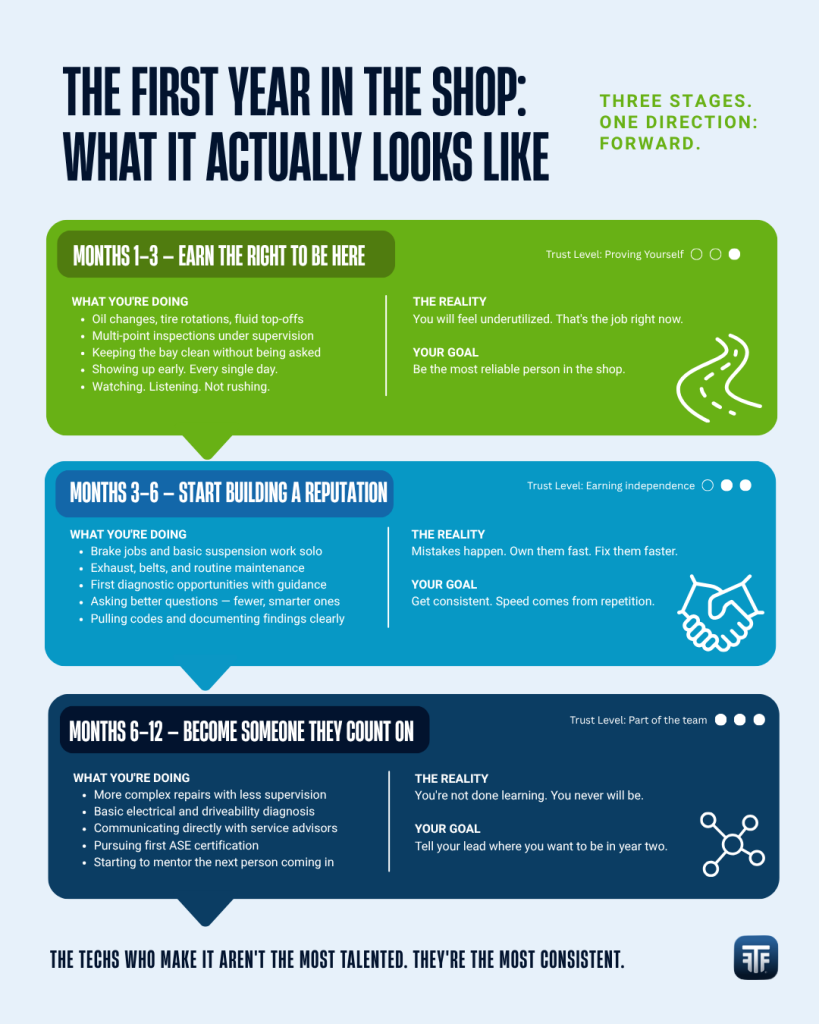
There’s a story that gets told in skilled trades circles – usually by a master tech looking back on their early days. It goes something like this: on their first week, they were handed a mop and told to clean the shop floor. Not a scan tool. Not a work order. A mop.
The point isn’t that new techs should expect to be mistreated or underutilized indefinitely. The point is that trust in a shop is earned through small things first. Showing up on time. Being the last one to leave. Keeping the bay clean without being asked. Asking good questions. Being reliable on the simple jobs before being given the complex ones.
The techs who resent that process tend to leave early. The ones who understand it as a passage tend to advance faster because they build genuine trust instead of demanding it.
What Employers Actually Expect from New Techs
Here’s what hiring managers and shop leads consistently say they want from a first-year tech – and it has almost nothing to do with technical skill:
- Show up. Reliability is the single most valued quality in a new hire. A tech who is always on time, rarely calls out, and communicates proactively when something comes up is rare and noticed immediately.
- Be coachable. New techs who accept feedback without defensiveness and apply it quickly are the ones who get more responsibility. New techs who argue with every correction get fewer opportunities.
- Ask good questions. Not constant questions about things you could figure out yourself – but thoughtful questions that show you’ve already done some thinking. There’s a difference.
- Take care of the vehicle. A customer’s car or truck is often their most valuable possession and the thing that gets them to work. Treating it with respect – every time, not just when someone is watching – builds the kind of reputation that leads to advancement.
- Stay curious. The new techs who advance fastest are the ones who are genuinely interested in the work. They hang around after hours to watch a repair. They look up things they didn’t know. The curiosity shows.
How to Show Up, Prove Yourself, and Advance
The path from entry-level tech to trusted team member isn’t complicated. It’s just not fast. Here’s what it actually takes:
Master the Basics Before Asking for More
Every shop has a set of foundational services: oil changes, tire rotations, fluid checks, basic inspections. Get so good at these that the service advisor never has to think twice about sending you a car. Speed and accuracy on the basics is what opens the door to more complex work.
Make Your Intentions Known
Most shop leads don’t automatically track who wants to advance and who is content where they are. Tell your lead or mentor directly: “I’m working toward my ASE certifications and I want to be doing more diagnostic work in the next year. What do I need to demonstrate to get there?” That conversation changes how people see you.
Find a Mentor
The fastest path to advancement in any skilled trade runs through someone who has already made it. Find a tech in your shop who is willing to answer questions, let you watch their work, and give you honest feedback. TechForce also connects students to mentors outside their immediate shop through the platform’s community and mentorship networks.
Pursue Certifications Systematically
ASE certifications, manufacturer training programs, and sector-specific credentials are the clearest signal to any employer that you are serious about your career. Don’t wait for your shop to send you – start studying on your own time and schedule tests as soon as you’re eligible.
A Note on Pay Expectations
The skilled trades offer some of the strongest earning potential of any career that doesn’t require a four-year degree. A master automotive technician, diesel specialist, or senior HVAC tech can earn $50 to $85+ per hour. But that earning level is the destination of a 10 to 15 year career, not the starting point.
Entry-level and apprentice pay in most sectors runs $14 to $22 per hour. That’s real money, especially compared to the debt that often comes with a four-year degree. The trajectory is steep if you put in the work. The key is not to judge the career by where it starts.
TechForce and the Level Up Mentality
TechForce Foundation was built around a simple idea: students in technical education deserve the same quality of support, resources, and career guidance that students in four-year programs get. That includes being honest about what the path looks like.
The platform connects students to career path maps with clear milestones, mentors who have been where they are, community circles of peers navigating the same challenges, and scholarships and other financial support that makes it possible to stay the course during the early years.
The technician shortage is real. The career opportunity is real. The path requires starting at the bottom – just like it always has. Visit TechForce.org to access the tools that help you move through it faster.
The Bottom Line
The techs who make it to master level are not the ones who skipped the hard early years. They’re the ones who understood what those years were for: building a foundation of trust, skill, and reputation that everything else is built on.
Start where you are. Do the small things exceptionally well. Keep your eyes on where the path leads. The level up is earned – and it’s absolutely within reach.

Sources & Further Reading
For more information on the topics covered in this article, we recommend the following resources:
- U.S. Bureau of Labor Statistics (BLS) Occupational Outlook Handbook: bls.gov – median wages, job outlook, and career progression data for automotive technicians, diesel mechanics, and other skilled trade occupations
- National Institute for Automotive Service Excellence (ASE): ase.com – certification pathways and professional development resources for automotive and diesel technicians