
Balancing school, work, and life in a technical program isn’t easy. These strategies are built for the reality of a student in the skilled trades.

Why Is Time Management So Hard for Trade Students?
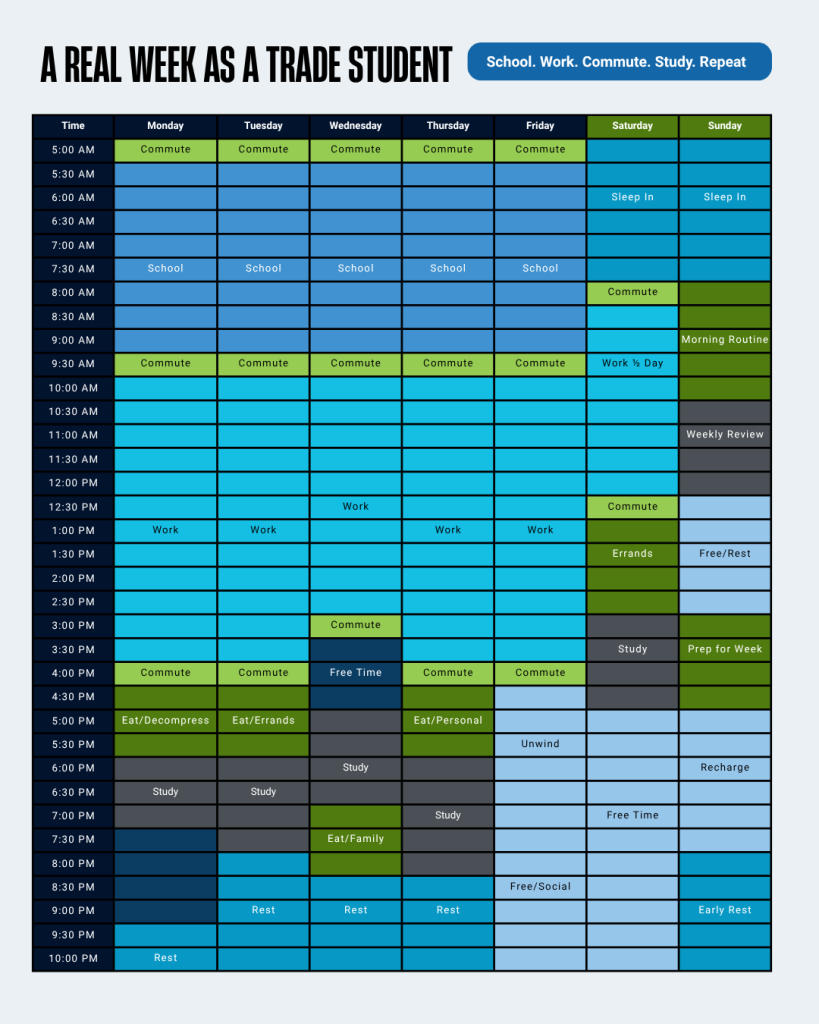
Most time management advice is written for people with a fairly predictable schedule. Trade students rarely have that luxury. A typical week might look like: class in the morning, a part-time job in the afternoon, a long commute in between, family obligations in the evening, and studying squeezed in wherever it fits.
Nearly every TechForce student entry about daily life mentions some version of this. Waking up at 5 a.m. Going to school at 6. Starting work at 9. Not getting home until 7 p.m. It’s a real load – and it requires real strategy, not generic productivity tips.
The good news is that time management is a skill, just like technical diagnostics. It can be learned, practiced, and improved. Here’s how to build it.
“I wake up at 5 a.m., go to school at 6, start work at 9, and don’t get home until around 7 p.m.” – TechForce student, describing a schedule that is far more common than most people realize.
The Foundation: Know Where Your Time Actually Goes
Before you can manage your time better, you need an honest picture of where it’s going now. For one week, track how you spend each hour. Not how you think you spend it – how you actually spend it.
Most people are surprised by two things: how much time disappears into their phone without producing anything, and how much time is lost to transitions – commuting, waiting, getting started on things. Both of those are recoverable time once you see them.
Prioritization: The Most Important Skill You’re Not Teaching Yourself
Not all tasks are equal, and treating them as if they are is one of the fastest ways to feel constantly busy while falling behind on the things that matter. The Eisenhower Matrix is a simple framework that trade students and working techs can use to sort what actually deserves your time:
| URGENT + IMPORTANTDo it now.Failing a class, a car needed for work breaking down, a missed shift | NOT URGENT + IMPORTANTSchedule it.Studying for an upcoming test, saving for tools, health appointments | URGENT + NOT IMPORTANTDelegate or limit it.Most texts and social notifications, minor favors others ask of you | NOT URGENT + NOT IMPORTANTCut it or do it last.Endless scrolling, TV reruns, low-value time fillers |
Most stress comes from spending too much time in the bottom two quadrants – urgent but unimportant tasks, or neither urgent nor important – while the important-but-not-yet-urgent things (studying, savings, health) quietly become crises.
Each week, look at your task list and ask: which of these is genuinely urgent AND important? Start there. Everything else gets scheduled, delegated, or cut.
Study Strategies That Actually Work for Technical Students
Studying for a technical program is different from studying for a traditional academic course. You’re learning hands-on skills alongside technical theory, and cramming doesn’t work well for either.
Study in Short Blocks, Not Long Sessions
45 to 60 minute focused sessions with a short break outperform 3-hour marathon study blocks almost every time. Your brain consolidates information during rest. Use the commute or lunch break for quick review rather than saving everything for one long night.
Connect Theory to What You Did That Day
After every shop session, spend 10 minutes writing down what you worked on and what the theory behind it was. This active recall locks in the learning far more effectively than re-reading your notes.
Use Your Commute
Long commutes are a significant time drain for many trade students – but they’re also recoverable time. Audio content (podcasts about the trade, recorded notes, technical explanations) can turn a 45-minute drive into productive review. Some students even record their own notes and listen back.
Balancing Work, School, and Life
The honest truth is that something usually has to give when you’re working and going to school at the same time. The goal isn’t perfect balance – it’s intentional trade-offs that protect your highest priorities.
- Define your non-negotiables. What absolutely cannot slip? For most trade students it’s: showing up to school, showing up to work, and keeping commitments to family. Everything else is negotiable.
- Communicate with your employer. If your school schedule changes or a major assessment is coming up, most employers in the skilled trades will work with students who communicate proactively rather than just calling out.
- Protect at least one full rest day per week. Running at 100% capacity 7 days a week isn’t sustainable. One genuine recovery day per week extends how long you can keep going at high intensity.
- Batch similar tasks together. Errands, emails, and admin tasks take less mental energy when grouped. Switching between a technical task and an administrative one costs more time than people realize.
Managing Long Commutes
Long commutes are one of the most common time challenges TechForce students mention. If your commute is more than 30 minutes each way, here are ways to make it work for you rather than against you:
- Use audio content for passive review of technical material
- Make phone calls for personal or family communication during drive time to protect evenings
- If you take public transit, use it for active study or planning your next day
- If commute time is genuinely unsustainable, explore whether your school or employer offers any flexibility in schedule or location
- TechForce’s Wraparound Services include transportation support resources for students facing significant commute barriers
A Simple Weekly Planning System
You don’t need an elaborate system. You need a consistent one. Here’s a bare-minimum approach that works for busy trade students:
- Sunday evening (15 minutes): Look at the week ahead. Identify the 3 most important things that must happen. Block time for them first.
- Each morning (5 minutes): Confirm your top 3 for the day. Know your schedule before the day starts.
- Each evening (5 minutes): Note what got done, what got moved, and what tomorrow looks like. This 5-minute debrief prevents things from falling through the cracks.
That’s 25 minutes a week of planning that replaces hours of reactive scrambling. It’s one of the highest-return habits a trade student can build.
TechForce Resources to Help You Manage the Load
TechForce Foundation’s platform includes more than 350 life skills trainings available to students in technical education – many of them focused on exactly the challenges covered in this article. Time management, financial literacy, communication skills, and career readiness are all available and student-ranked.
If the load feels unmanageable because of financial pressure, transportation barriers, or family obligations, TechForce’s Wraparound Services can connect you to resources that address the root causes – not just the symptoms. Visit TechForce.org to access your support network.
The Bottom Line
Time is the one resource you can’t get more of. The trade students who make it through technical school while working and managing real life aren’t superhuman – they’re strategic. They know their priorities, protect their time deliberately, and build systems that work with their actual schedule, not an ideal one.
Start small. Pick one strategy from this article and use it this week. That’s how the habit gets built.
Sources & Further Reading
For more information on the topics covered in this article, we recommend the following resources: