
Every skilled trade has a clear progression from entry level to master. Here’s what that path looks like across six sectors – with real timelines, pay ranges, and milestones.
What Does a Skilled Trade Career Path Actually Look Like?
One of the biggest misconceptions students bring into technical education is expecting to graduate and immediately earn top dollar. The reality is more nuanced – and actually more exciting. Every skilled trade follows a clear progression: you start at entry level, build speed and competency, earn certifications, and advance through defined stages toward master-level work and the earning power that comes with it.
America needs nearly 1 million new entry-level technicians by 2028 across automotive, diesel, aviation, collision, HVAC, and welding. Schools are graduating only a fraction of that number. That gap means the demand for what you’re training to do is at an all-time high – and the career path in front of you has never had more runway.
Below is a breakdown of the career progression in each of the six major skilled trade sectors TechForce supports. Use it as a roadmap, not a guarantee – actual pay and timeline vary by region, employer, and individual performance.
“My dream is to become a level 3, master diesel technician. I wish to make good money and provide great service to my customers.” – TechForce student. That path is real, and it starts at the beginning – just like it did for every master tech working today.
Automotive Technician Career Path
Automotive is the largest sector in the skilled trades, covering passenger vehicles, light trucks, and specialty vehicles. The path from lube tech to master technician typically takes 5 to 10 years of consistent work and certification-building.
| Stage | Timeline | Typical Pay Range | What You’re Doing |
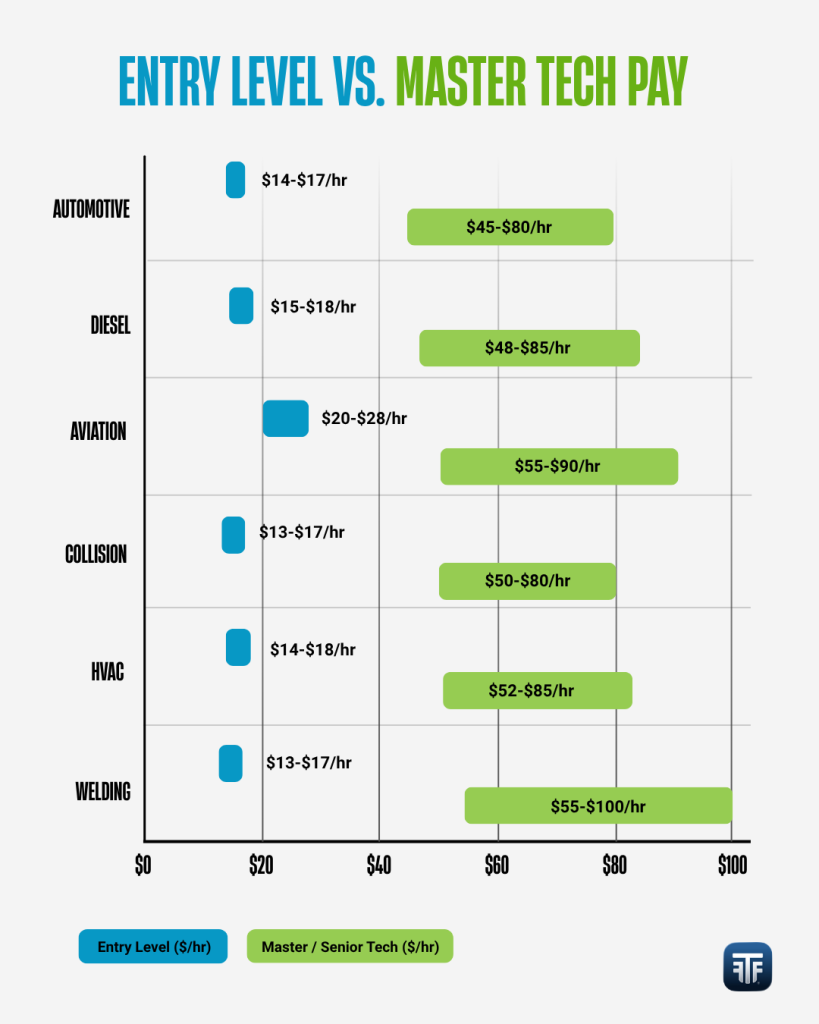
| Lube Tech / Detail | 0-6 months | $14-$17/hr | Oil changes, tire rotations, basic inspections. Learning shop workflow and customer interaction. |
| Entry-Level Tech | 6 months – 2 years | $16-$22/hr | Basic repairs, brakes, suspension, exhaust. Building speed and consistency. |
| Mid-Level Tech | 2-5 years | $22-$32/hr | Diagnostics, electrical, engine work. Pursuing ASE certifications. |
| Senior / A-Tech | 5-10 years | $30-$45/hr+ | Complex diagnostics, driveability, all systems. ASE Master Technician pursuit. |
| Master Tech / Specialist | 10+ years | $45-$80/hr+ | Full diagnostics, team leadership, specialty certifications (EV, hybrid, OEM). |
Key certifications: ASE A1-A8 for Master Technician status, OEM-specific certifications (Ford, GM, Toyota, etc.), EV and hybrid specialist credentials as the market shifts.
Diesel Mechanic / Technician Career Path
Diesel technicians work on heavy trucks, commercial vehicles, construction equipment, agricultural machinery, and marine engines. The sector commands strong wages and has some of the most severe technician shortages in the skilled trades.
| Stage | Timeline | Typical Pay Range | What You’re Doing |
| Lube / Service Tech | 0-6 months | $15-$18/hr | Fluid services, filters, basic PM work on diesel equipment. |
| Entry-Level Diesel Tech | 6 months – 2 years | $18-$24/hr | Basic engine repairs, brake systems, electrical fundamentals on heavy equipment. |
| Mid-Level Diesel Tech | 2-5 years | $24-$36/hr | Engine overhauls, advanced electrical, emissions systems, diagnostics. |
| Senior Diesel Tech | 5-10 years | $34-$50/hr | Complex diagnostics, injection systems, turbochargers, fleet management support. |
| Master Diesel Tech / Specialist | 10+ years | $48-$85/hr+ | Full system mastery, manufacturer certifications, team lead or shop foreman roles. |
Key certifications: ASE T1-T8 for Medium/Heavy Truck, ASE C1 for service consultant track, manufacturer-specific programs (Cummins, Detroit, Caterpillar, Duramax).
Aviation Mechanic / Technician Career Path
Aviation maintenance is one of the most regulated and credential-driven skilled trades. The FAA Airframe and Powerplant (A&P) license is the foundation of the career, and the path from student to senior technician is structured and well-defined.
| Stage | Timeline | Typical Pay Range | What You’re Doing |
| AMT Student / Trainee | 0-2 years (school) | $12-$16/hr (training) | Technical school focused on FAA-approved curriculum. Airframe and Powerplant coursework. |
| A&P Mechanic (Entry) | 0-3 years post-cert | $20-$28/hr | Line maintenance, routine inspections, basic component repair under supervision. |
| A&P Mechanic (Mid) | 3-7 years | $28-$42/hr | Heavy maintenance, avionics support, complex inspections, independent sign-offs. |
| Senior A&P / IA | 7-15 years | $40-$60/hr | Inspection Authorization (IA) certification. Sign-off authority on major repairs and alterations. |
| Lead Tech / Director of Maintenance | 15+ years | $55-$90/hr+ | Team leadership, regulatory compliance oversight, MRO management. |
Key certifications: FAA A&P License (required to work), Inspection Authorization (IA), avionics add-on ratings, manufacturer type certifications. Aviation is one of the few skilled trades where federal licensing is mandatory at entry.
Collision Repair Technician Career Path
Collision repair technicians restore vehicles after accidents, working with body panels, frames, paint, and increasingly with advanced driver assistance systems (ADAS) that require precise calibration after any structural repair.
| Stage | Timeline | Typical Pay Range | What You’re Doing |
| Prep Tech / Detail | 0-6 months | $13-$17/hr | Surface prep, masking, basic bodywork assistance. Learning shop flow and paint safety. |
| Entry Collision Tech | 6 months – 2 years | $16-$22/hr | Panel replacement, basic dent repair, unibody inspection fundamentals. |
| Body Tech / Painter | 2-6 years | $22-$38/hr | Frame straightening, welding, full refinishing, color matching. I-CAR training pursuit. |
| Senior Collision Tech | 6-12 years | $36-$55/hr | Complex structural repair, ADAS calibration, estimating, OEM repair procedures. |
| Master Collision Tech / Estimator | 12+ years | $50-$80/hr+ | Full shop capability, insurance negotiation, team oversight, damage analysis. |
Key certifications: I-CAR Gold Class (industry standard), ASE B2-B6 for collision specialists, OEM certification programs (Tesla, Rivian, and other manufacturers with proprietary repair requirements), ADAS calibration training.
HVAC Technician Career Path
HVAC technicians install, maintain, and repair heating, ventilation, air conditioning, and refrigeration systems in residential, commercial, and industrial settings. The sector has strong year-round demand and a clear apprenticeship-to-journeyman progression.
| Stage | Timeline | Typical Pay Range | What You’re Doing |
| HVAC Helper / Apprentice | 0-1 year | $14-$18/hr | Assisting experienced techs, learning system components, basic installation tasks. |
| HVAC Installer / Service Tech I | 1-3 years | $18-$26/hr | Residential installation and basic service, EPA 608 certification, ductwork. |
| HVAC Tech II / Journeyman | 3-7 years | $26-$40/hr | Commercial systems, complex diagnostics, refrigerant handling, controls. |
| Senior HVAC Tech | 7-12 years | $38-$55/hr | Industrial systems, building automation, full diagnostic capability, team lead. |
| Master HVAC / Project Manager | 12+ years | $52-$85/hr+ | System design, large commercial and industrial projects, contractor licensing. |
Key certifications: EPA 608 (required to handle refrigerants), NATE certification (industry standard), state contractor license (required for independent work in most states), manufacturer-specific training (Carrier, Trane, Lennox).
Welder / Welding Technician Career Path
Welding is one of the most versatile skilled trades, with applications across automotive, construction, manufacturing, pipelines, aerospace, and shipbuilding. The career path varies significantly by industry sector and welding process specialty.
| Stage | Timeline | Typical Pay Range | What You’re Doing |
| Welding Student / Helper | 0-1 year | $13-$17/hr | Learning core processes (MIG, TIG, Stick), safety fundamentals, basic joint types. |
| Entry Welder | 1-3 years | $17-$24/hr | Production welding, structural work, reading blueprints and weld symbols. |
| Certified Welder | 3-7 years | $24-$40/hr | AWS or API certifications, specialty processes, quality inspection basics. |
| Senior Welder / Weld Inspector | 7-15 years | $38-$60/hr | CWI certification pursuit, complex structural and pressure vessel work. |
| Certified Welding Inspector / Engineer | 15+ years | $55-$100/hr+ | AWS CWI, quality assurance, weld engineering, project management. |
Key certifications: AWS D1.1 Structural Welding, API 1104 Pipeline Welding, AWS Certified Welding Inspector (CWI), ASME pressure vessel certifications. Specialty processes like TIG on exotic metals (titanium, Inconel) command significant pay premiums.
The Level Up Mindset: How to Move Through the Stages
Every career path above has one thing in common: progression is earned through time, certifications, and demonstrated competency – not just seniority. The techs who advance fastest are the ones who treat each stage as preparation for the next one, not just a job to get through.
- Certifications are non-negotiable. In every sector, certifications are the clearest signal to employers that you’ve invested in your own growth. Pursue them systematically, not eventually.
- Speed comes from repetition. On flat rate or production pay, your income is directly tied to how efficiently you work. The only way to get faster is to do the work – a lot.
- Specialization creates leverage. Generalists are valuable. Specialists are in demand. Once you have a foundation, identify an area of the trade that interests you and go deep.
- Ask where the market is going. EV and hybrid in auto, ADAS in collision, automation in welding and HVAC – the techs building skills in emerging technology today are the ones with the most options in 10 years.
How TechForce Supports Your Career Path
TechForce Foundation connects students across all six sectors to the resources they need to move through the career path with less friction.
For students just starting out, TechForce offers millions of dollars in scholarships every year to reduce the financial barrier to entry. For students further along, apprenticeship connections, job listings, and community networks support the transition from school into a working career.
With 3 to 7 job openings per graduate across multiple sectors, the path forward is clear. The support to get there is at TechForce.org.
The Bottom Line
Every master technician in automotive, diesel, aviation, collision, HVAC, and welding started exactly where you are right now. The path is laid out. The demand is real. The only question is how you want to move through it.
Start at the entry point for your sector. Build the certifications. Put in the repetitions. Find your specialization. The level up is waiting – and TechForce is here to help you get there.

Sources & Further Reading
For more information on the topics covered in this article, we recommend the following resources:
- U.S. Bureau of Labor Statistics (BLS) Occupational Outlook Handbook: bls.gov – median pay, job outlook, and entry requirements for automotive technicians, diesel mechanics, HVAC technicians, welders, and aircraft mechanics
- National Institute for Automotive Service Excellence (ASE): ase.com – certification pathways, testing requirements, and industry standards for automotive and diesel technicians
- Federal Aviation Administration (FAA): faa.gov – Airframe and Powerplant (A&P) licensing requirements, regulations, and career guidance for aviation mechanics
- American Welding Society (AWS): aws.org – welding certification pathways, wage data, and industry standards
- Air Conditioning Contractors of America (ACCA): acca.org – HVAC industry career information, standards, and technician resources
- I-CAR (Inter-Industry Conference on Auto Collision Repair):i-car.com – collision repair training, certification programs, and career development resources