
Technical skill gets you in the door. Communication skill keeps you there and moves you up. Here’s how to develop both.

Why Communication Skills Matter in a Technical Career
Ask any shop foreman or service manager what separates a good tech from a great one, and communication comes up almost every time. The ability to explain a complex repair in plain language, write a clear work order, ask the right question without seeming clueless, and handle a frustrated customer professionally – these are skills that directly affect your career trajectory.
Technical competency gets you hired. Communication skills determine how fast you advance, how much trust you earn, and how long customers keep coming back to your bay.
Talking to Customers: The Basics
Most new techs dread customer interactions, especially early in their career when they’re still building confidence in their technical knowledge. But effective customer communication isn’t about knowing everything – it’s about being clear, honest, and respectful.
Lead with What You Know, Not What You Don’t
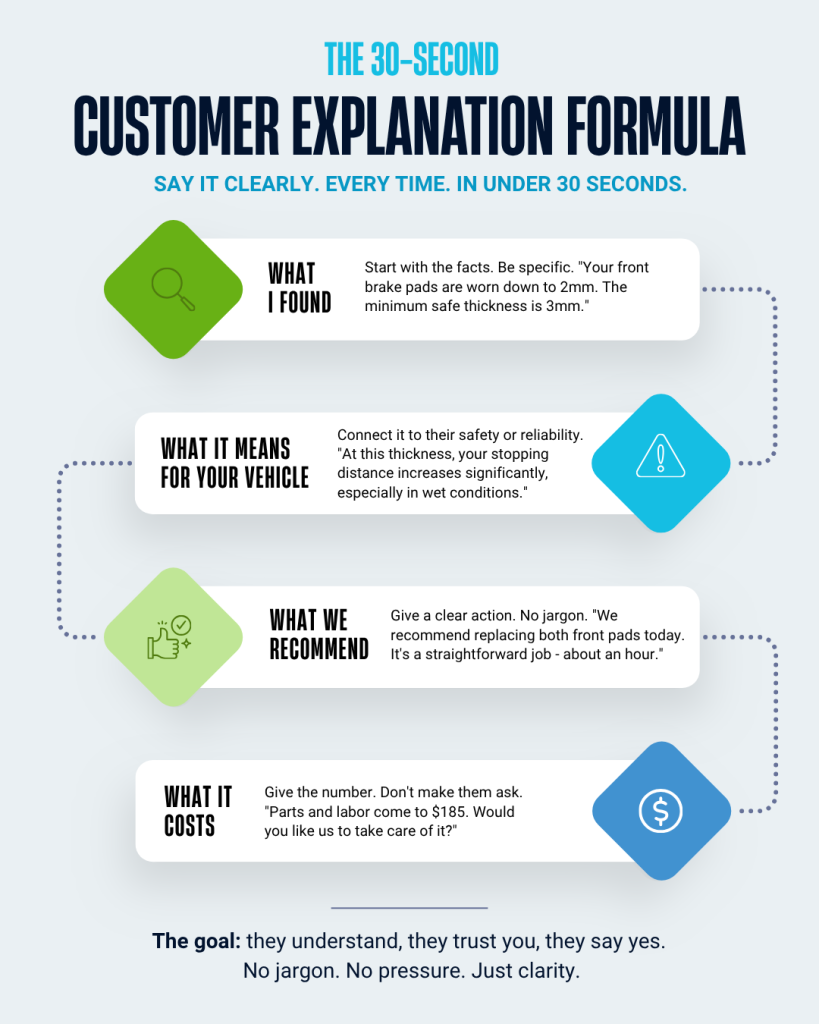
Instead of starting with uncertainty, lead with what you’ve confirmed. “I’ve checked the brakes and found the front pads are at 2mm – they need to be replaced” is more reassuring than “I’m not sure, but I think the brakes might be a problem.”
Translate Tech Talk into Plain Language
Customers don’t know what a camshaft position sensor is – and they don’t need to. What they need to know is what it affects, what happens if it’s not fixed, and what it costs. Practice giving 30-second plain-language explanations of common repairs. It’s a skill that builds fast with repetition.
Handle Difficult Customers with a Simple Formula
When a customer is upset, use this three-step approach: acknowledge their frustration without arguing, explain what you know factually, and offer a clear next step. You don’t have to accept abuse, but staying calm and factual almost always de-escalates the situation faster than matching their energy.
Communicating with Service Advisors
Your relationship with the service advisor is one of the most important in the shop. They’re the link between you and the customer – and if that communication breaks down, everyone loses.
- Be specific, not vague. “The noise is a metallic grinding from the front left wheel while braking above 30 mph” is useful. “It makes a noise sometimes” is not.
- Flag problems early. If a job is going to take longer than estimated or you’ve found an additional concern, tell the advisor before the customer calls asking about their car.
- Document everything. If you told the advisor something verbally, note it in the system too. Paper trails protect you and the shop.
- Ask about customer preferences. Some customers want every detail. Others just want it fixed and a total. Advisors usually know which is which – use that information.
How to Ask Questions Without Seeming Inexperienced
This is one of the most common concerns for new techs and trade students – and it’s worth addressing directly. Asking questions is not a sign of weakness. Not asking questions is how expensive mistakes happen.
The key is how you ask, not whether you ask. There’s a big difference between “I have no idea what I’m doing” and a well-framed question that shows you’ve already done some thinking.
| Instead of… | Try saying… |
| “I don’t know how to do this.” | “I haven’t run into this exact issue before – can you point me toward where I should start?” |
| “What does this mean?” | “I’m seeing this code and I’ve checked X and Y. Does that match what you’d expect?” |
| “Is this right?” | “I completed the repair and torqued to spec. Would you mind doing a quick check before I button it up?” |
| “I messed this up.” | “I ran into a problem on this job and want to flag it before going further. Here’s what happened.” |
Notice the pattern: each “try saying” version shows that you’ve already thought about the problem, taken some action, or are being proactive. That framing changes how the question lands completely.
Written Communication: Work Orders and Documentation
In a professional shop, if it isn’t written down, it didn’t happen. Work orders, inspection sheets, and digital documentation are legal and financial records – and they reflect directly on your professionalism.
What Makes a Good Work Order Entry
A clear work order entry answers four questions: What was the complaint? What did you find? What did you do? What should the customer know? It doesn’t need to be long – it needs to be accurate, specific, and legible.
Handwriting Still Matters in the Trades
Many shops still use paper inspection forms, service tickets, and parts requests – especially smaller independents and fleet operations. Illegible handwriting creates real problems: wrong parts ordered, missed services, miscommunication with advisors and customers.
If your handwriting is hard to read, it’s worth practicing. Write clearly, print if cursive is messy, and slow down on key numbers like part numbers, VINs, and labor times. One misread digit on a parts order costs everyone time and money.
Written Communication Beyond the Bay
As you advance in your career, written communication expands: emails to customers, digital inspection reports with photos, text updates on vehicle status, and eventually team communication if you move into a lead or management role. Building clean, professional writing habits early pays off for years.
Reading Service Requests and Technical Documentation
A significant part of shop communication runs in the other direction – from the written page to you. Technical service bulletins, factory repair procedures, work orders from advisors, and inspection checklists all require careful reading.
Skimming is a habit that causes errors in technical work. Develop the discipline to read work orders completely before starting a job. Verify the complaint, confirm the vehicle, check for any flags or customer notes. Two minutes of careful reading at the start of a job prevents hours of rework.
TechForce Communication Resources
TechForce Foundation’s platform includes life skills trainings covering professional communication, customer service fundamentals, and workplace communication – all student-ranked and available to students in technical education at no cost.
Developing good communications skills early is one of the best investments you can make in your professional future. Visit TechForce.org to access training resources.
The Bottom Line
Every skill in this article can be learned. None of it requires a specific personality type or natural talent for talking to people. It requires practice, awareness, and the willingness to get a little uncomfortable in order to get better.
The techs who advance fastest in the skilled trades are not always the most technically gifted. They’re the ones who can fix the car and explain it clearly, document it accurately, and make the customer feel heard. That combination is hard to beat.
Sources & Further Reading
For more information on the topics covered in this article, we recommend the following resources:
- National Institute for Automotive Service Excellence (ASE): ase.com – professional standards and certification pathways for automotive and diesel technicians
- I-CAR (Inter-Industry Conference on Auto Collision Repair): i-car.com – technical training and communication standards for collision repair professionals
Toastmasters International: toastmasters.org – free and low-cost resources for building professional communication and public speaking skills