
Learning to manage money on an apprentice wage is one of the most important skills you’ll develop in a technical career. Here’s where to start.

Why Financial Literacy Matters in a Skilled Career
One of the most common challenges students in technical education face has nothing to do with diagnostics or shop skills. It’s money. Covering rent, tuition, food, and tools on an apprentice or entry-level wage while going to school is genuinely hard – and most trade programs don’t teach you how to manage it.
Financial stress is one of the leading reasons students leave technical school before finishing. Getting your finances under control isn’t just a life skill. It’s a career survival skill.
This article covers the basics: how to budget on a tight income, how to understand your pay structure, how to build credit, how to manage debt, and how to save for tools without falling behind on bills.
“I have to work to cover rent, tuition, food for myself, my girlfriend, and our 1-year-old son.” – TechForce student, describing the financial reality many trade students navigate daily.
Understanding Your Pay: Flat Rate vs. Hourly
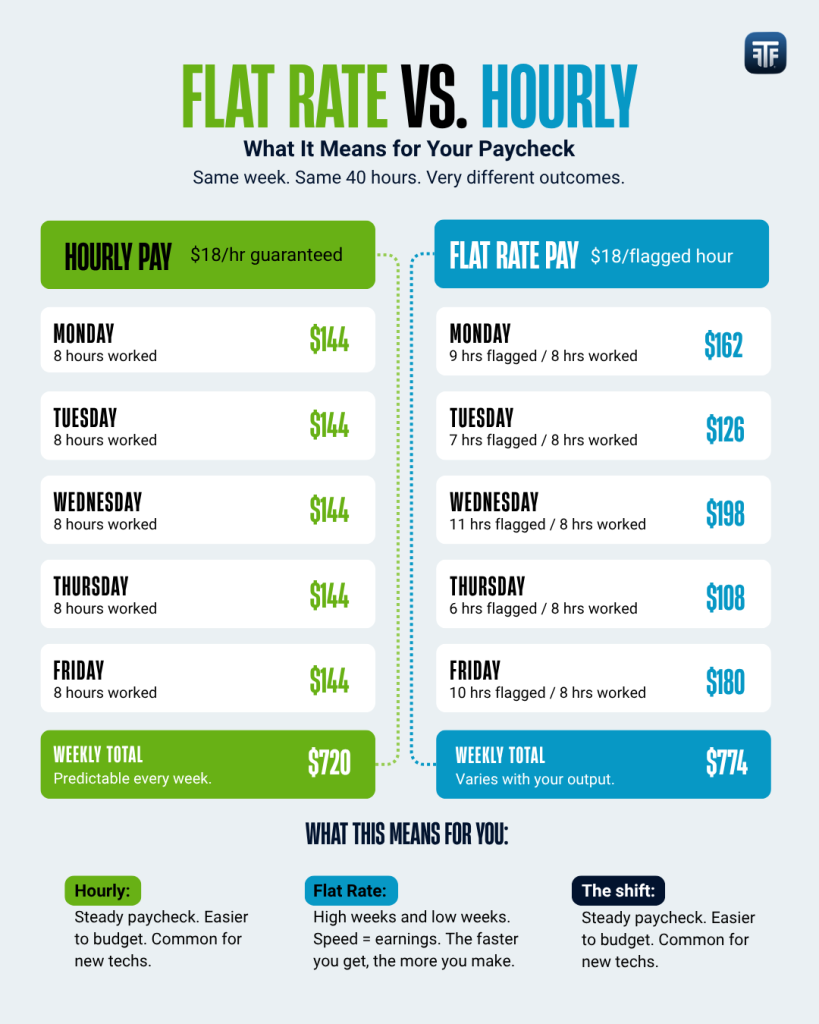
Before you can budget, you need to understand how you get paid. In the automotive and diesel industries, there are two main pay structures – and knowing the difference matters a lot for your financial planning.
Hourly Pay
You get paid for every hour you’re at work, regardless of how many jobs you complete. This is more common for apprentices and entry-level techs. It’s predictable, which makes budgeting easier – but the ceiling is lower.
Flat Rate Pay
You get paid per job based on a standard time estimate, not the actual time it takes. If a job is flagged at 2 hours and you finish it in 1.5, you still get paid for 2. If it takes you 3 hours, you still only get 2. Experienced techs can earn significantly more on flat rate. Newer techs often earn less until their speed improves.
When you’re starting out, flat rate can feel like a penalty for being new. It’s not – it’s an incentive system. The faster and more accurate you get, the more you earn. Budget conservatively when you’re new to flat rate and adjust as your efficiency improves.
How to Budget on an Apprentice Salary
Budgeting on a tight income isn’t about cutting everything fun. It’s about making intentional choices so the important things are covered. Entry-level and apprentice tech pay typically ranges from $14 to $22 per hour depending on your sector, region, and shop type – that works out to roughly $2,200 to $3,400 per month take-home for a full-time schedule. Here’s a starting framework based on $2,500 per month take-home, which is a reasonable mid-range estimate for an apprentice or first-year tech:
| Category | % of Take-Home | Est. on $2,500/mo |
| Housing (rent/utilities) | 30-35% | $750-$875 |
| Food & groceries | 10-15% | $250-$375 |
| Transportation | 10-15% | $250-$375 |
| Tuition/school costs | 10-15% | $250-$375 |
| Tools (savings fund) | 5-10% | $125-$250 |
| Personal/miscellaneous | 5-10% | $125-$250 |
| Emergency savings | 5% | $125 |
These are starting points, not rules. Your actual take-home will vary based on your hourly rate, whether you’re on flat rate, the hours available at your shop, and whether you’re also working part-time while in school. The goal is to know where every dollar is going before it leaves your account – regardless of the exact number.
Saving for Tools While Paying Bills
Tools are one of the biggest financial challenges for new techs. A basic starter set can run anywhere from a few hundred to several thousand dollars, and shops often expect you to show up with your own. Here’s how to build your toolbox without wrecking your budget:
- Start with the essentials only. You don’t need a full rollaway on day one. Research the top tools your specific sector requires and build from there.
- Use a dedicated tools fund. Even $50 a month set aside adds up to $600 in a year. Treat it like a bill you pay yourself first.
- Buy used strategically. Used hand tools from reputable brands often outlast cheap new ones. Avoid used diagnostic equipment unless you can verify it works.
- Look into tool financing carefully. Snap-on and Matco offer payment plans, but interest adds up fast on small paychecks. Know the total cost before you sign.
- Ask about tool scholarships. TechForce partners with tool companies to provide tool vouchers and giveaways for students and working techs who qualify. Check TechForce.org for current opportunities.
Managing Student Loans and Tuition Debt
If you took out loans for technical school, understanding your repayment options before you graduate saves you money and stress. A few key things to know:
- Federal student loans have income-driven repayment options that cap your monthly payment based on what you earn
- Grace periods (usually 6 months after graduation) give you time to get employed before payments start
- Defaulting on student loans damages your credit and can affect your ability to get financing for tools, vehicles, or housing
- Some employers in the skilled trades offer tuition reimbursement or loan assistance as a benefit – ask about this during job interviews
If your debt feels unmanageable, contact your loan servicer before you miss a payment. There are deferment and forbearance options available, but you have to ask for them.
Building Credit and Financial Foundations
A strong credit score opens doors: better rates on vehicle loans, easier approval for housing, access to financing when you need it. Here’s how to build credit from scratch or rebuild it after a rough patch:
- Get a secured credit card. Put a small recurring charge on it (like a streaming service) and pay it off in full every month. This builds a positive payment history with no risk of overspending.
- Never miss a payment. Payment history is the single biggest factor in your credit score. Set up autopay for at least the minimum on every account.
- Keep utilization low. Try to use less than 30% of your available credit limit at any time. High utilization tanks your score even if you pay on time.
- Check your credit report annually. You’re entitled to a free report at annualcreditreport.com. Errors are common and can drag your score down without you knowing.
Financial Support Available Through TechForce
You don’t have to figure all of this out alone. TechForce Foundation offers financial support specifically for students in automotive, diesel, aviation, and other technical careers:
- Scholarships for automotive students and technical school scholarships to reduce tuition debt
- Emergency grants for unexpected financial hardship that threatens your ability to stay in school
- Tool vouchers and tool grants through partnerships with leading tool brands
- Housing and transportation resources for students facing housing instability or transportation barriers
- Financial literacy trainings available through the TechForce platform, student-ranked and free to access
Visit TechForce.org to see what support is currently available to you.
The Bottom Line
Financial literacy is a technical skill, same as reading a wiring diagram or running a diagnostic. You can learn it, you can get better at it, and the earlier you start, the bigger the payoff. Managing your money well on a tight income now builds the habits that create real financial stability over a long career in the skilled trades.
The automotive technician shortage means the demand for what you’re training to do is at an all-time high. Three to seven job openings exist for every graduate in multiple sectors. The earning potential is real. Build the financial foundation to take full advantage of it.

Sources & Further Reading
For more information on the topics covered in this article, we recommend the following resources:
- U.S. Bureau of Labor Statistics (BLS): bls.gov – wage data for automotive technicians, diesel mechanics, and other skilled trade occupations
- Consumer Financial Protection Bureau (CFPB): consumerfinance.gov – free tools and guides for budgeting, building credit, and managing debt
- AnnualCreditReport.com: annualcreditreport.com – free annual credit reports from all three major bureaus
- Federal Student Aid (FAFSA): studentaid.gov – federal student loan information, repayment options, and income-driven repayment plans