Land the Job, Choose the Right Shop: Interview and Job Search Skills for Techs

The technician shortage means jobs are available. The skill is finding the right one and making a strong first impression. Here’s how to do both.

How to Find Skilled Trade Jobs

There are currently tens of thousands of job locations loading through TechForce alone – and the broader market has 3 to 7 open positions for every technical school graduate across automotive, diesel, aviation, and collision sectors. Finding a job in the skilled trades is not the hard part right now. Finding the right job, and presenting yourself well, is where the real work is.

For students coming out of technical education, job search resources include:

  • TechForce job board: Tens of thousands of positions available at TechForce.org, directly connected to employers actively seeking graduates
  • School placement offices: Many technical schools have employer relationships and can connect students directly with hiring shops
  • Dealer group career pages: Large dealer groups post frequently and often have structured apprenticeship programs for new techs
  • Industry job boards: iATN, Indeed, and sector-specific boards post automotive technician, diesel mechanic, and aviation tech openings regularly

Writing a Resume as a New Tech

Most hiring managers in the skilled trades spend about 30 seconds on a resume before deciding whether to call someone in. Here’s what they’re looking for from a new tech or recent graduate:

Keep It to One Page

You’re early in your career. One clean, scannable page beats two pages of padding. Use clear headings, consistent formatting, and plenty of white space.

Lead with Your Training and Certifications

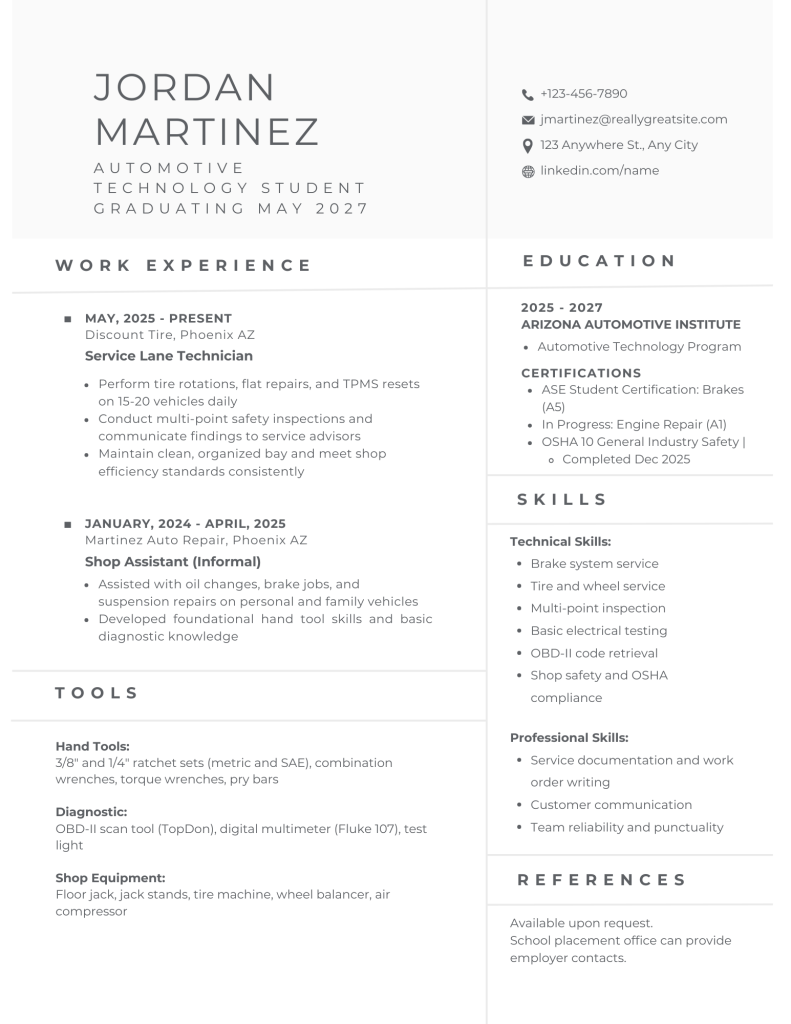
Your technical education and any certifications (ASE, OEM, manufacturer-specific) go near the top. Include the program name, school, and graduation date or expected completion. If you have any certifications in progress, list them with an expected date.

Include Relevant Experience – Even If It’s Informal

Worked on your own vehicles? Helped a family member with repairs? Completed school projects that involved real diagnostics or repair work? Include it. Frame it specifically: what you did, what tools you used, what result you achieved.

List Your Tools

Many automotive and diesel shops want to know what you’re coming in with. A brief line noting your current toolset shows you’re serious about the trade and have made an investment.
How to Prepare for a Shop Interview

A shop interview is different from a corporate job interview. It’s often informal, sometimes happening right in the bay, and heavily focused on what you actually know and how you carry yourself.

Research the Shop Before You Go

Know whether it’s a dealership, independent, fleet, or specialty shop. Know what brands or sectors they focus on. Look at their reviews – both customer reviews and any employee reviews you can find. Showing up informed tells the interviewer you’re serious.

Be Ready to Talk Through a Repair

Many shop interviews include a technical question or a walk-through scenario. You don’t need to know everything – but be prepared to think out loud. Walk through your diagnostic process clearly: gather information, identify possibilities, test systematically, confirm the fix. The 3 C’s (Concern, Cause, Correction) are a clean framework to fall back on.

Show Up on Time and Dressed Right

Dress for the position you are applying for. Clean clothes, punctuality, and a firm handshake still matter in a shop interview. You don’t need a suit – but you do need to look like someone who takes the opportunity seriously. Shop-appropriate means clean and professional, not formal.

Questions to Ask the Employer

An interview is not one-sided. The questions you ask an employer reveal as much about you as your answers do – and they help you avoid landing in a shop that’s wrong for your career. Here are seven questions worth asking, and why each one matters:

Question to AskWhy It Matters
What does a typical first-year tech’s schedule look like here?Shows you’re realistic about starting at the bottom and planning ahead.
How are technicians evaluated and how often?Tells you how feedback and advancement actually work in this shop.
What does the tool situation look like for new techs – is there any support?Practical and shows awareness of what the job actually requires.
How would you describe the culture in the shop?Opens the door for them to reveal red flags voluntarily.
What does the path to flat rate or to a lead tech role look like here?Shows ambition and long-term thinking without being pushy.
Why do technicians typically leave this shop?A direct question that good employers answer confidently and bad ones dodge.
Is there support for continuing education or ASE certifications?Shows you’re invested in growing your skills – which good shops want.

Pay attention to how these questions are answered, not just what is said. Hesitation, vague answers, or dismissiveness on questions about culture and retention are worth noting.

Red Flags to Watch for in a Shop

Not every employer in the skilled trades is worth working for. The technician shortage means you have more leverage than you might think – use it. Here are warning signs worth taking seriously:

  • High turnover with no clear explanation. If a shop has had 6 techs in 3 years, find out why before accepting an offer.
  • Vague or evasive answers about pay structure. A legitimate shop can tell you clearly how you’ll be paid and what the path to higher earnings looks like.
  • No answer on training or advancement. Shops that don’t invest in their techs’ growth tend to use them up and move on.
  • Pressure to start immediately without a clear offer. Urgency that skips proper onboarding is a sign of disorganization at best.
  • A shop culture that feels dismissive or hostile in the interview. If they treat you poorly when they’re trying to hire you, it doesn’t improve after you start.

Negotiating Pay and Benefits

Many new techs accept the first number they’re offered because they don’t know it can be negotiable. In most cases, it is – especially when the market has 3 to 7 openings for every graduate.

  • Know the market rate. Research what entry-level techs earn in your sector and region before negotiating. TechForce career path maps include pay progression data by sector.
  • Consider the total package. Base pay, flat rate potential, tool allowances, training reimbursement, health benefits, and paid time off all have real dollar value. A lower base with strong benefits may outperform a higher base without them.
  • Ask about the path, not just the starting point. “What does pay typically look like at 1 year and 3 years for a tech who performs well?” gives you more useful information than haggling over your starting hourly rate.

How TechForce Connects Students to Jobs

TechForce Foundation connects students in technical education directly to employers through the platform’s job board, apprenticeship listings, and employer partner network. With tens of thousands of job locations available and direct relationships with employers who are actively hiring, TechForce is one of the most direct paths from technical school to a skilled career.

Students can also access career readiness tools, resume guidance, and job search support through the platform. Log in to TechForce.org to access the job board and connect with employers in your sector.

The Bottom Line

The technician shortage is real and the demand for skilled techs is at an all-time high. You have more options than you might think coming out of technical school. The goal isn’t to take any job – it’s to find the right shop, negotiate fairly, and start building a career that has real runway.

Prepare for the interview like you’d prepare for a difficult diagnostic. Do your research, know your process, ask the right questions, and trust what you find.

Sources & Further Reading

For more information on the topics covered in this article, we recommend the following resources:

  • U.S. Bureau of Labor Statistics (BLS) Occupational Outlook Handbook: bls.gov – job outlook, median wages, and hiring data for automotive technicians, diesel mechanics, and other skilled trade occupations
  • National Institute for Automotive Service Excellence (ASE): ase.com – certification information and professional standards used by employers when evaluating technician candidates
  • Good Jobs Institute: goodjobsinstitute.org – research and criteria for evaluating employer quality, job stability, and workplace culture

More Than Wrenches: Communication Skills Every Tech Needs

Technical skill gets you in the door. Communication skill keeps you there and moves you up. Here’s how to develop both.

Why Communication Skills Matter in a Technical Career

Ask any shop foreman or service manager what separates a good tech from a great one, and communication comes up almost every time. The ability to explain a complex repair in plain language, write a clear work order, ask the right question without seeming clueless, and handle a frustrated customer professionally – these are skills that directly affect your career trajectory.

Technical competency gets you hired. Communication skills determine how fast you advance, how much trust you earn, and how long customers keep coming back to your bay.

Talking to Customers: The Basics

Most new techs dread customer interactions, especially early in their career when they’re still building confidence in their technical knowledge. But effective customer communication isn’t about knowing everything – it’s about being clear, honest, and respectful.

Lead with What You Know, Not What You Don’t

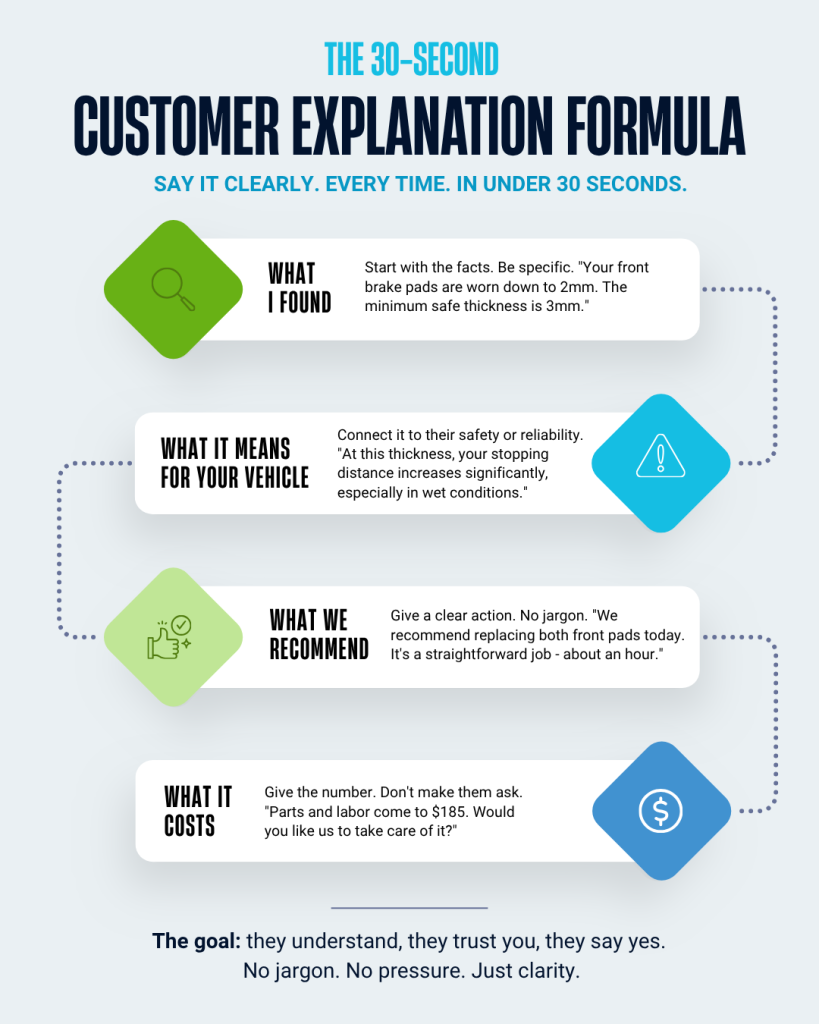
Instead of starting with uncertainty, lead with what you’ve confirmed. “I’ve checked the brakes and found the front pads are at 2mm – they need to be replaced” is more reassuring than “I’m not sure, but I think the brakes might be a problem.”

Translate Tech Talk into Plain Language

Customers don’t know what a camshaft position sensor is – and they don’t need to. What they need to know is what it affects, what happens if it’s not fixed, and what it costs. Practice giving 30-second plain-language explanations of common repairs. It’s a skill that builds fast with repetition.

Handle Difficult Customers with a Simple Formula

When a customer is upset, use this three-step approach: acknowledge their frustration without arguing, explain what you know factually, and offer a clear next step. You don’t have to accept abuse, but staying calm and factual almost always de-escalates the situation faster than matching their energy.

Communicating with Service Advisors

Your relationship with the service advisor is one of the most important in the shop. They’re the link between you and the customer – and if that communication breaks down, everyone loses.

  • Be specific, not vague. “The noise is a metallic grinding from the front left wheel while braking above 30 mph” is useful. “It makes a noise sometimes” is not.
  • Flag problems early. If a job is going to take longer than estimated or you’ve found an additional concern, tell the advisor before the customer calls asking about their car.
  • Document everything. If you told the advisor something verbally, note it in the system too. Paper trails protect you and the shop.
  • Ask about customer preferences. Some customers want every detail. Others just want it fixed and a total. Advisors usually know which is which – use that information.

How to Ask Questions Without Seeming Inexperienced

This is one of the most common concerns for new techs and trade students – and it’s worth addressing directly. Asking questions is not a sign of weakness. Not asking questions is how expensive mistakes happen.

The key is how you ask, not whether you ask. There’s a big difference between “I have no idea what I’m doing” and a well-framed question that shows you’ve already done some thinking.

Instead of…Try saying…
“I don’t know how to do this.”“I haven’t run into this exact issue before – can you point me toward where I should start?”
“What does this mean?”“I’m seeing this code and I’ve checked X and Y. Does that match what you’d expect?”
“Is this right?”“I completed the repair and torqued to spec. Would you mind doing a quick check before I button it up?”
“I messed this up.”“I ran into a problem on this job and want to flag it before going further. Here’s what happened.”

Notice the pattern: each “try saying” version shows that you’ve already thought about the problem, taken some action, or are being proactive. That framing changes how the question lands completely.

Written Communication: Work Orders and Documentation

In a professional shop, if it isn’t written down, it didn’t happen. Work orders, inspection sheets, and digital documentation are legal and financial records – and they reflect directly on your professionalism.

What Makes a Good Work Order Entry

A clear work order entry answers four questions: What was the complaint? What did you find? What did you do? What should the customer know? It doesn’t need to be long – it needs to be accurate, specific, and legible.

Handwriting Still Matters in the Trades

Many shops still use paper inspection forms, service tickets, and parts requests – especially smaller independents and fleet operations. Illegible handwriting creates real problems: wrong parts ordered, missed services, miscommunication with advisors and customers.

If your handwriting is hard to read, it’s worth practicing. Write clearly, print if cursive is messy, and slow down on key numbers like part numbers, VINs, and labor times. One misread digit on a parts order costs everyone time and money.

Written Communication Beyond the Bay

As you advance in your career, written communication expands: emails to customers, digital inspection reports with photos, text updates on vehicle status, and eventually team communication if you move into a lead or management role. Building clean, professional writing habits early pays off for years.

Reading Service Requests and Technical Documentation

A significant part of shop communication runs in the other direction – from the written page to you. Technical service bulletins, factory repair procedures, work orders from advisors, and inspection checklists all require careful reading.

Skimming is a habit that causes errors in technical work. Develop the discipline to read work orders completely before starting a job. Verify the complaint, confirm the vehicle, check for any flags or customer notes. Two minutes of careful reading at the start of a job prevents hours of rework.

TechForce Communication Resources

TechForce Foundation’s platform includes life skills trainings covering professional communication, customer service fundamentals, and workplace communication – all student-ranked and available to students in technical education at no cost.

Developing good communications skills early is one of the best investments you can make in your professional future. Visit TechForce.org to access training resources.

The Bottom Line

Every skill in this article can be learned. None of it requires a specific personality type or natural talent for talking to people. It requires practice, awareness, and the willingness to get a little uncomfortable in order to get better.

The techs who advance fastest in the skilled trades are not always the most technically gifted. They’re the ones who can fix the car and explain it clearly, document it accurately, and make the customer feel heard. That combination is hard to beat.

Sources & Further Reading

For more information on the topics covered in this article, we recommend the following resources:

  • National Institute for Automotive Service Excellence (ASE): ase.com – professional standards and certification pathways for automotive and diesel technicians
  • I-CAR (Inter-Industry Conference on Auto Collision Repair): i-car.com – technical training and communication standards for collision repair professionals

Toastmasters International: toastmasters.org – free and low-cost resources for building professional communication and public speaking skills

Making Time Work for You: Time Management for Trade Students

Balancing school, work, and life in a technical program isn’t easy. These strategies are built for the reality of a student in the skilled trades.

Why Is Time Management So Hard for Trade Students?

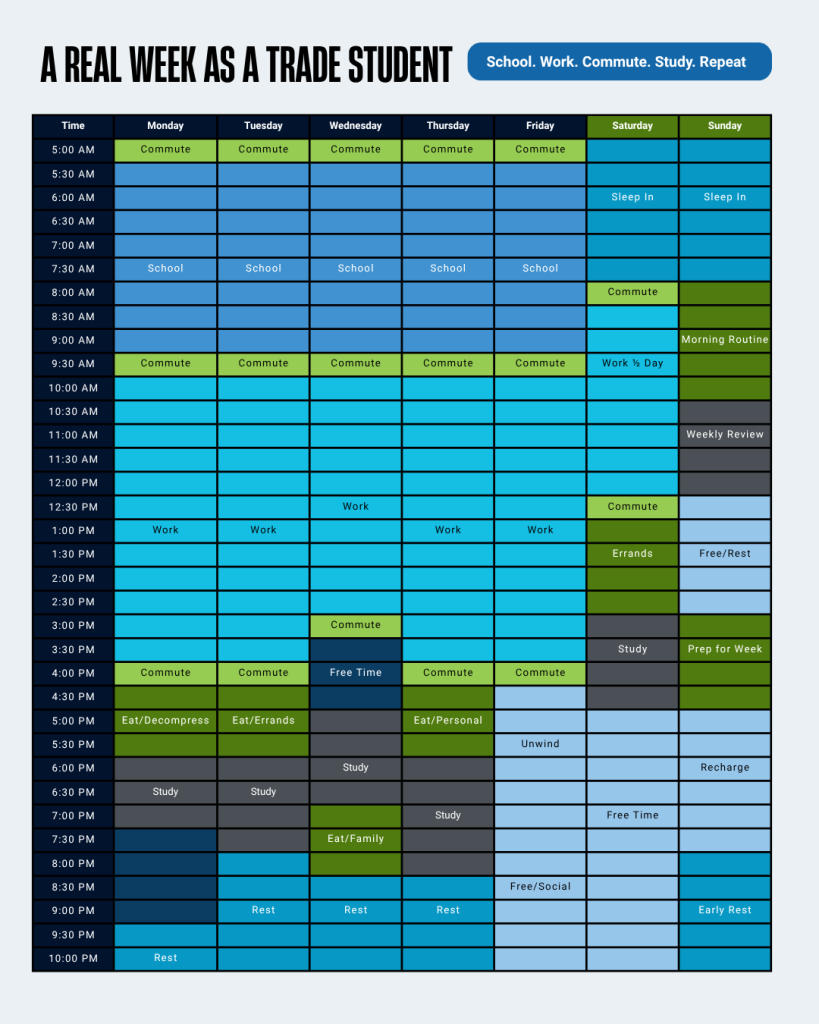
Most time management advice is written for people with a fairly predictable schedule. Trade students rarely have that luxury. A typical week might look like: class in the morning, a part-time job in the afternoon, a long commute in between, family obligations in the evening, and studying squeezed in wherever it fits.

Nearly every TechForce student entry about daily life mentions some version of this. Waking up at 5 a.m. Going to school at 6. Starting work at 9. Not getting home until 7 p.m. It’s a real load – and it requires real strategy, not generic productivity tips.

The good news is that time management is a skill, just like technical diagnostics. It can be learned, practiced, and improved. Here’s how to build it.

“I wake up at 5 a.m., go to school at 6, start work at 9, and don’t get home until around 7 p.m.” – TechForce student, describing a schedule that is far more common than most people realize.

The Foundation: Know Where Your Time Actually Goes

Before you can manage your time better, you need an honest picture of where it’s going now. For one week, track how you spend each hour. Not how you think you spend it – how you actually spend it.

Most people are surprised by two things: how much time disappears into their phone without producing anything, and how much time is lost to transitions – commuting, waiting, getting started on things. Both of those are recoverable time once you see them.

Prioritization: The Most Important Skill You’re Not Teaching Yourself

Not all tasks are equal, and treating them as if they are is one of the fastest ways to feel constantly busy while falling behind on the things that matter. The Eisenhower Matrix is a simple framework that trade students and working techs can use to sort what actually deserves your time:

URGENT + IMPORTANTDo it now.Failing a class, a car needed for work breaking down, a missed shiftNOT URGENT + IMPORTANTSchedule it.Studying for an upcoming test, saving for tools, health appointmentsURGENT + NOT IMPORTANTDelegate or limit it.Most texts and social notifications, minor favors others ask of youNOT URGENT + NOT IMPORTANTCut it or do it last.Endless scrolling, TV reruns, low-value time fillers

Most stress comes from spending too much time in the bottom two quadrants – urgent but unimportant tasks, or neither urgent nor important – while the important-but-not-yet-urgent things (studying, savings, health) quietly become crises.

Each week, look at your task list and ask: which of these is genuinely urgent AND important? Start there. Everything else gets scheduled, delegated, or cut.

Study Strategies That Actually Work for Technical Students

Studying for a technical program is different from studying for a traditional academic course. You’re learning hands-on skills alongside technical theory, and cramming doesn’t work well for either.

Study in Short Blocks, Not Long Sessions

45 to 60 minute focused sessions with a short break outperform 3-hour marathon study blocks almost every time. Your brain consolidates information during rest. Use the commute or lunch break for quick review rather than saving everything for one long night.

Connect Theory to What You Did That Day

After every shop session, spend 10 minutes writing down what you worked on and what the theory behind it was. This active recall locks in the learning far more effectively than re-reading your notes.

Use Your Commute

Long commutes are a significant time drain for many trade students – but they’re also recoverable time. Audio content (podcasts about the trade, recorded notes, technical explanations) can turn a 45-minute drive into productive review. Some students even record their own notes and listen back.

Balancing Work, School, and Life

The honest truth is that something usually has to give when you’re working and going to school at the same time. The goal isn’t perfect balance – it’s intentional trade-offs that protect your highest priorities.

  • Define your non-negotiables. What absolutely cannot slip? For most trade students it’s: showing up to school, showing up to work, and keeping commitments to family. Everything else is negotiable.
  • Communicate with your employer. If your school schedule changes or a major assessment is coming up, most employers in the skilled trades will work with students who communicate proactively rather than just calling out.
  • Protect at least one full rest day per week. Running at 100% capacity 7 days a week isn’t sustainable. One genuine recovery day per week extends how long you can keep going at high intensity.
  • Batch similar tasks together. Errands, emails, and admin tasks take less mental energy when grouped. Switching between a technical task and an administrative one costs more time than people realize.

Managing Long Commutes

Long commutes are one of the most common time challenges TechForce students mention. If your commute is more than 30 minutes each way, here are ways to make it work for you rather than against you:

  • Use audio content for passive review of technical material
  • Make phone calls for personal or family communication during drive time to protect evenings
  • If you take public transit, use it for active study or planning your next day
  • If commute time is genuinely unsustainable, explore whether your school or employer offers any flexibility in schedule or location
  • TechForce’s Wraparound Services include transportation support resources for students facing significant commute barriers

A Simple Weekly Planning System

You don’t need an elaborate system. You need a consistent one. Here’s a bare-minimum approach that works for busy trade students:

  • Sunday evening (15 minutes): Look at the week ahead. Identify the 3 most important things that must happen. Block time for them first.
  • Each morning (5 minutes): Confirm your top 3 for the day. Know your schedule before the day starts.
  • Each evening (5 minutes): Note what got done, what got moved, and what tomorrow looks like. This 5-minute debrief prevents things from falling through the cracks.

That’s 25 minutes a week of planning that replaces hours of reactive scrambling. It’s one of the highest-return habits a trade student can build.

TechForce Resources to Help You Manage the Load

TechForce Foundation’s platform includes more than 350 life skills trainings available to students in technical education – many of them focused on exactly the challenges covered in this article. Time management, financial literacy, communication skills, and career readiness are all available and student-ranked.

If the load feels unmanageable because of financial pressure, transportation barriers, or family obligations, TechForce’s Wraparound Services can connect you to resources that address the root causes – not just the symptoms. Visit TechForce.org to access your support network.

The Bottom Line

Time is the one resource you can’t get more of. The trade students who make it through technical school while working and managing real life aren’t superhuman – they’re strategic. They know their priorities, protect their time deliberately, and build systems that work with their actual schedule, not an ideal one.

Start small. Pick one strategy from this article and use it this week. That’s how the habit gets built.

Sources & Further Reading

For more information on the topics covered in this article, we recommend the following resources:

  • American Psychological Association (APA): apa.org – research on cognitive load, study strategies, and effective learning for skill-based training
  • National Career Development Association (NCDA):ncda.org – career readiness, work-life balance resources, and professional development guidance

Money in the Shop: Financial Literacy for Automotive and Trade Students

Learning to manage money on an apprentice wage is one of the most important skills you’ll develop in a technical career. Here’s where to start.

Focused young African American woman in eyeglasses looking through paper documents, managing business affairs, summarizing taxes, planning future investments, accounting alone at home office.

Why Financial Literacy Matters in a Skilled Career

One of the most common challenges students in technical education face has nothing to do with diagnostics or shop skills. It’s money. Covering rent, tuition, food, and tools on an apprentice or entry-level wage while going to school is genuinely hard – and most trade programs don’t teach you how to manage it.

Financial stress is one of the leading reasons students leave technical school before finishing. Getting your finances under control isn’t just a life skill. It’s a career survival skill.

This article covers the basics: how to budget on a tight income, how to understand your pay structure, how to build credit, how to manage debt, and how to save for tools without falling behind on bills.

“I have to work to cover rent, tuition, food for myself, my girlfriend, and our 1-year-old son.” – TechForce student, describing the financial reality many trade students navigate daily.

Understanding Your Pay: Flat Rate vs. Hourly

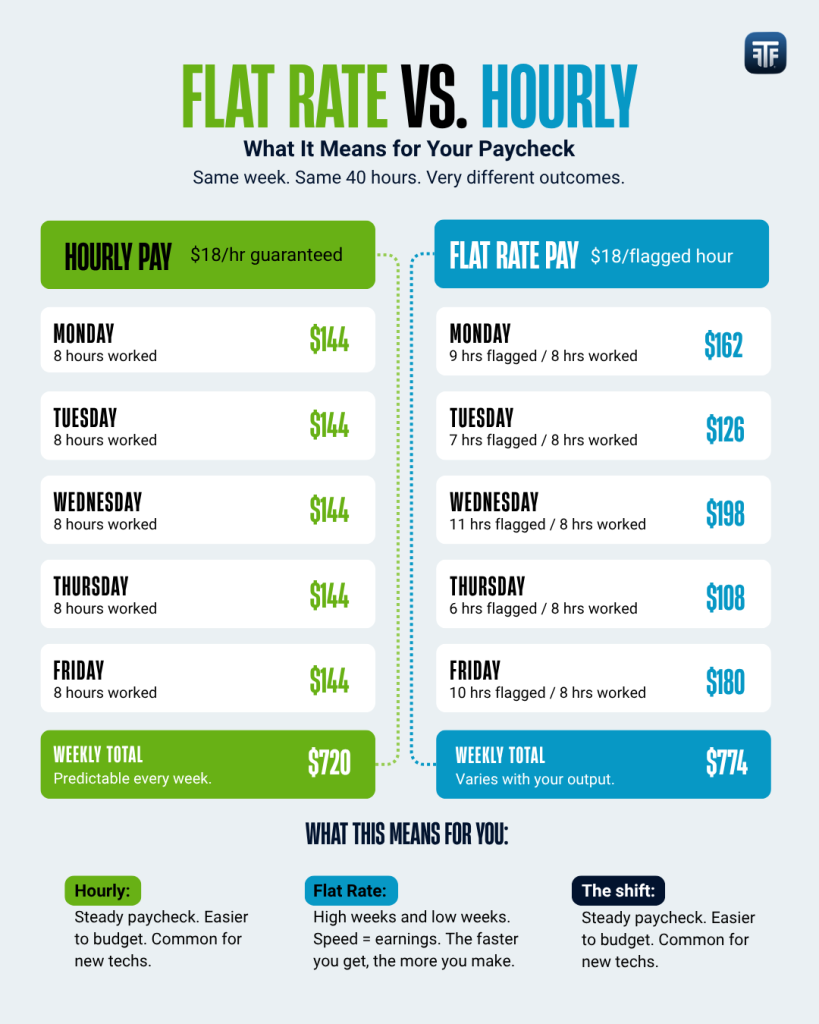
Before you can budget, you need to understand how you get paid. In the automotive and diesel industries, there are two main pay structures – and knowing the difference matters a lot for your financial planning.

Hourly Pay

You get paid for every hour you’re at work, regardless of how many jobs you complete. This is more common for apprentices and entry-level techs. It’s predictable, which makes budgeting easier – but the ceiling is lower.

Flat Rate Pay

You get paid per job based on a standard time estimate, not the actual time it takes. If a job is flagged at 2 hours and you finish it in 1.5, you still get paid for 2. If it takes you 3 hours, you still only get 2. Experienced techs can earn significantly more on flat rate. Newer techs often earn less until their speed improves.

When you’re starting out, flat rate can feel like a penalty for being new. It’s not – it’s an incentive system. The faster and more accurate you get, the more you earn. Budget conservatively when you’re new to flat rate and adjust as your efficiency improves.

How to Budget on an Apprentice Salary

Budgeting on a tight income isn’t about cutting everything fun. It’s about making intentional choices so the important things are covered. Entry-level and apprentice tech pay typically ranges from $14 to $22 per hour depending on your sector, region, and shop type – that works out to roughly $2,200 to $3,400 per month take-home for a full-time schedule. Here’s a starting framework based on $2,500 per month take-home, which is a reasonable mid-range estimate for an apprentice or first-year tech:

Category% of Take-HomeEst. on $2,500/mo
Housing (rent/utilities)30-35%$750-$875
Food & groceries10-15%$250-$375
Transportation10-15%$250-$375
Tuition/school costs10-15%$250-$375
Tools (savings fund)5-10%$125-$250
Personal/miscellaneous5-10%$125-$250
Emergency savings5%$125

These are starting points, not rules. Your actual take-home will vary based on your hourly rate, whether you’re on flat rate, the hours available at your shop, and whether you’re also working part-time while in school. The goal is to know where every dollar is going before it leaves your account – regardless of the exact number.

Saving for Tools While Paying Bills

Tools are one of the biggest financial challenges for new techs. A basic starter set can run anywhere from a few hundred to several thousand dollars, and shops often expect you to show up with your own. Here’s how to build your toolbox without wrecking your budget:

  • Start with the essentials only. You don’t need a full rollaway on day one. Research the top tools your specific sector requires and build from there. 
  • Use a dedicated tools fund. Even $50 a month set aside adds up to $600 in a year. Treat it like a bill you pay yourself first.
  • Buy used strategically. Used hand tools from reputable brands often outlast cheap new ones. Avoid used diagnostic equipment unless you can verify it works.
  • Look into tool financing carefully. Snap-on and Matco offer payment plans, but interest adds up fast on small paychecks. Know the total cost before you sign.
  • Ask about tool scholarships. TechForce partners with tool companies to provide tool vouchers and giveaways for students and working techs who qualify. Check TechForce.org for current opportunities.

Managing Student Loans and Tuition Debt

If you took out loans for technical school, understanding your repayment options before you graduate saves you money and stress. A few key things to know:

  • Federal student loans have income-driven repayment options that cap your monthly payment based on what you earn
  • Grace periods (usually 6 months after graduation) give you time to get employed before payments start
  • Defaulting on student loans damages your credit and can affect your ability to get financing for tools, vehicles, or housing
  • Some employers in the skilled trades offer tuition reimbursement or loan assistance as a benefit – ask about this during job interviews

If your debt feels unmanageable, contact your loan servicer before you miss a payment. There are deferment and forbearance options available, but you have to ask for them.

Building Credit and Financial Foundations

A strong credit score opens doors: better rates on vehicle loans, easier approval for housing, access to financing when you need it. Here’s how to build credit from scratch or rebuild it after a rough patch:

  • Get a secured credit card. Put a small recurring charge on it (like a streaming service) and pay it off in full every month. This builds a positive payment history with no risk of overspending.
  • Never miss a payment. Payment history is the single biggest factor in your credit score. Set up autopay for at least the minimum on every account.
  • Keep utilization low. Try to use less than 30% of your available credit limit at any time. High utilization tanks your score even if you pay on time.
  • Check your credit report annually. You’re entitled to a free report at annualcreditreport.com. Errors are common and can drag your score down without you knowing.

Financial Support Available Through TechForce

You don’t have to figure all of this out alone. TechForce Foundation offers financial support specifically for students in automotive, diesel, aviation, and other technical careers:

  • Scholarships for automotive students and technical school scholarships to reduce tuition debt
  • Emergency grants for unexpected financial hardship that threatens your ability to stay in school
  • Tool vouchers and tool grants through partnerships with leading tool brands
  • Housing and transportation resources for students facing housing instability or transportation barriers
  • Financial literacy trainings available through the TechForce platform, student-ranked and free to access

Visit TechForce.org to see what support is currently available to you.

The Bottom Line

Financial literacy is a technical skill, same as reading a wiring diagram or running a diagnostic. You can learn it, you can get better at it, and the earlier you start, the bigger the payoff. Managing your money well on a tight income now builds the habits that create real financial stability over a long career in the skilled trades.

The automotive technician shortage means the demand for what you’re training to do is at an all-time high. Three to seven job openings exist for every graduate in multiple sectors. The earning potential is real. Build the financial foundation to take full advantage of it.

Sources & Further Reading

For more information on the topics covered in this article, we recommend the following resources:

  • U.S. Bureau of Labor Statistics (BLS): bls.gov – wage data for automotive technicians, diesel mechanics, and other skilled trade occupations
  • Consumer Financial Protection Bureau (CFPB): consumerfinance.gov – free tools and guides for budgeting, building credit, and managing debt
  • AnnualCreditReport.com: annualcreditreport.com – free annual credit reports from all three major bureaus
  • Federal Student Aid (FAFSA): studentaid.gov – federal student loan information, repayment options, and income-driven repayment plans

Please share your contact details and a TechForce team member will contact you.


"By connecting students, instructors, industry pros and working techs, the TechForce Foundation provides unilateral support to the transportation industry’s technician recruiting needs… The administration of our Scholarships by the TechForce team has been instrumental in delivering us with a successful method to gain interest from qualified candidates as well as provide our students with additional assistance to complete their education."
Tony Farr
Ford Technical Programs Manager