Never Stop Learning: A Guide to Continuing Education for Skilled Trade Technicians

The techs who keep learning are the techs who keep advancing. Here’s a complete guide to ASE certifications, OEM training programs, industry credentials, and free resources available to you right now.

Why Continuing Education Matters in the Skilled Trades

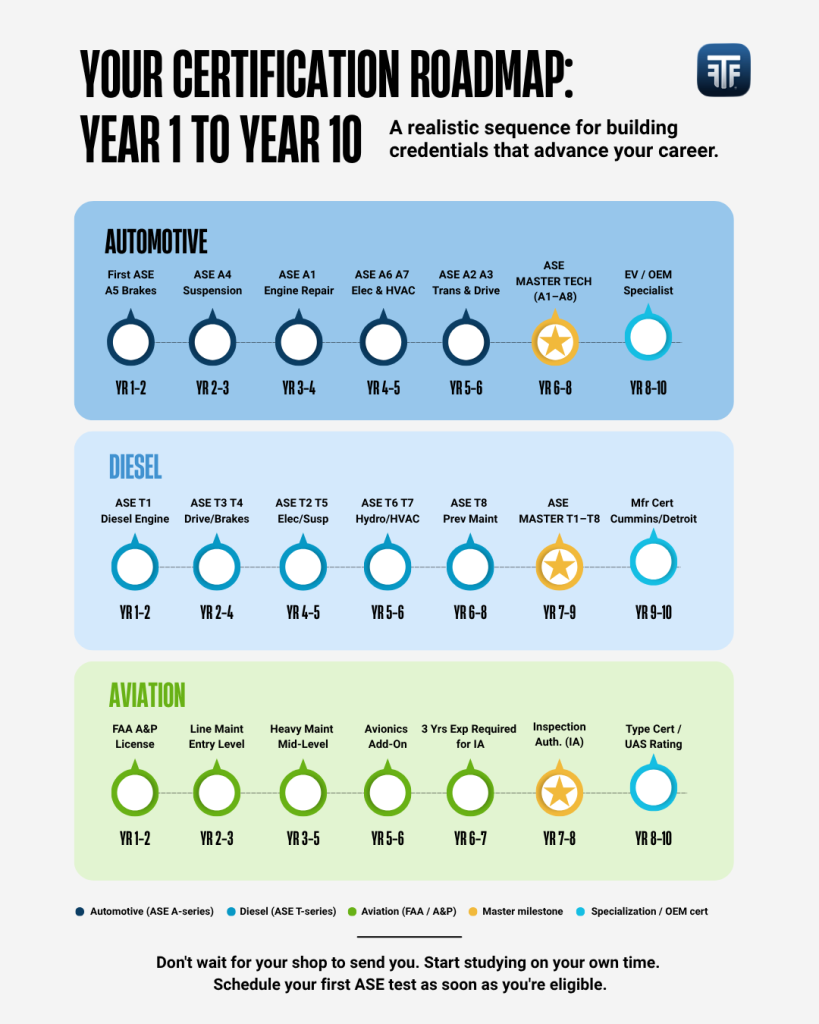
Graduating from technical school is the beginning of your education, not the end of it. The skilled trades are evolving faster than at any point in their history – new vehicle platforms, new diagnostic systems, new materials, new regulations. The technicians who keep pace with that change through ongoing training and certification are the ones who advance, earn more, and stay employed in the roles they want.

Continuing education in the skilled trades takes several forms: industry certifications like ASE, OEM-specific training programs from manufacturers, sector certifications like I-CAR or NATE, and the informal but equally important daily learning that comes from service information, peer knowledge, and platform resources like TechForce’s training library.

This article covers the most important certifications and programs across automotive, diesel, aviation, collision, HVAC, and welding – and how to build a continuing education plan that moves your career forward.

Certifications are the clearest signal to any employer that you have invested in your own growth. In the skilled trades, they also directly affect what you get paid and what work you’re trusted to do.

How to Think About Certifications Strategically

Not every certification is equally valuable at every stage of your career. Here’s how to prioritize:

  • Start with the foundational credential in your sector. For automotive and diesel techs, that’s ASE. For aviation, it’s the FAA A&P license. For HVAC, it’s EPA 608. For collision, it’s I-CAR. For welding, it’s AWS D1.1. These are the baseline requirements – pursue them as early as you’re eligible.
  • Layer in OEM training after your foundation is established. Manufacturer certifications increase your value at specific dealers or with specific makes – but they build on a solid general foundation, not instead of one.
  • Target your specialization. Once you know what area of your trade you want to go deep in, identify the certification that signals that expertise and pursue it deliberately. EV specialist, pipeline welder, ADAS calibration tech – specializations command pay premiums.
  • Ask your employer to invest in your training. Many shops pay for testing fees, study materials, and time off to test. If yours doesn’t have a formal policy, ask directly. The worst answer is no – and many employers say yes to techs who demonstrate initiative.
  • Check with local unions. Unions offer training multiple times throughout the year. 

Certifications and Programs by Sector

The table below covers the most recognized certifications and training programs across six major skilled trade sectors. Use it as a planning reference for your continuing education roadmap.

CertificationWhat It Covers and Why It Matters
ASE CERTIFICATIONS  |  Automotive & Diesel
ASE A1-A8Automotive Master Technician series covering Engine Repair, Automatic Transmission, Manual Drivetrain, Suspension & Steering, Brakes, Electrical, HVAC, and Engine Performance. Passing all 8 earns Master Technician status.
ASE A9Light Vehicle Diesel Engines – for techs working on light trucks with diesel powerplants.
ASE T1-T8Medium/Heavy Truck series – the diesel equivalent of the A-series. Covers all major systems on Class 4-8 vehicles.
ASE L1 & L2Advanced Engine Performance Specialist and Diesel Advanced Specialist. Prerequisites require existing A or T certifications – these are senior-level credentials.
ASE C1Service Consultant certification – valuable for techs moving into advisor or management roles.
ASE B2-B6Collision Repair series covering Painting & Refinishing, Non-Structural Analysis, Structural Analysis, Mechanical & Electrical, and Damage Analysis & Estimating.
ASE F1Exhaust Systems – relevant to techs working in emissions repair and specialty exhaust.
OEM & MANUFACTURER TRAINING PROGRAMS  |  Automotive
Ford FACT / Ford PROFord’s Automotive Career Technology program – offered through community colleges and technical schools with Ford partnerships. Structured curriculum with OEM certification levels.
GM ASEPGeneral Motors Automotive Service Educational Program – similar structured school-to-dealer pathway with tiered GM certifications.
Toyota T-TEN / TTCToyota Technical Education Network and Toyota Technical Center – widely regarded as one of the strongest OEM training programs in the industry.
Stellantis CAPChrysler/Dodge/Jeep/Ram Automotive Program – structured training with Stellantis dealer placement.
Honda PACTProfessional Automotive Career Training – Honda’s school partnership program with tiered dealer-level certification.
Hyundai/Kia HMTHyundai Motor Tech program offered through partner schools and continuing education for working technicians.
EV & Hybrid Specialist (OEM)Most major OEMs now offer EV-specific certification tracks for working technicians. Ford EV, GM Ultium, Toyota Hybrid, and Tesla’s own certification program are among the most recognized.
AVIATION CERTIFICATIONS  |  FAA & Industry
FAA A&P LicenseAirframe and Powerplant – the foundational federal license required to work as an aviation mechanic. Earned through an FAA-approved school or 30 months of documented work experience.
FAA Inspection Authorization (IA)Advanced credential allowing the holder to inspect and approve major repairs and alterations. Requires an active A&P plus 3 years of practical experience.
FAA UAS Remote Pilot CertificateFor techs entering the drone/unmanned aircraft sector. Growing demand in commercial inspection, agriculture, and logistics.
COLLISION REPAIR  |  I-CAR & OEM
I-CAR Gold ClassThe collision industry’s most recognized quality standard. Requires ongoing annual training for all roles in a certified shop. Individual Platinum status is the highest I-CAR credential for technicians.
I-CAR Welding CertificationValidates welding competency to OEM standards – required by many insurers and OEM certification programs.
OEM Collision CertificationsTesla, Rivian, BMW, Mercedes, and others operate proprietary collision certification programs that restrict which shops can perform structural repairs on their vehicles. High value, limited supply.
HVAC CERTIFICATIONS  |  EPA, NATE & Industry
EPA Section 608Federal certification required by law to purchase and handle refrigerants. Four types: Type I (small appliances), Type II (high-pressure), Type III (low-pressure), Universal (all). Universal certification is the standard for most HVAC techs.
NATE CertificationNorth American Technician Excellence – the HVAC industry’s most widely recognized third-party certification. Covers installation, service, and senior technician levels across multiple HVAC specialty areas.
ACCA Quality Assured ContractorCompany-level designation, but individual techs benefit from working in ACCA-certified shops that maintain training standards.
Building Automation & Controls (BAS)Certifications from Honeywell, Johnson Controls, Siemens, and others for smart building system integration – a growing specialty in commercial HVAC.
WELDING CERTIFICATIONS  |  AWS & ASME
AWS D1.1 Structural WeldingAmerican Welding Society structural welding certification – the foundational credential for structural steel work in construction and manufacturing.
API 1104 Pipeline WeldingRequired for pipeline and energy sector welding. One of the highest-paying welding specializations. Strict testing and recertification requirements.
ASME Section IXPressure vessel and boiler welding certification – required in power generation, chemical processing, and industrial manufacturing.
AWS Certified Welding Inspector (CWI)Senior credential for welders moving into quality assurance and inspection roles. Requires documented work experience and a comprehensive exam.
AWS Certified Welding Educator (CWE)For experienced welders transitioning into training and instruction roles.

How to Prepare for ASE Certifications

ASE tests are challenging. Pass rates vary by test, but many hover around 60 to 70 percent for first-time test takers – which means preparation matters significantly. Here’s how to approach it:

  • Study the task list, not just the content. ASE publishes a task list for every certification that outlines exactly what is covered and how heavily each area is weighted. This is your study roadmap. Find it at ase.com before you open a single study guide.
  • Use purpose-built study materials. ASE study guides, Delmar’s test prep books, and online practice test platforms like Pocket Prep are purpose-built for ASE preparation. Generic automotive textbooks cover similar content but aren’t structured around the test format.
  • Test with experience behind you. ASE recommends at least two years of hands-on experience before testing for most certifications. That recommendation exists because test questions are scenario-based and require practical context to answer correctly. Studying without shop experience is significantly harder.
  • Schedule your test strategically. ASE tests are offered in two windows per year. Schedule when you have time to prepare properly, not just when it’s convenient. A failed test requires a waiting period and a retesting fee.
  • Retake without shame. Many strong technicians fail their first ASE attempt. The test is comprehensive and the format takes getting used to. A fail is information – it tells you exactly which areas need more work.

Building a Personal Continuing Education Plan

A continuing education plan doesn’t need to be elaborate. It needs to be written down and revisited regularly. Here’s a simple framework:

  • Identify your next certification target. Be specific: not ‘I want to get certified’ but ‘I am taking the ASE A6 Electrical test in the spring window.’ A specific goal with a deadline is the difference between planning and wishing.
  • Set a weekly study commitment. Even 30 minutes three times a week adds up to over 75 hours of study in six months. Consistency beats intensity for retention of technical content.
  • Track what you complete. A simple log of courses completed, tests taken, and certifications earned is useful for resume updates, performance reviews, and your own sense of progress.
  • Review and update annually. At least once a year, look at where your sector is heading and ask whether your certification roadmap still reflects the skills that will be in demand. Adjust accordingly.

Financial Support for Continuing Education

The cost of certifications, testing fees, and study materials adds up – and for students on an apprentice wage, it can feel like a barrier. A few resources worth knowing:

  • Employer reimbursement is available at many shops that invest in technician development. 
  • ASE’s own resources include information on available scholarships, reduced testing fees for students, and study material discounts. Check ase.com for current offerings.

The Bottom Line

A career in the skilled trades is not a static thing. The vehicle, equipment, and systems you will work on in year 10 of your career will be significantly different from what you work on today. The technicians who treat continuing education as a career-long habit rather than a one-time credential are the ones who stay relevant, stay employable, and keep advancing.

Pick your next certification. Set a study schedule. Use the resources available to you through TechForce, your employer, and the industry. Then do it again.

Sources & Further Reading

For more information on the topics covered in this article, we recommend the following resources:

  • National Institute for Automotive Service Excellence (ASE): ase.com – full certification catalog, task lists, testing schedules, and study resources for automotive and diesel technicians
  • Federal Aviation Administration (FAA): faa.gov – A&P licensing requirements, Inspection Authorization, and UAS certification information
  • I-CAR (Inter-Industry Conference on Auto Collision Repair): i-car.com – Gold Class, Platinum individual certification, welding certification, and OEM collision training programs
  • NATE (North American Technician Excellence): natex.org – HVAC technician certification catalog, testing locations, and continuing education requirements
  • American Welding Society (AWS): aws.org – structural, pipeline, and inspector certification programs, testing procedures, and welding education resources
  • EPA Section 608 Certification: epa.gov – refrigerant handling certification requirements and approved testing organizations

Think Before You Replace: Building Strong Diagnostic Skills as a New Tech

Diagnostic ability is what separates a parts-changer from a technician. Here’s how to build a systematic approach to diagnosis that gets it right the first time.

What Is Diagnostic Skill and Why Does It Matter?

Technical education teaches you how systems work. Diagnostic skill is knowing what to do when they stop working – and that is a fundamentally different capability. It requires logical thinking, patience, familiarity with service information, and the discipline to follow a process rather than guess.

In the flat rate world, diagnostic ability directly affects your income. A tech who diagnoses accurately on the first attempt gets paid once and moves on. A tech who replaces parts based on guesswork spends unpaid time on comebacks, burns the shop’s money on unnecessary parts, and erodes the customer’s trust. Strong diagnostic skill is one of the highest-value things a technician can develop.

This article covers the foundational diagnostic process used by experienced technicians, the most common mistakes new techs make, and how to build the habit of thinking before reaching for a part.

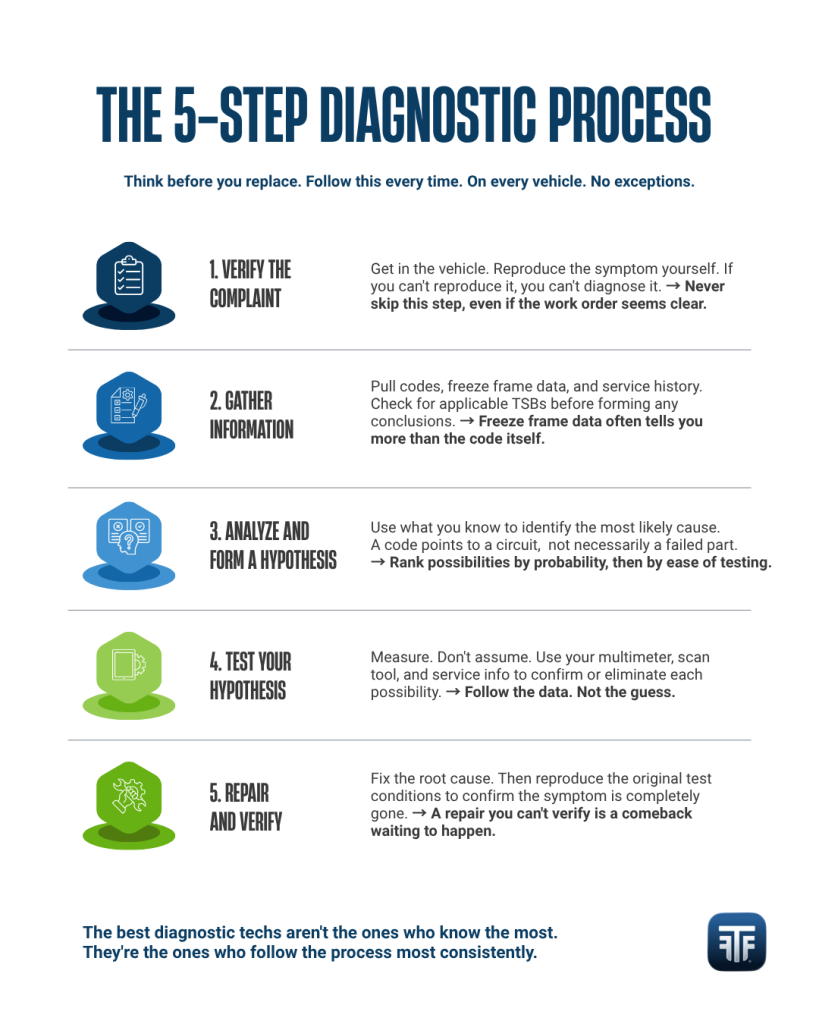
The best diagnostic techs aren’t the ones who know the most. They’re the ones who follow the process most consistently – every time, on every vehicle, no matter how confident they feel going in.

The Diagnostic Process: A Framework That Works

Experienced technicians across every sector of the skilled trades follow some version of this process, whether they call it that or not. Learning it early and applying it consistently is one of the fastest ways to build genuine diagnostic competency.

Step 1: Verify the Complaint

Before touching the vehicle, understand exactly what the customer is experiencing. Read the work order carefully. Ask the service advisor clarifying questions if needed. Then get in the vehicle and try to reproduce the symptom yourself.

A complaint you cannot reproduce is a complaint you cannot diagnose. And a complaint you reproduce under different conditions than the customer described may point to a completely different cause. Never skip this step.

Step 2: Gather Information

Once the complaint is verified, gather information before forming any conclusions. This means pulling codes and freeze frame data with your scan tool, reviewing the vehicle’s service history, checking for any applicable Technical Service Bulletins (TSBs), and noting any relevant symptoms beyond the primary complaint.

Freeze frame data tells you what the vehicle’s operating conditions were when a fault was recorded – engine load, RPM, temperature, fuel trim. This context is often more useful than the code itself in pointing toward the root cause.

Step 3: Analyze and Form a Hypothesis

With the information gathered, analyze what you know and identify the most likely cause or causes. This is where knowledge of how systems interact matters. A code points to a circuit or system – not necessarily to a failed component. Ask: what could cause this symptom in this system under these conditions?

Rank your hypotheses by probability and by how easy each one is to test. Start with the most likely and most accessible first.

Step 4: Test Your Hypothesis

Testing means measuring, not assuming. Use your multimeter to verify voltage, ground, and resistance. Use your scan tool’s live data to confirm sensor values against known specifications. Use service information to find the correct test procedure and the correct spec to compare against.

A reading that matches specification eliminates that component. A reading that doesn’t match is your next lead. Follow the data – not the guess.

Step 5: Repair and Verify

Once you’ve confirmed the root cause, perform the repair. Then verify the repair by reproducing the original test conditions and confirming the symptom is gone. Clear codes and perform a drive cycle if needed to confirm no faults return.

Verification is not optional. A repair that cannot be confirmed is a comeback waiting to happen.

The 3 C’s: Concern, Cause, Correction

Most shops use the 3 C’s framework for documenting diagnostic work, and it maps directly onto the process above. Every repair order should tell a complete story using these three elements:

  • Concern: What the customer experienced. Written in plain language that reflects the actual complaint. Example: ‘Customer states vehicle hesitates and bucks under light acceleration above 45 mph.’
  • Cause: What you found through diagnosis. Specific and supported by test results. Example: ‘Found MAF sensor reading 2.1 g/s at idle against spec of 4.0-6.0 g/s. Confirmed with back-probe voltage test. Sensor contaminated.’
  • Correction: What you did to fix it. Parts replaced, procedures performed, torque specs applied. Example: ‘Replaced MAF sensor per OEM procedure. Cleared codes. Road tested 15 miles, no return of symptom or fault codes.’

Clear 3 C’s documentation protects you legally, supports the shop’s warranty claims, and communicates professionally to every person who reads the repair order after you.

The Most Common Diagnostic Mistakes New Techs Make

These five mistakes account for the majority of diagnostic comebacks in shops across every sector. Knowing them in advance is the first step to avoiding them:

MistakeWhat It Looks LikeReal-World Example
Parts cannon approachReplacing parts based on a code without verifying the root causeA P0420 code (catalyst efficiency) gets a new catalytic converter. The actual cause was an upstream O2 sensor giving false data. The code returns immediately.
Skipping the verify stepStarting diagnosis without confirming the customer’s complaint firsthandCustomer says the car stalls at idle. Tech goes straight to code pulling. The actual complaint only occurs when the AC is running – a detail that changes the diagnostic path entirely.
Trusting the code, not the systemAssuming a code points directly to the failed componentA misfire code on cylinder 4 leads to a new ignition coil. The actual cause was a leaking fuel injector – same symptom, different system.
Skipping service informationDiagnosing from memory instead of verifying specsA tech sets base idle without checking the OEM spec. The spec is different from what they remembered from a similar vehicle. The complaint returns.
Not verifying the repairSigning off on a job without confirming the original complaint is resolvedA repair is completed, car goes back to the customer, and the original symptom returns the same day because the root cause had a second contributing factor that wasn’t checked.

Using Service Information Correctly

Service information is the most underused tool in most shops. Every OEM publishes detailed diagnostic procedures, wiring diagrams, component locations, and specification tables for every system on every vehicle they produce. Using it consistently is what separates systematic diagnosis from educated guessing.

  • Alldata and Mitchell 1 are the two most common professional service information platforms used in shops. If your shop subscribes to one, learn it thoroughly – not just how to look up a torque spec, but how to navigate wiring diagrams, identify connector locations, and follow a diagnostic tree.
  • OEM service portals are available directly from manufacturers for most makes. For complex electrical or powertrain diagnosis, OEM information is often more complete than third-party platforms.
  • TSBs (Technical Service Bulletins) are manufacturer-issued notices about known issues and updated repair procedures. Checking for applicable TSBs before diagnosing a complaint can save significant time – many common complaints already have a documented root cause and repair procedure.

Building Diagnostic Skills Over Time

Diagnostic competency is built through deliberate practice, not just exposure. Here’s how to develop it systematically:

  • Follow the process on every car, not just the hard ones. The habit of systematic diagnosis needs to be consistent to be reliable. Skipping steps on ‘easy’ jobs trains you to skip steps on hard ones too.
  • Study the system before diagnosing the symptom. If you’re weak on fuel system diagnosis, spend time with the service information for a fuel system before a fuel complaint lands on your lift. Proactive learning beats reactive scrambling.
  • Debrief your own comebacks honestly. When a repair comes back, resist the instinct to deflect. Walk through where the diagnostic process broke down. That honest review is the fastest path to not repeating the mistake.
  • Watch experienced techs work through difficult diagnosis. Ask questions. Observe the process. The diagnostic thinking of a skilled tech is often invisible in the final repair order – but visible when you watch them work in real time.

Diagnostic Tools Worth Understanding

Strong diagnostic skill requires more than a scan tool. Here’s the core equipment a developing diagnostic tech needs to understand:

  • Digital Multimeter (DMM): The most fundamental diagnostic tool in any shop. Measures voltage, resistance, and current. Essential for electrical diagnosis. Learn to use it properly before relying on any other diagnostic equipment.
  • OBD-II Scan Tool with Live Data: Entry-level code readers are useful but limited. A mid-range scan tool with live data streaming, freeze frame access, and bi-directional controls unlocks a significantly deeper level of diagnosis. TopDon makes strong options at accessible price points.
  • Lab Scope (Oscilloscope): The most powerful electrical diagnostic tool available to a tech. Displays voltage signals over time, allowing diagnosis of intermittent faults, signal quality issues, and component timing that a multimeter cannot capture. Lab scope competency is a significant career differentiator.
  • Fuel Pressure Gauge and Vacuum Gauge: Simple, affordable, and essential for engine diagnosis. Many driveability complaints trace back to fuel delivery or vacuum issues that are confirmed quickly with these analog tools.
  • Infrared Thermometer and Thermal Imager: Used for identifying temperature differentials across catalytic converters, brake components, HVAC systems, and electrical connections. A thermal imager is an advanced tool with a steep price – but an infrared thermometer is inexpensive and useful from day one.

The Bottom Line

Diagnostic skill is the highest-value technical capability a technician can develop. It is also the skill that takes the longest to build – because it requires not just knowledge but judgment, and judgment only comes from experience applied deliberately over time.

Follow the process. Use service information. Test before you replace. Document clearly. Debrief your mistakes. That’s the entire formula. The techs who apply it consistently are the ones shops fight to keep.

Sources & Further Reading

For more information on the topics covered in this article, we recommend the following resources:

  • National Institute for Automotive Service Excellence (ASE): ase.com – certification testing covering diagnostic competency across all automotive and diesel systems
  • Alldata: alldata.com – professional OEM service information, wiring diagrams, and Technical Service Bulletins used by shops nationwide
  • Mitchell 1: mitchell1.com – professional service information platform with diagnostic procedures, labor times, and repair data
  • iATN (International Automotive Technicians Network): iatn.net – professional community of diagnostic technicians sharing real-world case studies and diagnostic strategies

Build Smart, Not Fast: A Tool Buying Guide for New Automotive Techs

You don’t need everything on day one. You need the right things – bought in the right order, at the right price. Here’s how to build a professional toolbox without breaking your budget.

What Tools Does a New Automotive Tech Actually Need?

One of the first financial shocks students in technical education encounter is the tool requirement. Many shops expect you to arrive with your own tools on day one – and if you’ve ever browsed a Snap-on truck, you know the full setup can run tens of thousands of dollars. For a student on an apprentice wage, that number feels impossible.

Here’s the reality: you don’t need a master tech’s toolbox to start working. You need a solid foundation of quality hand tools, a basic scan tool and multimeter, and a plan for building the rest over time. This guide is designed to help you spend money where it counts, avoid the common buying mistakes that waste money, and build a professional toolbox at a pace your budget can handle.

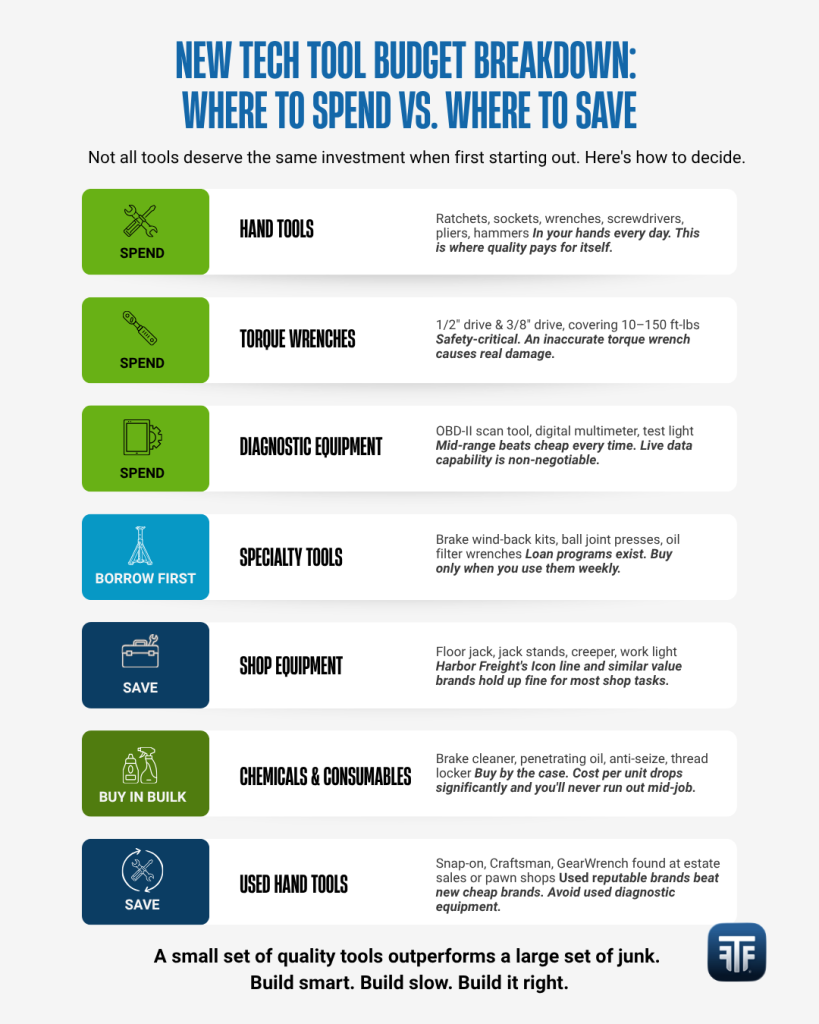
Start with the tools you’ll use every single day. Add the rest when the work demands it. A small set of quality tools outperforms a large set of junk every time.

The Golden Rules of Tool Buying for New Techs

  • Buy quality for tools you use daily. Ratchets, sockets, wrenches, and screwdrivers are in your hands all day every day. This is where quality pays for itself in durability, warranty, and feel. Brands like Snap-on, GearWrench, and Carlyle set the standard.
  • Buy value on tools you use occasionally. Specialty tools, pullers, and single-use items don’t need to be top-shelf. Harbor Freight’s Icon and Pittsburgh Pro lines are solid options for tools that won’t see daily abuse.
  • Never buy cheap safety-critical tools. Torque wrenches, jack stands, and electrical test equipment are not the place to cut corners. An inaccurate torque wrench or unreliable multimeter creates real risk.
  • Use loaner programs before you buy specialty tools. AutoZone, Advance Auto Parts, and NAPA all offer free tool loaner programs for specialty items like brake caliper wind-back kits and ball joint presses. Use these until you know you’ll need the tool regularly enough to own it.
  • Buy used hand tools strategically. Used hand tools from reputable brands often outlast new budget tools. Estate sales, pawn shops, and online marketplaces can yield Snap-on or Craftsman pieces at a fraction of new prices. Avoid used diagnostic equipment unless you can verify calibration and function.
  • Avoid jumping into tool truck financing too quickly. Payment plans can be convenient, but financing tools over time can raise the total cost significantly. Make sure you understand the full price and interest before you sign.

The Starter Toolbox: What to Buy and When

The table below is a practical starter guide organized by category and buying priority. It is built for an automotive tech entering the field – many items also apply to diesel, collision, and other sectors. Use it as a checklist and buying roadmap, not a one-time shopping list.

ToolNotes & Buying Guidance
HAND TOOLS  |  Priority: Day One
3/8″ drive ratchet and socket set (metric and SAE)Snap-on, GearWrench, or Carlyle are strong quality options. Harbor Freight’s Icon and Pittsburgh Pro lines offer solid value for a tight budget.
1/4″ drive ratchet and socket setEssential for tight spaces. Metric and SAE both needed.
Combination wrench set (metric and SAE, 8mm-19mm)Open-end and box-end in one tool. GearWrench flex-head ratcheting wrenches are worth the extra cost.
Screwdriver set (flathead and Phillips, multiple sizes)A quality set with comfortable handles pays off on long days. Magnetic tips are a bonus.
Pliers set (needle-nose, slip-joint, locking, diagonal)Snap-on, GearWrench, or comparable quality. These get used constantly.
Torque wrench (1/2″ drive, 20-150 ft-lbs)Accurate torque is non-negotiable for fasteners. Don’t skip this for cost.
Torque wrench (3/8″ drive, 10-80 ft-lbs)For smaller fasteners and sensors. Two torque wrenches cover most applications.
Breaker bar (1/2″ drive)For stubborn fasteners. A 1/2″ breaker bar with a 24″ or longer handle handles most stuck bolts.
Dead blow hammer and ball-peen hammerPlastic-faced dead blow for components. Ball-peen for general shop work.
Pry bar setFlat pry bars in multiple sizes. Used constantly on suspension, body, and drivetrain work.
DIAGNOSTIC & ELECTRICAL  |  Priority: First 3 Months
OBD-II scan tool (basic to mid-range)A quality entry-level scan tool is a must. TopDon offers solid value at entry-level price points. Avoid the cheapest readers – they miss live data.
Digital multimeter (DMM)An absolute essential for electrical diagnosis. Fluke is the industry standard; AutoZone and NAPA carry several reliable options at lower price points.
Test lightSimple, fast, inexpensive. Used constantly for basic circuit checks. Every tech needs one.
Electrical terminal kit and wire connectorsDeutsch, Weather-Pack, and metri-pack connectors cover most domestic applications. NAPA and AutoZone carry assorted kits.
Fuse puller and assorted fuse kitCheap insurance. Keep a variety of blade and mini fuses in stock.
SPECIALTY & SHOP TOOLS  |  Priority: Build Over Time
Oil filter wrench setA variety of cap-style and strap-style wrenches handles most makes. AutoZone and NAPA loan versions for free – buy your own once you know what you use most.
Brake caliper wind-back tool setRequired for rear disc brake service. Most sets cover domestic and import applications.
Ball joint separator / pickle fork setHeavy-duty forks for suspension work. Buy quality here – cheap forks bend and damage boots.
Thread repair kit (Helicoil or equivalent)Stripped threads happen. A basic M6, M8, M10, M12 kit handles most common fasteners.
Magnetic parts tray and telescoping magnetInexpensive and invaluable for dropped fasteners in tight spaces.
Creeper and floor matYour back will thank you. Harbor Freight sells solid options at low cost.
Shop towels and nitrile gloves (in bulk)CRC, Old World Industries, and WD-40 products pair well here for cleaning and lubrication alongside your consumables supply.
CHEMICALS & CONSUMABLES  |  Priority: Stock Continuously
Penetrating oil (PB Blaster or equivalent)For stuck fasteners. Apply the night before when possible. WD-40 Specialist Penetrant is a strong option.
Anti-seize compoundApplies to spark plugs, O2 sensors, and any fastener that sees heat. Prevents the stuck fastener problem before it starts.
Brake cleaner (non-chlorinated)The most-used aerosol in any shop. Buy by the case. CRC and similar brands are widely available through NAPA and AutoZone.
Contact cleanerFor electrical connectors and throttle bodies. Non-conductive formula is essential.
Dielectric greaseProtects electrical connectors from corrosion. A small tube lasts a long time.
Thread-locking compound (blue and red)Blue for serviceable fasteners, red for permanent. Both are needed in a fully stocked toolbox.

Building Your Toolbox Over Time

The goal in your first year is not to have everything – it’s to have what you need for the jobs in front of you. Here’s a realistic phased approach:

Month 1-3: The Foundation

Hand tools, basic sockets and wrenches, a multimeter, a test light, and a basic OBD-II scan tool. This covers the vast majority of entry-level and maintenance work and gets you productive from day one.

Month 3-12: Fill the Gaps

Add tools as specific jobs require them. When you encounter a repair you can’t complete because of a missing tool, that’s the signal to add it. This organic approach prevents buying tools you’ll never use.

Year 2 and Beyond: Invest in Diagnostics

As your work gets more complex, your diagnostic equipment needs to keep pace. A professional-grade scan tool with bi-directional controls, a lab scope, and component-specific testers become valuable as you move into driveability and electrical diagnosis.

Organizing and Protecting Your Investment

Tools are a significant financial investment – treat them accordingly:

  • Label and engrave. Mark your tools with your name or a unique identifier. Tool theft in shops happens, and identifiable tools are both a deterrent and a recovery aid.
  • Clean tools before putting them away. Dirt and grime accelerate wear on ratchet mechanisms and moving parts. A quick wipe-down takes 30 seconds and extends tool life significantly.
  • Keep a tool inventory. A simple list or photo record of what you own matters for insurance purposes and helps you track what’s been borrowed or misplaced.
  • Invest in a quality toolbox early. A rolling cabinet with a lock protects your investment and keeps you organized. It doesn’t need to be top-of-the-line to start – it needs to be lockable and large enough to grow into.

Tool Support Through TechForce

Tools represent one of the biggest upfront costs for students entering the skilled trades – and TechForce Foundation recognizes that. Through partnerships with leading tool brands and suppliers, TechForce connects students to tool grants, vouchers, and discounts that reduce the financial barrier to getting started.

TechForce partners include NAPA, AutoZone, Advance Auto Parts, Snap-on, GearWrench, Carlyle, TopDon, Harbor Freight, and others who support students entering technical careers. Check TechForce.org for current tool support opportunities available to students in your sector and region.

The Bottom Line

Your toolbox is a career-long investment that grows with you. The techs who build it strategically – spending on quality where it matters, using loaners and used tools where it doesn’t, and adding tools as the work demands them – end up with better equipment and less debt than the ones who try to buy everything at once.

Start with the foundation. Do the work. Let the toolbox grow with your career.

Sources & Further Reading

For more information on the topics covered in this article, we recommend the following resources:

  • NAPA Auto Parts: napaonline.com – hand tools, diagnostic equipment, chemicals, and free tool loaner program for specialty items
  • AutoZone: autozone.com – tool loaner program (Loan-A-Tool), hand tools, and diagnostic equipment for entry-level techs
  • Advance Auto Parts: advanceautoparts.com – tool loaner program, hand tools, and consumables
  • TopDon: topdon.com – entry-level to professional OBD-II scan tools and diagnostic equipment at accessible price points
  • GearWrench: gearwrench.com – professional-grade hand tools and ratcheting wrench sets used widely in automotive and diesel shops

Please share your contact details and a TechForce team member will contact you.


"By connecting students, instructors, industry pros and working techs, the TechForce Foundation provides unilateral support to the transportation industry’s technician recruiting needs… The administration of our Scholarships by the TechForce team has been instrumental in delivering us with a successful method to gain interest from qualified candidates as well as provide our students with additional assistance to complete their education."
Tony Farr
Ford Technical Programs Manager