Know Who You’re Working For: Employer Insights for Skilled Trade Students

Not all shops are created equal. Here’s how to evaluate employers, understand different shop cultures, and find the kind of workplace where your career can actually grow.
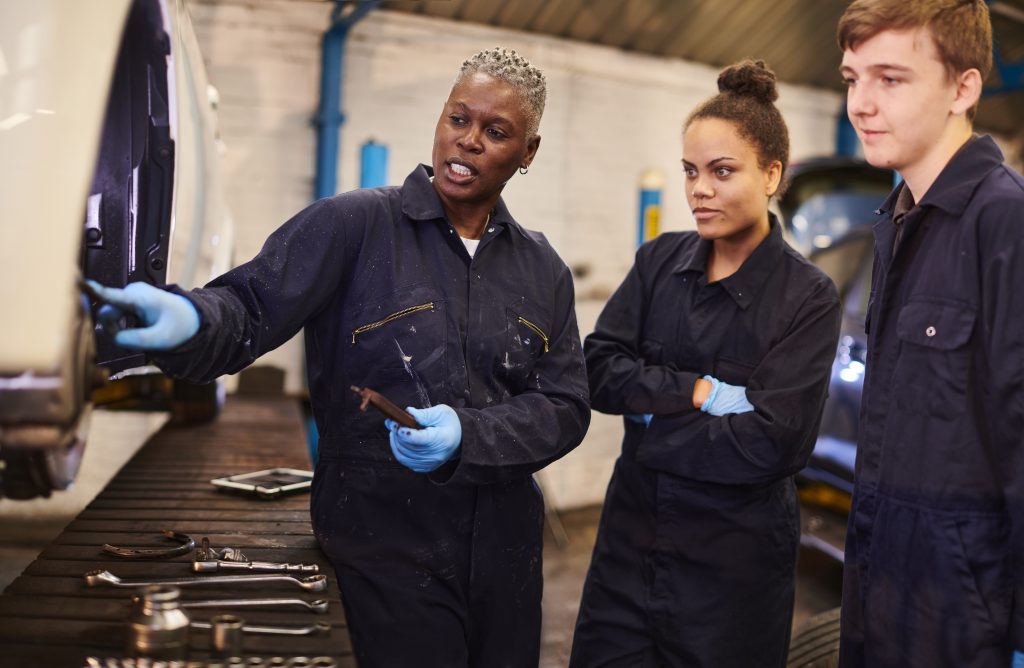
female auto mechanic tutor with students

Why Employer Quality Matters as Much as the Job Offer

In a market with 3 to 7 job openings per graduate across skilled trade sectors, new technicians have more options than they often realize. The question is not just whether you can get a job – it’s whether you get the right one.

The shop you start in shapes your first years in the trade more than almost any other factor. A great employer invests in your training, gives you a clear path to advance, pays fairly, and treats you like a professional. A poor employer burns through new techs, offers no growth, and can erode enthusiasm for a career that took real effort to enter.

Knowing what to look for – and what to walk away from – is one of the most important skills a new technician can develop.

What makes a great employer in the skilled trades is not complicated: fair pay, real training, honest communication, and a culture where people are treated with respect. The shops that get all four tend to have the same techs for 10 to 20 years.

What Makes a Great Employer in the Skilled Trades?

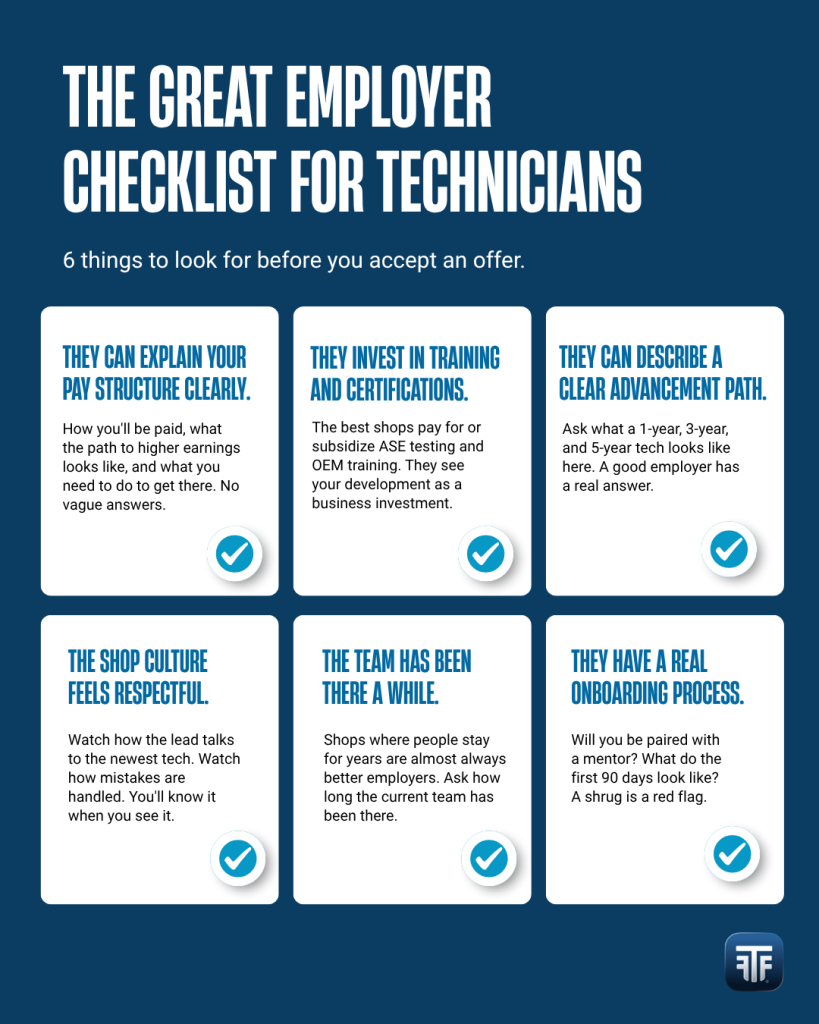
TechForce evaluates employer quality using criteria informed by the Good Jobs Institute framework, which defines a good job as one that provides economic stability, growth opportunity, and a sense of dignity and purpose at work. In the skilled trades, that translates to:

  • Fair and transparent pay. A great employer can explain clearly how you’ll be compensated, what the path to higher earnings looks like, and what you need to do to get there. Vague or evasive answers about pay are a warning sign.
  • Investment in training and certifications. The best shops pay for or subsidize ASE testing, OEM training, and continuing education. They see technician development as a business investment, not a cost.
  • Clear advancement pathways. Good employers can tell you what a 1-year, 3-year, and 5-year tech looks like at their shop – in terms of responsibility, title, and pay. If there’s no answer to that question, there may be no path.
  • A culture of respect. This is harder to measure but easy to observe. Watch how the shop lead talks to the newest tech. Watch how mistakes are handled. Watch whether people seem genuinely engaged or just counting the hours.
  • Low voluntary turnover. Shops where people stay for years are almost always better employers than shops with constant turnover. Ask how long the current team has been there.
Understanding Different Shop Types and Cultures

The skilled trades offer employment across several different shop environments, each with its own culture, structure, and trade-offs. Here’s how they compare:

Shop TypeStrengthsConsiderations
Franchise DealershipStructured training, OEM certifications, consistent workflow, benefits packagesHigher volume pressure, less flexibility, corporate culture may not suit everyone
Independent ShopMore autonomy, broader repair variety, closer team relationshipsBenefits and training support vary widely – vet carefully before accepting an offer
Fleet OperationConsistent hours, predictable work, often strong benefits and union representationLess variety, may be brand or system specific, less customer interaction
Specialty ShopDeep expertise in a niche (performance, diesel, European imports, EV), passionate team cultureSmaller teams, fewer advancement layers, business stability depends on niche demand

None of these shop types is universally better than the others. The right fit depends on what you value at each stage of your career – structured training early on, autonomy and variety later, or depth of specialization in a niche you’re passionate about.

How to Evaluate a Job Offer

A job offer is more than a number. Here’s what to look at before you accept:

Total Compensation, Not Just Base Pay

Factor in health insurance, paid time off, tool allowances, uniform programs, and any training reimbursement. A shop offering $18/hour with full benefits may be worth more than $22/hour with nothing else – depending on the cost of benefits in your area.

The Pay Progression Timeline

Ask what the path from your starting rate to flat rate or senior tech pay looks like – and over what timeline. Get specific. “We’ll see how it goes” is not an answer. A shop with a clear answer to this question has thought about retaining its people.

The Training Commitment

Ask directly: does the shop pay for ASE testing? Are there OEM training programs available? Is there time built into the schedule for continuing education? These answers tell you how serious the employer is about your long-term development.

The First 90 Days

Ask what onboarding looks like. Will you be paired with a mentor or senior tech? What will your first months of work actually involve? A shop with a real answer to this has a real onboarding process. A shop that shrugs probably doesn’t.

Red Flags That Are Worth Walking Away From

The technician shortage means you have leverage. Use it to avoid situations that will hurt your career:

  • High turnover with no explanation. If multiple techs have left in the past year and nobody will tell you why, assume the worst and keep looking.
  • Pressure to skip the onboarding process. “We need you to start immediately” combined with no structured introduction to the shop is a sign of disorganization that will affect your daily experience.
  • Vague or shifting answers about compensation. If the pay structure keeps changing through the interview process, expect the same pattern after you’re hired.
  • No answer on advancement. If a shop cannot tell you what growth looks like for a tech who performs well, there is no growth path. That’s a ceiling, not a starting point.
  • A dismissive attitude toward training. Shops that view certifications as unnecessary or “something you do on your own time” are telling you exactly how much they value your professional development.

TechForce Tools for Finding the Right Employer

TechForce Foundation’s platform connects students to employers through a job board with tens of thousands of positions, direct employer partnerships, and events where students and hiring managers meet in person. The platform also provides career path maps and salary data that help students evaluate offers with real information rather than guesswork.

With the technician shortage at historically high levels, the right employer is out there. The tools to find them are at TechForce.org.

The Bottom Line

The trade you choose is only half the decision. The employer you choose shapes everything that comes after – your training, your advancement speed, your daily experience, and your long-term earning potential. Take the evaluation seriously.

A great shop and a skilled technician who shows up every day ready to work is one of the most productive relationships in the skilled trades. That relationship starts with choosing well on both sides.

Sources & Further Reading

For more information on the topics covered in this article, we recommend the following resources:

  • Good Jobs Institute: goodjobsinstitute.org – research and criteria defining high-quality employment, used as a framework for evaluating employer quality in the skilled trades
  • U.S. Bureau of Labor Statistics (BLS): bls.gov – wage data, benefits information, and labor market conditions for skilled trade occupations
  • National Institute for Automotive Service Excellence (ASE): ase.com – employer training investment standards and certification programs used to evaluate technician development

The Future of the Trades: Industry Trends Every Tech Needs to Know

Electric vehicles, smart buildings, autonomous systems, and advanced materials are changing every skilled trade. Here’s what’s coming, what it means for your career, and how to stay ahead of it.

Are the Skilled Trades Being Replaced by Technology?

This is the question a lot of students ask, and it deserves a direct answer: no. Technology is changing the skilled trades – dramatically, in some sectors – but it is not replacing the technicians who understand it. If anything, the gap between what technology can do and what humans are needed to install, maintain, diagnose, and repair it is growing faster than the workforce can keep up.

America already needs nearly 1 million new entry-level technicians by 2028. That shortage exists right now, before the full wave of EV adoption, smart building automation, and autonomous systems hits the mainstream. The techs who combine foundational trade skills with knowledge of emerging technology will be among the most valuable workers in the country.

This article breaks down the most important trends in each of the six major skilled trade sectors – and what they mean for your career trajectory.

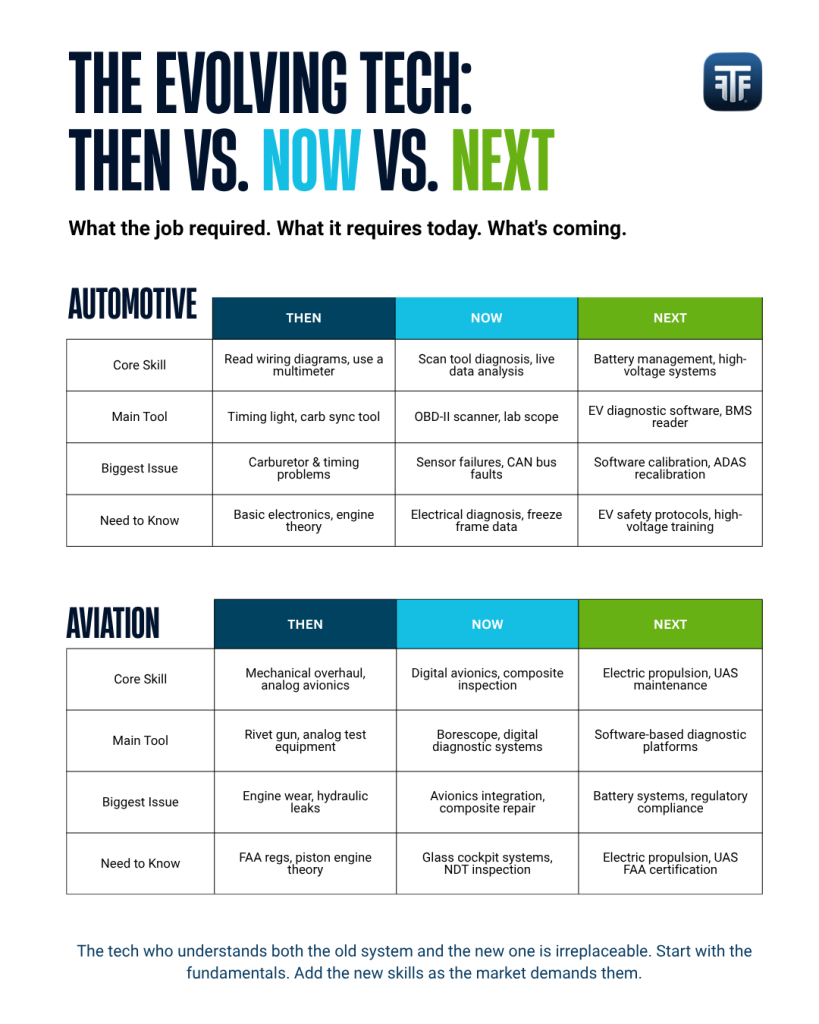
The skilled trades are not disappearing. They are evolving. The technician who understands both the old system and the new one is irreplaceable.

Key Trends by Sector

Here’s a sector-by-sector overview of the technologies and trends shaping the future of skilled technical work:

SectorKey Technologies and Trends to Watch
AutomotiveEV and hybrid systems, ADAS calibration, over-the-air software updates, connected vehicle diagnostics
DieselEmissions technology (DEF, DPF, EGR), alternative fuels (hydrogen, CNG), telematics and fleet management software
AviationAdvanced composite materials, unmanned aerial systems (UAS/drones), electric aircraft propulsion, digital avionics
CollisionADAS recalibration after every structural repair, OEM-certified repair procedures, aluminum and mixed-material construction
HVACSmart building automation, heat pump technology, low-GWP refrigerants, energy efficiency compliance
WeldingRobotic welding integration, laser and friction stir welding, advanced alloys (titanium, Inconel), NDT inspection

Electric Vehicles and What They Mean for Automotive Techs

EV and hybrid technology is the biggest shift the automotive sector has seen since the introduction of electronic fuel injection. It does not eliminate the need for automotive technicians – but it changes the skills required and creates a significant premium for techs who have high-voltage system training.

  • High-voltage safety is non-negotiable. Working on HV systems without proper training is genuinely dangerous. OEM certification programs and courses through organizations like the Electric Vehicle Infrastructure Training Program (EVITP) are increasingly valuable.
  • Diagnostics are shifting toward software. EV diagnostics rely heavily on software tools, data logging, and battery management system analysis rather than traditional mechanical inspection. Techs comfortable with digital tools have a significant advantage.
  • ICE vehicles aren’t going away immediately. The existing fleet of internal combustion engine vehicles will need service and repair for decades. Hybrid competency bridges both worlds and is the most practical near-term investment for most automotive techs.
  • ADAS is already here. Advanced driver assistance systems – lane keep assist, automatic emergency braking, adaptive cruise control – are on vehicles in service right now and require calibration after any structural or windshield repair. Every automotive and collision tech needs to understand them.

Diesel and the Future of Heavy Equipment

Diesel is not going away – but it is getting cleaner and smarter. Emissions regulations are driving significant changes in engine technology, and fleet operators are increasingly relying on telematics data to predict maintenance needs before failures occur.

  • Emissions systems are complex and require specialized knowledge. DEF (diesel exhaust fluid), DPF (diesel particulate filter), and EGR (exhaust gas recirculation) systems are now standard on commercial diesel engines and are a major source of diagnostic work.
  • Alternative fuels are gaining ground. Compressed natural gas (CNG), liquefied natural gas (LNG), and hydrogen fuel cell technology are growing in fleet applications. Diesel techs with alternative fuel training have expanding opportunities in transportation and logistics.
  • Telematics creates new diagnostic workflows. Fleet management software now provides real-time data on vehicle performance, fault codes, and maintenance intervals. Diesel techs who can interpret this data and act on it proactively are valuable to fleet operators.

Aviation: Digital Systems and New Aircraft Technology

Aviation maintenance is already one of the most technology-intensive skilled trades, and the pace of change is accelerating. Two trends stand out as particularly significant for students entering the field now:

  • Unmanned Aerial Systems (UAS/drones) are creating new career paths. Commercial drone operations require FAA-licensed maintenance technicians. This is a growing sector within aviation maintenance that didn’t meaningfully exist a decade ago.
  • Electric aircraft propulsion is moving from concept to reality. Short-haul electric aircraft are in development and early deployment at several manufacturers. A&P mechanics with high-voltage and electric propulsion training will be positioned at the front of a major industry shift.

Collision Repair and the ADAS Calibration Requirement

ADAS calibration is the single biggest change to collision repair in the past decade. Virtually every modern vehicle with advanced safety systems requires camera and sensor recalibration after any repair that affects the vehicle’s geometry – including windshield replacement, wheel alignment, and structural work.

Shops that cannot perform ADAS calibration in-house are already turning away work or subcontracting it out. Collision techs with calibration training and equipment access are among the most in-demand workers in the sector right now.

HVAC: Smart Buildings and the Refrigerant Transition

Two regulatory shifts are reshaping the HVAC industry simultaneously. First, the phasedown of high-global-warming-potential (GWP) refrigerants under EPA regulations is forcing equipment manufacturers to transition to new refrigerant blends – requiring updated training and handling procedures. Second, smart building automation systems are becoming standard in commercial construction, creating demand for HVAC techs who understand building controls and IoT integration.

Heat pump technology is also growing rapidly as a more energy-efficient alternative to traditional heating systems in residential and light commercial applications. Techs with heat pump expertise are seeing strong demand across much of the country.

Welding: Robotics, Advanced Materials, and NDT

Robotic welding has been part of manufacturing for decades – but the role of human welders alongside robotic systems is evolving, not disappearing. Humans are needed to program, maintain, and quality-check robotic systems, and to perform the complex, non-repetitive welds that robots still cannot reliably execute.

The fastest-growing specializations in welding involve advanced alloys (titanium, Inconel, duplex stainless steel) used in aerospace, energy, and chemical processing – sectors where precision is non-negotiable and certified welders command significant pay premiums. Non-destructive testing (NDT) skills complement welding expertise and open additional career pathways.

How to Stay Relevant and Keep Learning

The common thread across every sector is this: the skilled trades reward people who keep learning. Here’s how to build a habit of staying current:

  • Pursue certifications proactively. Don’t wait for your employer to send you to training. Research the certifications that are gaining value in your sector and pursue them on your own timeline.
  • Follow the industry publications. Automotive Body Repair News (ABRN), Fleet Owner, Aviation Week, ACHR News, and the American Welding Society all publish free industry updates. Spending 15 minutes a week with relevant publications keeps you ahead of most of your peers.
  • Pay attention to what OEMs are investing in. The technology priorities of major manufacturers – Ford, GM, Boeing, Carrier, Lincoln Electric – signal where the skilled trades are heading. What they’re building today is what techs will be servicing in 5 years.
  • Engage with the TechForce community. TechForce AMA sessions regularly feature industry professionals discussing where their sectors are heading. These conversations are among the most direct ways to hear what skills will be in demand from the people doing the hiring.

TechForce and Career Readiness for the Future

TechForce Foundation supports students across multiple sectors of the skilled trades – not just in getting started, but in staying current as the industry evolves. The platform includes continuing education resources, industry trend content, and connections to employers who are actively investing in technology training for their teams.

Scholarships, grants, and other financial support through TechForce help students invest in the advanced training that emerging technology requires. Visit TechForce.org to explore what’s available in your sector.

The Bottom Line

The future of the skilled trades is not a threat to the people who do this work. It’s an opportunity. Every new technology that enters a shop, a fleet, a building, or an aircraft creates demand for a human being who understands it – how it works, what it needs, and what to do when it fails.

Start with the fundamentals. Build the certifications. Pay attention to where your sector is heading. The techs who do those three things will never struggle to find work.

Sources & Further Reading

For more information on the topics covered in this article, we recommend the following resources:

  • U.S. Bureau of Labor Statistics (BLS) Occupational Outlook Handbook: bls.gov – job outlook and skills projections for automotive technicians, diesel mechanics, HVAC technicians, welders, and aircraft mechanics
  • U.S. Department of Energy (DOE) Alternative Fuels Data Center: afdc.energy.gov – data and trends on EV adoption, alternative fuels, and fleet electrification
  • Federal Aviation Administration (FAA): faa.gov – UAS regulations, electric aircraft developments, and aviation maintenance certification updates
  • U.S. Environmental Protection Agency (EPA): epa.gov – refrigerant phasedown regulations and HVAC compliance information
  • American Welding Society (AWS): aws.org – welding technology trends, certification updates, and workforce development resources
  • I-CAR (Inter-Industry Conference on Auto Collision Repair): i-car.com – ADAS calibration training, OEM repair procedures, and collision industry technology updates

Everyone Starts Somewhere: Setting Realistic Expectations for Your First Years in the Trade

The gap between what new techs expect and what the first year actually looks like is where a lot of careers end before they begin. Here’s what to actually expect – and how to make the most of it.

What Do New Technicians Actually Expect?

One of the most consistent conversations TechForce has with industry partners comes down to this: students graduate from technical school expecting to walk into a shop and immediately do the advanced work they trained for. The reality is almost always different – and that gap catches a lot of new techs off guard.

That’s not a criticism of students. It’s a flaw in how the skilled trades are sometimes presented. Technical education does a good job of teaching the skills. It doesn’t always do a good job of preparing students for the culture, pace, and hierarchy of a real working shop.

This article is the honest conversation most new techs wish they’d had before their first day.

“They want to come out of school making $100,000 without starting at the bottom. Our solution is going to be who talks to them in gaming language about how to level up.” – TechForce industry partner, describing the expectation gap and what it takes to bridge it.

The Expectation vs. Reality Gap

Here are the five most common expectation gaps new techs and trade students encounter in their first year – and what’s actually true:

The ExpectationThe Reality
“I’ll be doing real repairs right away.”Most shops start new techs on oil changes, tire rotations, and basic maintenance. That’s not a slight – it’s how you prove you’re trustworthy with a customer’s vehicle.
“I’ll be making good money from day one.”Entry-level pay is real pay, but master-tech earnings come later. The path to strong wages is clear – it just takes time and certifications to get there.
“My instructor said I was one of the best in class.”School and shop are different environments. Being a strong student means you have a foundation to build on. It doesn’t mean you skip the beginner stage.
“I know more than some of the older techs here.”Maybe true on specific topics. Irrelevant right now. Watch, listen, and prove yourself with your work before forming opinions about others.
“If I’m not advancing in 6 months, something is wrong.”Real advancement in a skilled trade takes 1-3 years of consistent performance. Six months is barely enough time to learn the shop’s systems and earn trust.

The Mopping the Floor Reality

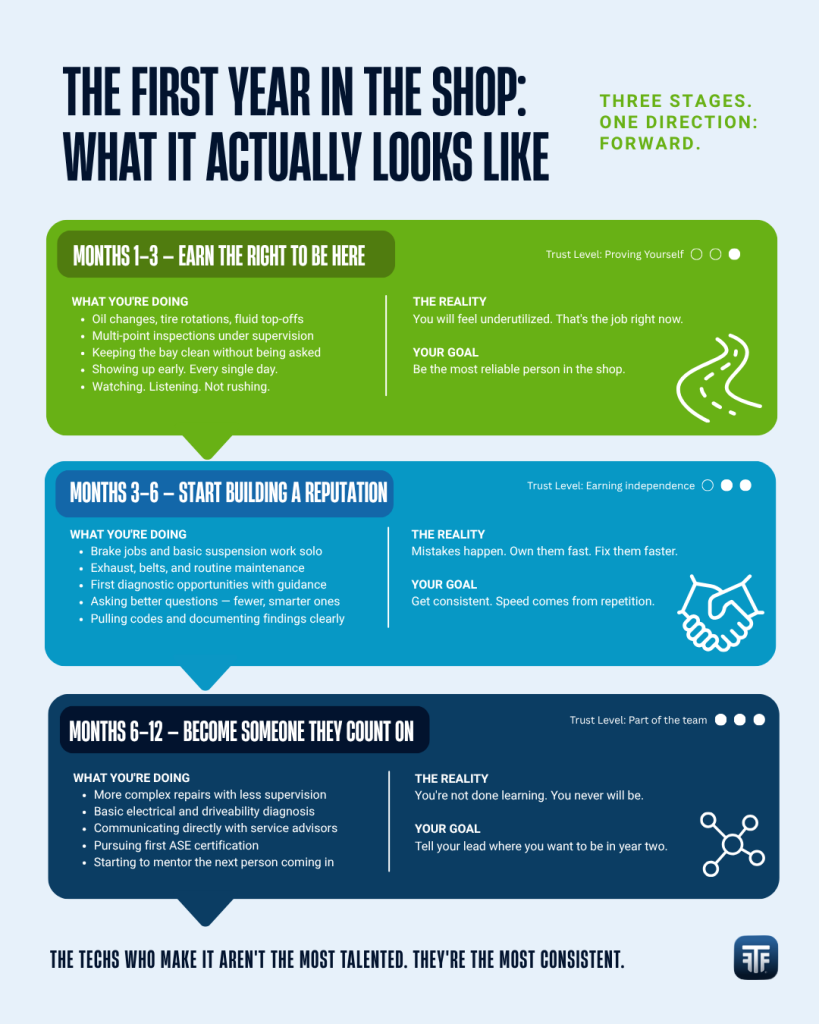
There’s a story that gets told in skilled trades circles – usually by a master tech looking back on their early days. It goes something like this: on their first week, they were handed a mop and told to clean the shop floor. Not a scan tool. Not a work order. A mop.

The point isn’t that new techs should expect to be mistreated or underutilized indefinitely. The point is that trust in a shop is earned through small things first. Showing up on time. Being the last one to leave. Keeping the bay clean without being asked. Asking good questions. Being reliable on the simple jobs before being given the complex ones.

The techs who resent that process tend to leave early. The ones who understand it as a passage tend to advance faster because they build genuine trust instead of demanding it.

What Employers Actually Expect from New Techs

Here’s what hiring managers and shop leads consistently say they want from a first-year tech – and it has almost nothing to do with technical skill:

  • Show up. Reliability is the single most valued quality in a new hire. A tech who is always on time, rarely calls out, and communicates proactively when something comes up is rare and noticed immediately.
  • Be coachable. New techs who accept feedback without defensiveness and apply it quickly are the ones who get more responsibility. New techs who argue with every correction get fewer opportunities.
  • Ask good questions. Not constant questions about things you could figure out yourself – but thoughtful questions that show you’ve already done some thinking. There’s a difference.
  • Take care of the vehicle. A customer’s car or truck is often their most valuable possession and the thing that gets them to work. Treating it with respect – every time, not just when someone is watching – builds the kind of reputation that leads to advancement.
  • Stay curious. The new techs who advance fastest are the ones who are genuinely interested in the work. They hang around after hours to watch a repair. They look up things they didn’t know. The curiosity shows.

How to Show Up, Prove Yourself, and Advance

The path from entry-level tech to trusted team member isn’t complicated. It’s just not fast. Here’s what it actually takes:

Master the Basics Before Asking for More

Every shop has a set of foundational services: oil changes, tire rotations, fluid checks, basic inspections. Get so good at these that the service advisor never has to think twice about sending you a car. Speed and accuracy on the basics is what opens the door to more complex work.

Make Your Intentions Known

Most shop leads don’t automatically track who wants to advance and who is content where they are. Tell your lead or mentor directly: “I’m working toward my ASE certifications and I want to be doing more diagnostic work in the next year. What do I need to demonstrate to get there?” That conversation changes how people see you.

Find a Mentor

The fastest path to advancement in any skilled trade runs through someone who has already made it. Find a tech in your shop who is willing to answer questions, let you watch their work, and give you honest feedback. TechForce also connects students to mentors outside their immediate shop through the platform’s community and mentorship networks.

Pursue Certifications Systematically

ASE certifications, manufacturer training programs, and sector-specific credentials are the clearest signal to any employer that you are serious about your career. Don’t wait for your shop to send you – start studying on your own time and schedule tests as soon as you’re eligible.

A Note on Pay Expectations

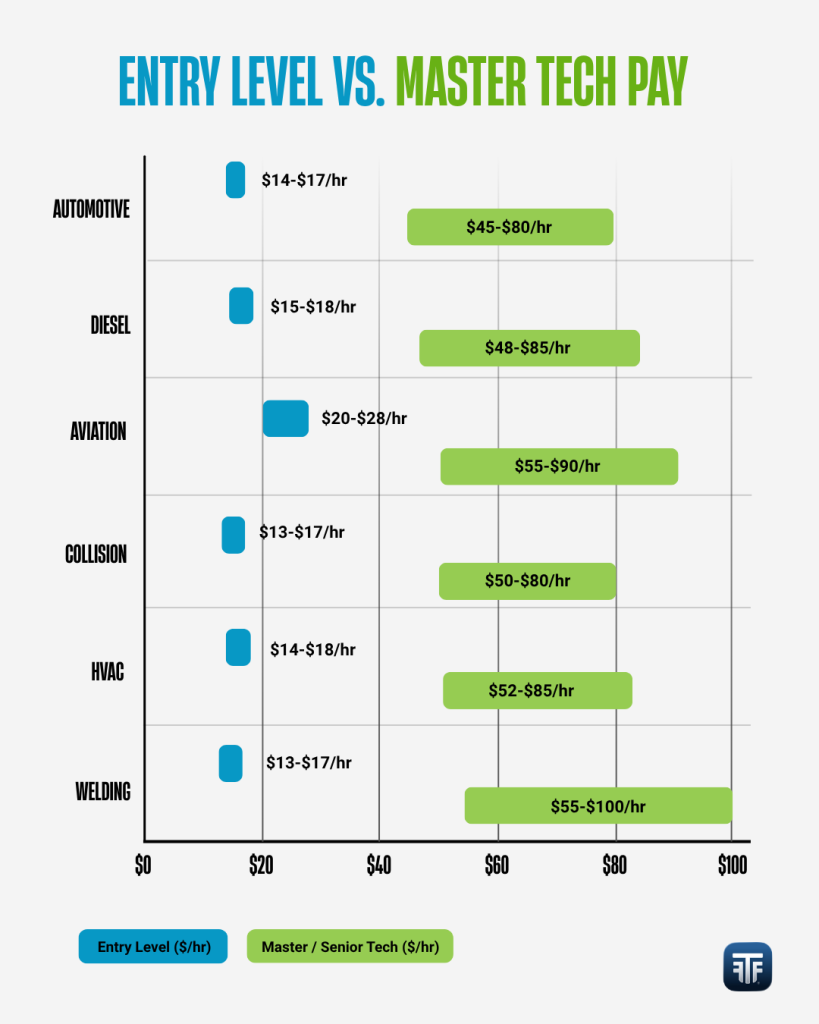
The skilled trades offer some of the strongest earning potential of any career that doesn’t require a four-year degree. A master automotive technician, diesel specialist, or senior HVAC tech can earn $50 to $85+ per hour. But that earning level is the destination of a 10 to 15 year career, not the starting point.

Entry-level and apprentice pay in most sectors runs $14 to $22 per hour. That’s real money, especially compared to the debt that often comes with a four-year degree. The trajectory is steep if you put in the work. The key is not to judge the career by where it starts.

TechForce and the Level Up Mentality

TechForce Foundation was built around a simple idea: students in technical education deserve the same quality of support, resources, and career guidance that students in four-year programs get. That includes being honest about what the path looks like.

The platform connects students to career path maps with clear milestones, mentors who have been where they are, community circles of peers navigating the same challenges, and scholarships and other financial support that makes it possible to stay the course during the early years.

The technician shortage is real. The career opportunity is real. The path requires starting at the bottom – just like it always has. Visit TechForce.org to access the tools that help you move through it faster.

The Bottom Line

The techs who make it to master level are not the ones who skipped the hard early years. They’re the ones who understood what those years were for: building a foundation of trust, skill, and reputation that everything else is built on.

Start where you are. Do the small things exceptionally well. Keep your eyes on where the path leads. The level up is earned – and it’s absolutely within reach.

Sources & Further Reading

For more information on the topics covered in this article, we recommend the following resources:

  • U.S. Bureau of Labor Statistics (BLS) Occupational Outlook Handbook: bls.gov – median wages, job outlook, and career progression data for automotive technicians, diesel mechanics, and other skilled trade occupations
  • National Institute for Automotive Service Excellence (ASE): ase.com – certification pathways and professional development resources for automotive and diesel technicians

Level Up: Career Path Maps for Auto, Diesel, Aviation, Collision, HVAC, and Welding

Every skilled trade has a clear progression from entry level to master. Here’s what that path looks like across six sectors – with real timelines, pay ranges, and milestones.

What Does a Skilled Trade Career Path Actually Look Like?

One of the biggest misconceptions students bring into technical education is expecting to graduate and immediately earn top dollar. The reality is more nuanced – and actually more exciting. Every skilled trade follows a clear progression: you start at entry level, build speed and competency, earn certifications, and advance through defined stages toward master-level work and the earning power that comes with it.

America needs nearly 1 million new entry-level technicians by 2028 across automotive, diesel, aviation, collision, HVAC, and welding. Schools are graduating only a fraction of that number. That gap means the demand for what you’re training to do is at an all-time high – and the career path in front of you has never had more runway.

Below is a breakdown of the career progression in each of the six major skilled trade sectors TechForce supports. Use it as a roadmap, not a guarantee – actual pay and timeline vary by region, employer, and individual performance.

“My dream is to become a level 3, master diesel technician. I wish to make good money and provide great service to my customers.” – TechForce student. That path is real, and it starts at the beginning – just like it did for every master tech working today.

Automotive Technician Career Path

Automotive is the largest sector in the skilled trades, covering passenger vehicles, light trucks, and specialty vehicles. The path from lube tech to master technician typically takes 5 to 10 years of consistent work and certification-building.

StageTimelineTypical Pay RangeWhat You’re Doing
Lube Tech / Detail0-6 months$14-$17/hrOil changes, tire rotations, basic inspections. Learning shop workflow and customer interaction.
Entry-Level Tech6 months – 2 years$16-$22/hrBasic repairs, brakes, suspension, exhaust. Building speed and consistency.
Mid-Level Tech2-5 years$22-$32/hrDiagnostics, electrical, engine work. Pursuing ASE certifications.
Senior / A-Tech5-10 years$30-$45/hr+Complex diagnostics, driveability, all systems. ASE Master Technician pursuit.
Master Tech / Specialist10+ years$45-$80/hr+Full diagnostics, team leadership, specialty certifications (EV, hybrid, OEM).

Key certifications: ASE A1-A8 for Master Technician status, OEM-specific certifications (Ford, GM, Toyota, etc.), EV and hybrid specialist credentials as the market shifts.

Diesel Mechanic / Technician Career Path

Diesel technicians work on heavy trucks, commercial vehicles, construction equipment, agricultural machinery, and marine engines. The sector commands strong wages and has some of the most severe technician shortages in the skilled trades.

StageTimelineTypical Pay RangeWhat You’re Doing
Lube / Service Tech0-6 months$15-$18/hrFluid services, filters, basic PM work on diesel equipment.
Entry-Level Diesel Tech6 months – 2 years$18-$24/hrBasic engine repairs, brake systems, electrical fundamentals on heavy equipment.
Mid-Level Diesel Tech2-5 years$24-$36/hrEngine overhauls, advanced electrical, emissions systems, diagnostics.
Senior Diesel Tech5-10 years$34-$50/hrComplex diagnostics, injection systems, turbochargers, fleet management support.
Master Diesel Tech / Specialist10+ years$48-$85/hr+Full system mastery, manufacturer certifications, team lead or shop foreman roles.

Key certifications: ASE T1-T8 for Medium/Heavy Truck, ASE C1 for service consultant track, manufacturer-specific programs (Cummins, Detroit, Caterpillar, Duramax).

Aviation Mechanic / Technician Career Path

Aviation maintenance is one of the most regulated and credential-driven skilled trades. The FAA Airframe and Powerplant (A&P) license is the foundation of the career, and the path from student to senior technician is structured and well-defined.

StageTimelineTypical Pay RangeWhat You’re Doing
AMT Student / Trainee0-2 years (school)$12-$16/hr (training)Technical school focused on FAA-approved curriculum. Airframe and Powerplant coursework.
A&P Mechanic (Entry)0-3 years post-cert$20-$28/hrLine maintenance, routine inspections, basic component repair under supervision.
A&P Mechanic (Mid)3-7 years$28-$42/hrHeavy maintenance, avionics support, complex inspections, independent sign-offs.
Senior A&P / IA7-15 years$40-$60/hrInspection Authorization (IA) certification. Sign-off authority on major repairs and alterations.
Lead Tech / Director of Maintenance15+ years$55-$90/hr+Team leadership, regulatory compliance oversight, MRO management.

Key certifications: FAA A&P License (required to work), Inspection Authorization (IA), avionics add-on ratings, manufacturer type certifications. Aviation is one of the few skilled trades where federal licensing is mandatory at entry.

Collision Repair Technician Career Path

Collision repair technicians restore vehicles after accidents, working with body panels, frames, paint, and increasingly with advanced driver assistance systems (ADAS) that require precise calibration after any structural repair.

StageTimelineTypical Pay RangeWhat You’re Doing
Prep Tech / Detail0-6 months$13-$17/hrSurface prep, masking, basic bodywork assistance. Learning shop flow and paint safety.
Entry Collision Tech6 months – 2 years$16-$22/hrPanel replacement, basic dent repair, unibody inspection fundamentals.
Body Tech / Painter2-6 years$22-$38/hrFrame straightening, welding, full refinishing, color matching. I-CAR training pursuit.
Senior Collision Tech6-12 years$36-$55/hrComplex structural repair, ADAS calibration, estimating, OEM repair procedures.
Master Collision Tech / Estimator12+ years$50-$80/hr+Full shop capability, insurance negotiation, team oversight, damage analysis.

Key certifications: I-CAR Gold Class (industry standard), ASE B2-B6 for collision specialists, OEM certification programs (Tesla, Rivian, and other manufacturers with proprietary repair requirements), ADAS calibration training.

HVAC Technician Career Path

HVAC technicians install, maintain, and repair heating, ventilation, air conditioning, and refrigeration systems in residential, commercial, and industrial settings. The sector has strong year-round demand and a clear apprenticeship-to-journeyman progression.

StageTimelineTypical Pay RangeWhat You’re Doing
HVAC Helper / Apprentice0-1 year$14-$18/hrAssisting experienced techs, learning system components, basic installation tasks.
HVAC Installer / Service Tech I1-3 years$18-$26/hrResidential installation and basic service, EPA 608 certification, ductwork.
HVAC Tech II / Journeyman3-7 years$26-$40/hrCommercial systems, complex diagnostics, refrigerant handling, controls.
Senior HVAC Tech7-12 years$38-$55/hrIndustrial systems, building automation, full diagnostic capability, team lead.
Master HVAC / Project Manager12+ years$52-$85/hr+System design, large commercial and industrial projects, contractor licensing.

Key certifications: EPA 608 (required to handle refrigerants), NATE certification (industry standard), state contractor license (required for independent work in most states), manufacturer-specific training (Carrier, Trane, Lennox).

Welder / Welding Technician Career Path

Welding is one of the most versatile skilled trades, with applications across automotive, construction, manufacturing, pipelines, aerospace, and shipbuilding. The career path varies significantly by industry sector and welding process specialty.

StageTimelineTypical Pay RangeWhat You’re Doing
Welding Student / Helper0-1 year$13-$17/hrLearning core processes (MIG, TIG, Stick), safety fundamentals, basic joint types.
Entry Welder1-3 years$17-$24/hrProduction welding, structural work, reading blueprints and weld symbols.
Certified Welder3-7 years$24-$40/hrAWS or API certifications, specialty processes, quality inspection basics.
Senior Welder / Weld Inspector7-15 years$38-$60/hrCWI certification pursuit, complex structural and pressure vessel work.
Certified Welding Inspector / Engineer15+ years$55-$100/hr+AWS CWI, quality assurance, weld engineering, project management.

Key certifications: AWS D1.1 Structural Welding, API 1104 Pipeline Welding, AWS Certified Welding Inspector (CWI), ASME pressure vessel certifications. Specialty processes like TIG on exotic metals (titanium, Inconel) command significant pay premiums.

The Level Up Mindset: How to Move Through the Stages

Every career path above has one thing in common: progression is earned through time, certifications, and demonstrated competency – not just seniority. The techs who advance fastest are the ones who treat each stage as preparation for the next one, not just a job to get through.

  • Certifications are non-negotiable. In every sector, certifications are the clearest signal to employers that you’ve invested in your own growth. Pursue them systematically, not eventually.
  • Speed comes from repetition. On flat rate or production pay, your income is directly tied to how efficiently you work. The only way to get faster is to do the work – a lot.
  • Specialization creates leverage. Generalists are valuable. Specialists are in demand. Once you have a foundation, identify an area of the trade that interests you and go deep.
  • Ask where the market is going. EV and hybrid in auto, ADAS in collision, automation in welding and HVAC – the techs building skills in emerging technology today are the ones with the most options in 10 years.

How TechForce Supports Your Career Path

TechForce Foundation connects students across all six sectors to the resources they need to move through the career path with less friction. 

For students just starting out, TechForce offers millions of dollars in scholarships every year to reduce the financial barrier to entry. For students further along, apprenticeship connections, job listings, and community networks support the transition from school into a working career.

With 3 to 7 job openings per graduate across multiple sectors, the path forward is clear. The support to get there is at TechForce.org.

The Bottom Line

Every master technician in automotive, diesel, aviation, collision, HVAC, and welding started exactly where you are right now. The path is laid out. The demand is real. The only question is how you want to move through it.

Start at the entry point for your sector. Build the certifications. Put in the repetitions. Find your specialization. The level up is waiting – and TechForce is here to help you get there.

Sources & Further Reading

For more information on the topics covered in this article, we recommend the following resources:

  • U.S. Bureau of Labor Statistics (BLS) Occupational Outlook Handbook: bls.gov – median pay, job outlook, and entry requirements for automotive technicians, diesel mechanics, HVAC technicians, welders, and aircraft mechanics
  • National Institute for Automotive Service Excellence (ASE): ase.com – certification pathways, testing requirements, and industry standards for automotive and diesel technicians
  • Federal Aviation Administration (FAA): faa.gov – Airframe and Powerplant (A&P) licensing requirements, regulations, and career guidance for aviation mechanics
  • American Welding Society (AWS): aws.org – welding certification pathways, wage data, and industry standards
  • Air Conditioning Contractors of America (ACCA): acca.org – HVAC industry career information, standards, and technician resources
  • I-CAR (Inter-Industry Conference on Auto Collision Repair):i-car.com – collision repair training, certification programs, and career development resources

Please share your contact details and a TechForce team member will contact you.


"By connecting students, instructors, industry pros and working techs, the TechForce Foundation provides unilateral support to the transportation industry’s technician recruiting needs… The administration of our Scholarships by the TechForce team has been instrumental in delivering us with a successful method to gain interest from qualified candidates as well as provide our students with additional assistance to complete their education."
Tony Farr
Ford Technical Programs Manager