Tool Support for Trade Students: Contests, Loans, Grants, and Discounts

Tools are one of the biggest upfront costs of a technical career. Here are multiple resource available to help you build your toolbox without breaking your budget.

Why Tool Support Matters

One of the first financial shocks students encounter when entering technical education is the tool requirement. Many shops expect you to arrive with your own tools on day one – and building even a basic professional starter set can cost anywhere from $1,500 to $4,000 depending on your sector. On an apprentice wage, that number is significant.

The good news is that tool support exists – through contests, loaner programs, grants, in-kind donations, and partner discounts. Most students don’t know these resources exist, or don’t know how to access them. This article lays out multiple available options so you can build your toolbox smarter.

You don’t need a $30,000 toolbox to start. You need the right $2,000 toolbox – and a plan for building the rest over time.

TechForce Tool Contests: Win the Tools You Need

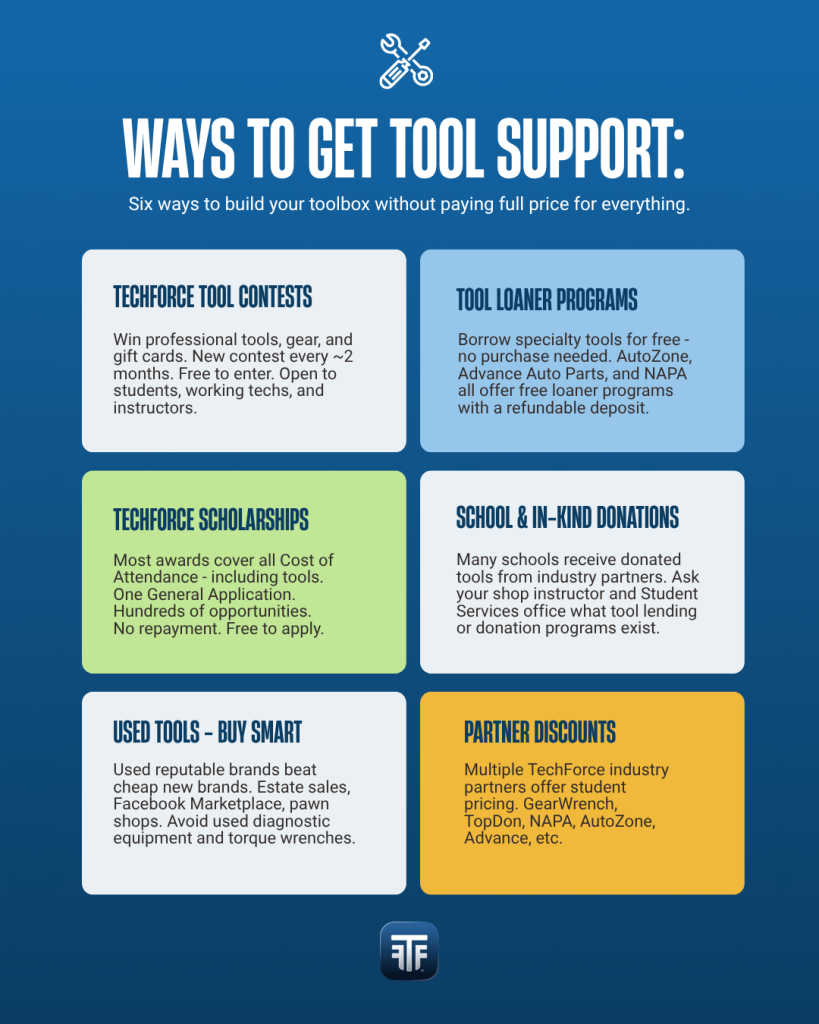
TechForce Foundation runs tool contests throughout the year – every two months – giving students, instructors, and working techs the chance to win tools, gear, gift cards, and more from leading industry partners.

These contests are one of the most direct and accessible forms of tool support TechForce offers. Entry requirements vary by contest but are designed to be straightforward. Winners receive real, professional-grade prizes that make a genuine difference in a starter toolbox.

Who Can Enter

TechForce tool contests are open to a range of participants depending on the specific contest – including enrolled students in technical programs, working technicians, and sometimes instructors. Check the TechForce platform for the current contest details and eligibility requirements.

What You Can Win

Prize packages vary by contest and by the partner sponsoring it. Past prizes have included professional hand tools, diagnostic equipment, tool storage, branded gear, and gift cards to major tool suppliers. Every contest is different, and new partner prizes are added throughout the year.

How to Enter

Log in to your free TechForce account at TechForce.org and check the platform for the current active contests. New contests launch every two months, so if one has just closed, the next one is coming. It’s free to enter and free to join TechForce.
Tool Loaner Programs: Borrow Before You Buy

For specialty tools you don’t use every day, borrowing is almost always smarter than buying – especially early in your career when you’re still figuring out what jobs you’ll actually be doing regularly.

  • AutoZone Loan-A-Tool: AutoZone’s free tool loaner program covers a wide range of specialty tools including brake caliper wind-back kits, ball joint presses, harmonic balancer pullers, fuel pressure gauges, and more. Leave a deposit, borrow the tool, return it when the job is done, get your deposit back. Find participating locations at autozone.com.
  • Advance Auto Parts: Similar loaner program to AutoZone, with a range of specialty tools available at no cost beyond the refundable deposit. Visit advanceautoparts.com for participating locations and available tools.
  • NAPA Auto Parts: NAPA’s loaner program covers many of the same specialty tools. NAPA locations tend to be strong resources for professional-grade equipment. Visit napaonline.com for availability.

Use loaner programs aggressively in your first year. The money you save on specialty tools you only need occasionally is money that goes toward the quality hand tools you use every single day.

In-Kind Tool Donations and School Programs

Many technical schools receive tool donations from industry partners and alumni that are made available to students – often through school tool lending libraries, loaner programs, or end-of-year giveaways. These programs are frequently underutilized because students don’t ask about them.

  • Ask your school’s shop instructor: Instructors often know about donated tools, surplus equipment, and informal lending arrangements that aren’t advertised anywhere. A direct question is the fastest way to find out what’s available.
  • Check with your school’s Student Services office: Some schools have formal tool lending programs administered through student services rather than the shop. It’s worth asking both places.
  • Industry partner donations: TechForce’s network of industry partners – including tool companies, parts suppliers, and manufacturer programs – periodically make in-kind tool donations available to students through the platform. Check TechForce.org for current opportunities.

Tool Grants and Financial Assistance

Beyond TechForce contests, a few other sources of direct tool financial support exist for students in technical education:

  • TechForce Foundation Scholarships: Most TechForce scholarships can be applied toward all Cost of Attendance needs, which in many programs includes tools and equipment. If you haven’t applied for a TechForce scholarship, that’s the first step. One General Application considers you for all available awards. Visit TechForce.org to apply.
  • ASE Education Foundation: The ASE Education Foundation (aseeducationfoundation.org) funds scholarships and grants specifically for students in automotive and transportation technology programs, some of which can be applied toward tools and equipment costs.
  • SkillsUSA: SkillsUSA (skillsusa.org) offers scholarships for career and technical education students that can help offset tool and equipment costs. Membership in a SkillsUSA chapter through your school is often required.
  • Manufacturer student programs: Several major tool manufacturers run student discount or grant programs for enrolled technical students. Ask your school’s tool truck representative directly about what’s available for students at your program.

Buying Used Tools Strategically

Used hand tools from reputable brands are one of the best-kept secrets in building a professional toolbox on a budget. A used Snap-on ratchet purchased at an estate sale or online marketplace will outlast a cheap new ratchet from an unknown brand – often by years.

  • Ask your tech friends: Techs often upgrade and don’t get rid of their used tools. Ask if they’re willing to give them to you.
  • Estate sales and auctions: Estate sales regularly feature professional-grade tools from retired mechanics and tradespeople. Online estate sale platforms like EstateSales.net make it easy to search by location and category.
  • Online marketplaces: Facebook Marketplace, OfferUp, and Craigslist regularly have used professional tools. Search by brand name to find quality pieces at significant discounts.
  • Pawn shops: Many pawn shops carry professional tools. Quality varies, but recognizable brand names at pawn shop prices are often worth picking up.
  • What to avoid used: Diagnostic equipment, torque wrenches, and safety equipment (jack stands, etc.) should generally be purchased new or from a source where you can verify condition and calibration. The risk of inaccurate or failed equipment in these categories is too high to gamble on used.

Partner Discounts and Student Programs

Several TechForce industry partners offer discounts and student programs that reduce the out-of-pocket cost of professional tools:

  • NAPA Auto Parts: napaonline.com – professional-grade hand tools, diagnostic equipment, and chemicals with regular promotions
  • AutoZone: autozone.com – hand tools, scan tools, and consumables; check for student or loyalty program discounts
  • Advance Auto Parts: advanceautoparts.com – tools and consumables with frequent promotional pricing
  • GearWrench: gearwrench.com – professional hand tools and ratcheting wrench sets widely used in automotive and diesel
  • TopDon: topdon.com – entry-level to professional diagnostic scan tools at accessible price points for students

The Bottom Line

Tools are a career-long investment – but you don’t have to build your entire toolbox before your first day. Use TechForce contests for a chance to win professional gear. Use loaner programs for specialty tools. Apply for scholarships that cover Cost of Attendance, including tools. Buy used strategically. And build the rest incrementally as the work demands it.

The students who build their toolboxes smartly – rather than all at once – end up with better equipment and less debt. Start with what you need. Add the rest when you’ve earned it.

Sources & Further Reading

For more information on the topics covered in this article, we recommend the following resources:

  • AutoZone Loan-A-Tool: autozone.com – free specialty tool loaner program, refundable deposit required
  • Advance Auto Parts tool loaner: advanceautoparts.com – free specialty tool loaner program at participating locations
  • NAPA tool loaner: napaonline.com – specialty tool loans and professional-grade equipment
  • ASE Education Foundation: aseeducationfoundation.org – scholarships and grants for automotive and transportation technology students
  • SkillsUSA: skillsusa.org – scholarships and career development resources for career and technical education students
  • EstateSales.net: estatesales.net – search for estate sales near you to find used professional tools
  • TechForce Foundation: TechForce.org – tool contests (every two months), General Scholarship Application, industry partner discounts, and wraparound support services for students in skilled technical careers

Balancing School, Work, and Family: Support Resources for Student Parents in the Trades

Being a parent and a trade student at the same time is genuinely hard. Here’s where to find support, and how to build a family balance that holds.

The Reality of Being a Student Parent in the Skilled Trades

TechForce students are not the average college student. The average TechForce student is in their early-to-mid 20s, often working part-time or full-time alongside school, and a significant portion are supporting families: partners, children, or both.

Student parents in technical education face a specific and compounding set of pressures: tuition, tools, childcare, commute, and the relentless physical and mental demands of a technical program, all at the same time. Financial stress around childcare is one of the most common reasons students leave technical school before finishing.

This article does not minimize how hard that is. It also does not pretend there is an easy solution. What it does is lay out the resources that exist, the strategies that work, and the mindset that makes both possible at once.

“I have to work to cover rent, tuition, food for myself, my girlfriend, and our 1-year-old son.” – TechForce student, describing a reality that is far more common than most people realize.

Childcare: Finding and Funding It

Start with Your School

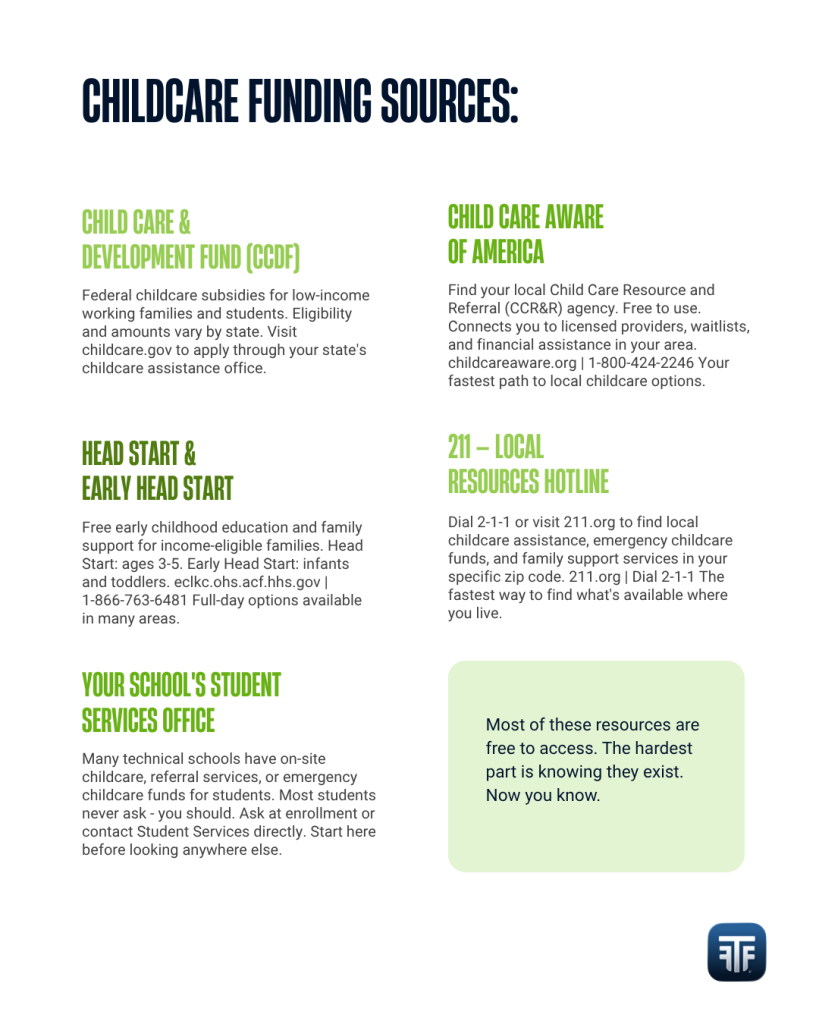
Many accredited technical schools and community colleges have childcare resources on campus or through affiliated programs – including on-site childcare centers, childcare referral services, and emergency childcare funds for students in crisis. These resources are often underutilized simply because students don’t know they exist.

Before looking anywhere else, contact your school’s Student Services office and ask directly: what childcare support is available to enrolled students? The answer may surprise you.

Child Care and Development Fund (CCDF)

The federal Child Care and Development Fund provides childcare subsidies to low-income working families and students. Eligibility and benefit levels vary significantly by state, but students in technical programs who meet income requirements may qualify for substantial assistance. Apply through your state’s childcare assistance office.

Find your state’s program at childcare.gov – the federal portal for all CCDF-related programs and state contacts.

Head Start and Early Head Start

Head Start provides free early childhood education, health, and family support services to income-eligible families with children up to age 5. Early Head Start serves infants and toddlers. Both programs are free to qualifying families and include full-day options in many areas.

Find a Head Start program near you at eclkc.ohs.acf.hhs.gov or call 1-866-763-6481.

Child Care Resource and Referral Agencies (CCR&Rs)

Every state has a network of Child Care Resource and Referral agencies that help families find licensed childcare providers, understand costs, and access subsidy programs. CCR&Rs are free to use and can connect you with local providers, waitlist information, and financial assistance options.

Find your local CCR&R at childcareaware.org or call 1-800-424-2246.

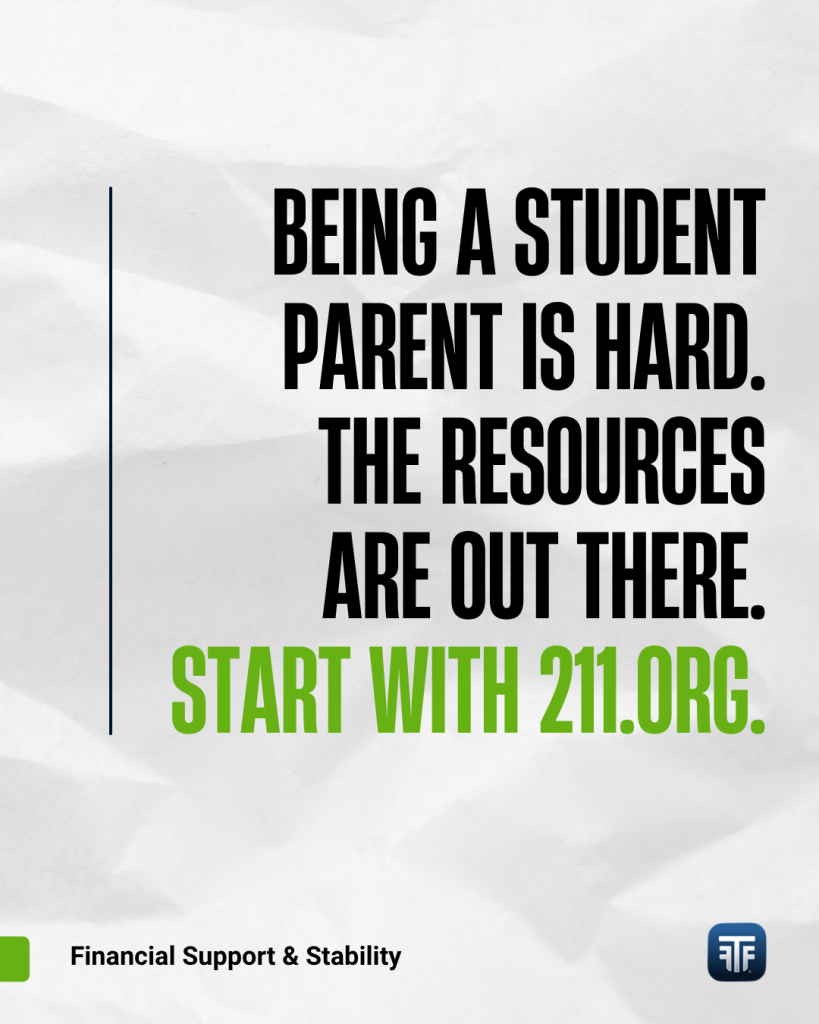
211.org

Dialing 2-1-1 or visiting 211.org connects you to a local specialist who can identify childcare resources, subsidy programs, emergency childcare assistance, and family support services in your specific area. This is often the fastest way to find what’s available locally.

Financial Support for Student Parents

SNAP (Food Assistance)

The Supplemental Nutrition Assistance Program (SNAP) provides monthly food assistance to eligible low-income households, including student families. Eligibility rules for students have specific requirements, but students who are working 20 or more hours per week, or who have dependent children, are often eligible regardless of student status. Apply through your state’s SNAP office or at fns.usda.gov/snap.

WIC (Women, Infants, and Children)

WIC provides food assistance, nutrition counseling, and healthcare referrals for pregnant women, new mothers, and children under age 5 who meet income guidelines. If you have a young child or a partner who is pregnant, WIC is worth applying for regardless of your income level – the cutoff is higher than many people expect. Apply through your local health department or at fns.usda.gov/wic.

Temporary Assistance for Needy Families (TANF)

TANF provides cash assistance and support services to low-income families with children. Many states allow TANF recipients to count technical school enrollment as an approved work activity, which can make student parents in technical programs eligible while they complete their training. Rules vary significantly by state. Apply through your state’s social services office.

Earned Income Tax Credit (EITC)

The EITC is a refundable federal tax credit for low-to-moderate income working individuals and families, particularly those with children. Many working student parents qualify and don’t claim it. Filing your taxes and claiming the EITC can result in a significant refund that helps cover childcare and family costs. Visit irs.gov/eitc for eligibility information and free filing resources.

Family Balance: Strategies That Actually Work

No strategy eliminates the pressure of being a student parent. But the student parents who finish technical school tend to share a few approaches in common.

Communicate Your Schedule in Advance

Your family, your employer, and your school all need to know when you’re unavailable and when you’re available. Get your school schedule as early as possible each term and build everything else around it. Surprises are where the system breaks down.

Identify Your Non-Negotiables – and Protect Them

Decide in advance what cannot be missed: a child’s medical appointment, a school performance, a family commitment that matters. Put these in your schedule the same way you put in a class. Everything else gets worked around them. Student parents who try to accommodate everything tend to end up protecting nothing.

Build a Backup Childcare Plan

Every working parent needs at least one backup childcare option: a family member, a trusted neighbor, a reciprocal arrangement with another parent. When your primary childcare falls through (and it will), having a backup means a stressful morning instead of a missed day of school or work.

Ask Your School About Flexibility

Many technical programs have more flexibility than students realize. If a family emergency affects your attendance or performance, communicating proactively with your instructor almost always produces a better outcome than going silent. Schools that understand the reality of their students’ lives exist, and the ones that don’t, are worth knowing about before you enroll.

Let Your Partner or Support System In

If you have a partner, family member, or close friend who is part of your support system, be honest with them about what the next 12-24 months will require. Students who try to manage everything without asking for help tend to burn out faster. The people around you cannot support what they don’t understand.

A Note on TechForce Resources

TechForce Foundation’s wraparound services are designed to help students stay enrolled and finish what they started, including students who are navigating family obligations alongside their technical education. While TechForce does not currently offer direct childcare funding, the platform connects students to scholarship support, emergency financial assistance (at select schools), and a range of life skills trainings that address the real challenges of being a student in the skilled trades.

If financial pressure related to family obligations is threatening your ability to stay enrolled, visit TechForce.org and look into the Life Happens Grant (available at select schools) and the General Scholarship Application. Both exist specifically for students who are doing everything right and still need a hand.

The Bottom Line

Being a student parent in the skilled trades is one of the hardest things a person can do. The demands are real, the margin for error is thin, and the support systems are not always easy to find.

But the career on the other side is real too. The earning potential, the job security, the sense of doing work that matters – all of it is available to student parents who finish the program. The resources in this article exist to help you get there. Use them.

Sources & Further Reading

For more information on the topics covered in this article, we recommend the following resources:

  • Child Care and Development Fund (CCDF): childcare.gov – federal portal for childcare subsidies, state program contacts, and eligibility information
  • Child Care Aware of America: childcareaware.org – find your local Child Care Resource and Referral agency and access childcare cost and availability data
  • Head Start / Early Head Start: eclkc.ohs.acf.hhs.gov – free early childhood education and family support for income-eligible families
  • SNAP (Food Assistance): fns.usda.gov/snap – eligibility information and state application portals
  • WIC: fns.usda.gov/wic – nutrition and food assistance for pregnant women, new mothers, and children under 5
  • Earned Income Tax Credit (EITC): irs.gov/eitc – eligibility information and free filing resources for working families
  • 211.org: 211.org – dial 2-1-1 or search online to find local childcare, family support, and financial assistance resources
  • TechForce Foundation: TechForce.org – scholarships, Life Happens Grant (select schools), wraparound support services, and life skills trainings for students in skilled technical careers
Housing and Transportation: Staying Stable While You’re in School

Rent, a reliable vehicle, and a manageable commute are not luxuries – they’re the foundation that keeps you in the program. Here’s how to manage both on a trade student budget.

Why Housing and Transportation Matter More Than You Think

Missing class or a shift because of a housing crisis or a broken-down vehicle ends careers before they start. In the skilled trades, reliability is everything – and reliability starts before you ever walk through the shop door.

Trade students face a specific set of challenges here. Technical programs are often located in areas where affordable housing is limited. Shops and schools usually require early start times that don’t align well with public transit schedules. And the first months of an apprenticeship – before regular paychecks are established and before you know the area – are almost always the hardest financially.

Getting housing and transportation right early isn’t just about comfort. It’s about staying enrolled and staying employed long enough to build the career you came here for.

Reliability is the first thing a shop notices about a new tech. Getting there on time, every day, is a skill in itself – and it starts with having a stable place to sleep and a way to get there.

Housing: Finding Something That Works on a Trade Student Budget

Know Your Numbers Before You Sign Anything

The general rule of thumb for housing costs is to keep rent at or below 30% of your gross monthly income. On an apprentice wage of $14-$18 per hour, that works out to roughly $700-$900 per month for rent. In many markets that’s tight – which means trade students often need to be creative about their living situation, at least in the early years.

  • Roommates: Splitting a two or three-bedroom with other students or working adults is the single most effective way to reduce housing costs without relocating. Many tech schools have student boards or housing resources to help connect students looking to share.
  • Proximity vs. cost tradeoffs: A cheaper apartment that adds 45 minutes to your commute may end up costing more in fuel, vehicle wear, and lost sleep than a slightly more expensive place that’s closer to school or your shop.
  • Utilities included: When comparing rentals, factor in what’s included. A higher-rent unit with water, heat, and internet included may be cheaper all-in than a lower-rent unit where you’re covering everything separately.
  • Month-to-month vs. lease: If you’re new to an area or unsure where you’ll land a job after graduation, a month-to-month rental gives you flexibility – even if the monthly rate is slightly higher.

Rental Assistance and Housing Support Programs

If you’re struggling to cover rent, several programs exist to help – most of them through local and state agencies rather than the federal government directly:

  • 211.org: Dial 2-1-1 or visit 211.org to find local housing assistance, emergency rental support, and utility programs in your area. This is the fastest way to find what’s available where you live.
  • HUD Rental Assistance: The U.S. Department of Housing and Urban Development (hud.gov) administers rental assistance programs including Section 8 housing vouchers. Waitlists can be long, but it’s worth applying early if you anticipate ongoing housing cost pressure.
  • Community Action Agencies (CAP agencies): Local CAP agencies offer emergency rental assistance, utility help, and other support for low-income households. Find your local agency at communityactionpartnership.com.
  • State emergency rental assistance: Many states have their own rental assistance programs separate from federal programs. Search “[your state] emergency rental assistance” to find what’s currently available.
  • Salvation Army and local nonprofits: Many local Salvation Army chapters and community nonprofits offer one-time emergency housing assistance for people at risk of eviction. Call your local chapter directly.

Transportation: Keeping Yourself Moving

Your Vehicle Is a Work Tool

For most trade students, a personal vehicle isn’t optional – it’s how you get to school, to your shop, and eventually to job sites. Treat it accordingly. That means staying on top of maintenance, keeping insurance current, and having a plan for when something goes wrong.

The particular irony of trade school is that you’re learning to fix vehicles while driving one that probably needs work. Use that to your advantage where you can – ask instructors about student repair days, find out if your program has access to shop time for student vehicles, and connect with classmates who have complementary skills.

Buying a Reliable Vehicle on a Limited Budget

If you need to purchase a vehicle, resist the pressure to finance more than you can comfortably afford. A $4,000-$7,000 used vehicle that you can maintain yourself will almost always serve a trade student better than a newer vehicle with a monthly payment that strains your budget every month.

  • Prioritize reliability over appearance: High-mileage vehicles from brands with strong reliability records are often better value than lower-mileage vehicles from brands with higher repair costs.
  • Get a pre-purchase inspection: Before buying any used vehicle, pay a trusted mechanic (or ask an instructor) to inspect it. A $100 inspection can save you from a $3,000 mistake.
  • Factor in insurance before you buy: Call your insurer with the VIN before committing. Insurance costs vary significantly by vehicle type, age, and your driving history.
  • Avoid buy-here-pay-here lots: High interest rates and unreliable vehicles make these a last resort. Credit unions often offer better rates for used vehicle loans, even for borrowers with limited credit history.

When Your Vehicle Breaks Down

It will happen. Having a plan before it does makes the difference between missing one day and missing a week. A few things to have ready:

  • Keep one trusted mechanic’s number saved – someone who will give you an honest assessment and won’t upsell unnecessary repairs
  • Know your school’s attendance policy for vehicle-related absences and communicate early – most instructors respond better to a heads-up than to a no-show
  • Identify a backup transportation option in advance: a classmate who lives nearby, a bus route that gets you close, a rideshare budget for emergencies
  • If the repair cost threatens your ability to stay enrolled, check whether you qualify for TechForce’s Life Happens Grant (available at select schools – see below)

Public Transit and Alternative Transportation

Public transit isn’t always viable for trade students – early start times, suburban or rural school locations, and the need to carry tools all work against it. But where it is an option, it’s worth the tradeoff on days when driving isn’t possible.

  • Student transit discounts: Many local transit authorities offer reduced fares for enrolled students. Check with your school’s student services office – discounted passes are sometimes available directly through the campus.
  • Carpooling with classmates: A coordinated carpool arrangement with one or two classmates reduces fuel costs significantly and provides a built-in backup when one vehicle is out of commission.
  • Employer shuttle programs: Some larger dealerships and fleet operations run shuttle or vanpool programs for employees. Ask during your job search whether this is available.

TechForce Support: What’s Available and What to Expect

TechForce offers some programs that can help with housing and transportation costs – but it’s important to understand that both are currently available at select schools only. If you’re facing a housing or transportation crisis, check the TechForce platform or ask your campus Student Services department to find out whether your school participates before counting on these funds.

  • Strong Start (Relocation and Startup Fund): Designed to help students who need to relocate to attend a program or who face significant startup costs at the beginning of their training. Available at select participating schools.
  • Life Happens Grant (Student Emergency Fund): For sudden, unexpected emergencies that threaten your ability to stay enrolled – including urgent vehicle repairs and emergency housing expenses. Not for routine tuition or planned relocation costs. Available at select participating schools.

The Bottom Line

Housing and transportation are the unsexy parts of building a technical career – but they’re the foundation everything else sits on. A plan that keeps your rent manageable, your vehicle running, and your commute predictable is what lets you show up every day and do the work.

Use the resources in this article. Ask your Student Services office what’s available locally. And if a crisis hits, don’t wait – reach out to 211, your local CAP agency, or TechForce before the situation gets worse.

Sources & Further Reading

For more information on the topics covered in this article, we recommend the following resources:

  • 211.org: 211.org – dial 2-1-1 or search online to find local housing assistance, emergency rental support, utility programs, and transportation resources in your area
  • U.S. Department of Housing and Urban Development (HUD): hud.gov – federal rental assistance programs, housing counseling, and renter’s rights information
  • Community Action Partnership: communityactionpartnership.com – find your local Community Action Agency for emergency rental assistance, utility help, and other support
  • Consumer Financial Protection Bureau – Renting a Home: consumerfinance.gov/renting – practical guidance on renter’s rights, lease agreements, and navigating the rental market
  • TechForce Foundation: TechForce.org – Strong Start and Life Happens Grant programs (select schools), financial support resources, and wraparound services for students in skilled technical careers. Email info@techforce.org for more information.

Scholarships, Grants, and Emergency Support: How TechForce Helps You Stay in School

Over $6 million in need-based scholarships. One application. No repayment. Plus emergency support when life gets in the way. Here’s everything you need to know.

What Is a TechForce Scholarship or Grant?

A TechForce scholarship or cash grant is a financial award to help cover the cost of your technical education. It’s not a loan, so you’re not expected to pay it back. 

TechForce scholarships are privately funded by corporate and individual donors, not the government. That distinction matters: these are funds raised specifically because companies and individuals believe in the skilled trades and want to invest in students like you. Awards are intended to be added on top of any other financial support you already receive – federal aid, state grants, employer tuition assistance, and so on.

TechForce Foundation will award more than $6 million in scholarships and grants in 2026, across automotive, diesel, aviation, marine, welding, motorsports, HVAC, and other technician programs.

“I got my scholarship from TechForce last year, it was actually really easy. I have never ‘won’ anything before but could not believe I was picked.” – Jordan Buncker, TechForce Student

How Much Can I Receive?

TechForce offers two types of financial awards:

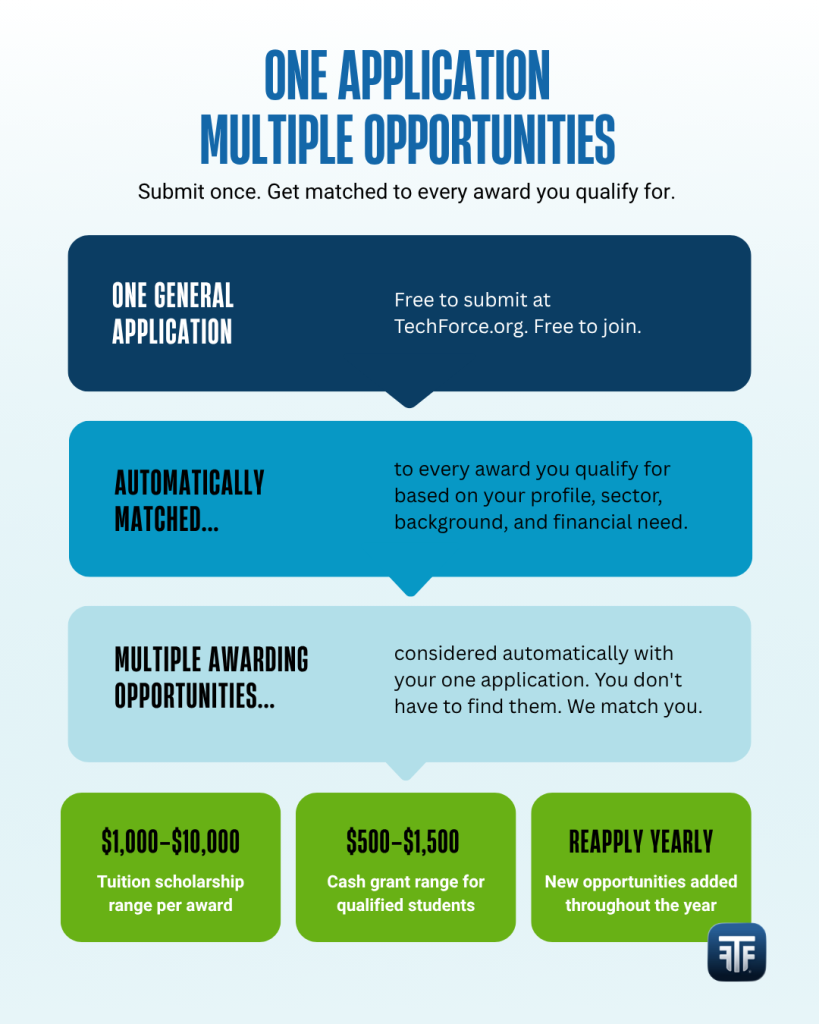
  • Tuition Scholarships: Range from $1,000 to $10,000 per award. The average award is $2,500. Most TechForce scholarships can be applied toward all Cost of Attendance needs – not just tuition – which can include fees, books, tools, housing, and transportation depending on the specific award.
  • Cash Grants: Smaller awards of $500 to $1,500, offered to qualified students who demonstrate financial need. These are particularly helpful for students navigating immediate financial gaps.

TechForce has more than 80 donor-specific awarding opportunities throughout the year. That range of funding sources is what gives TechForce the ability to make thousands of awards across different student profiles, program types, and financial situations. You don’t need to know which donors or awards exist – the application process handles the matching for you.

Who Can Apply?

TechForce scholarships are need-based and open to students nationwide. To be eligible, you must meet all five minimum requirements:

#RequirementWhat It Means
1U.S. Citizenship or StatusMust be a U.S. citizen or permanent resident.
2High School Diploma or GEDA completed high school diploma or GED equivalent is required.
3Enrolled StudentMust be an enrolled future student, or an active current student in good standing at an accredited post-secondary institution offering a technician curriculum.
4Demonstrated Financial NeedMust have a completed and approved FAFSA on file at your school for the current year.
5Meet Award-Specific RequirementsSome individual awards carry additional criteria such as minimum GPA, program start date, or school type. These are listed with each opportunity in the portal.

A note for veterans, women, and students with learning differences: many donors give specifically to support certain groups. TechForce also receives donations through the Combined Federal Campaign (CFC #70172) for veterans. You don’t need to find or apply for these separately – the general application automatically matches you to every opportunity you qualify for.

How Does the Application Work?

TechForce uses one General Application for all scholarship funding. Submit it once and you’re automatically considered for every award you may qualify for – all 80+ opportunities, matched to your profile.

Step 1: Complete Your FAFSA First

TechForce scholarships are need-based, determined by your completed and approved FAFSA (Free Application for Federal Student Aid) for the current school year. Make sure it’s submitted and on file at your school before you apply.

Step 2: Create a Free TechForce Profile

Go to TechForce.org and create your free account on the TechForce platform. Log in, click on Scholarships, then click Apply For Scholarships.

Use your personal email address – the one on file with your school. This is the most common login issue students run into.

Step 3: Submit the General Application

Complete the General Application carefully. Your answers are used to match you to every relevant award in the system. Some additional opportunities may be presented that have additional criteria requirements – these are optional and specifics can be seen in the opportunity descriptions.

Step 4: Check Your Status Anytime

Log into the Scholarship Portal and click the “My Applications” tab to track your status. TechForce awards scholarships and grants ongoing and year-round, with offers typically being sent out on a monthly basis. TechForce typically does not make ‘instant decisions’. Offers may be made at any time during the calendar year.

Can I Apply More Than Once?

Yes – students can apply for new yearly award cycles, and they can also be awarded more than once. Students may reapply each year for continued funding. TechForce is always raising new money from new donors, and award opportunities are added throughout the year. A student who doesn’t receive an award in one cycle may receive one in the next.

Why Didn’t I Get an Award?

TechForce has awarded millions of dollars in scholarships since its founding – but there is not enough funding for every applicant in every cycle. If you didn’t receive an award, it does not mean your application isn’t qualified. It means the competition was real and the budget has limits. You can update your application throughout the year with an added program, updated grades, etc. 

What If I Have an Emergency?

Scholarships and tuition grants aren’t the only financial support TechForce offers. The Life Happens Grant exists specifically for students facing a sudden financial crisis that threatens their ability to stay in school. Please note: emergency support programs are currently available at select schools only. Check with your campus Student Services department to confirm whether your school participates.

What Is the Life Happens Grant?

Life Happens is TechForce’s emergency support fund. It’s designed for moments when something unexpected hits and you don’t have the resources to handle it without putting your education at risk. Areas of support include:

  • Urgent vehicle or equipment repairs
  • Medical expenses
  • Child care emergencies
  • Emergency rent or living expenses
  • Sudden temporary gaps in employment
  • Emergency airline tickets for bereavement purposes
  • Natural disaster-related expenses
  • Other similar sudden financial emergencies
  • General financial shortage, if budget allows
Important: What Life Happens Does NOT Cover Life Happens grants are not intended for standard tuition payments – apply for a tuition scholarship for that.Life Happens grants are not for relocation support – see TechForce’s Strong Start opportunity for that, if your school qualifies.

Campus Pantry and On-the-Spot Emergency Grants

TechForce also offers Campus Pantry support and on-the-spot emergency grants at select schools. These programs provide immediate relief for students facing food insecurity or urgent short-term needs – without the wait of a formal application cycle. Check with your Student Services department for more information. 

Are There Other Scholarships I Should Know About?

After applying through TechForce, check the platform for a curated list of external scholarship opportunities from credible partner organizations. Your school’s Student Services office is also worth a conversation – they often know about institutional grants, state programs, and employer-sponsored funding that many students overlook.

A few additional sources worth checking:

Ready to Apply? Start Here Go to TechForce.org & create your free accountLog inClick ScholarshipsClick Apply & Submit the General Application Questions? Use the Contact Us form, call (866) 519-6923, or chat with the Help Desk from any TechForce pageVisit TechForce.org – free to join, one application, no repayment.

The Bottom Line

TechForce scholarships exist because companies and individuals believe the skilled trades are worth investing in – and that students who are doing the work deserve support to finish it. The application is free. One submission covers every opportunity. 

Sources & Further Reading

For more information on the topics covered in this article, we recommend the following resources:

Please share your contact details and a TechForce team member will contact you.


"By connecting students, instructors, industry pros and working techs, the TechForce Foundation provides unilateral support to the transportation industry’s technician recruiting needs… The administration of our Scholarships by the TechForce team has been instrumental in delivering us with a successful method to gain interest from qualified candidates as well as provide our students with additional assistance to complete their education."
Tony Farr
Ford Technical Programs Manager