Find a Mentor, Be a Mentor: How Mentorship Accelerates a Technical Career
The fastest path to advancement in any skilled trade runs through someone who has already made it. Here’s how to find a mentor, make the most of that relationship, and eventually become one yourself.

Why Is Mentorship So Valuable in the Skilled Trades?
Technical school teaches you how systems work. A mentor teaches you how the work actually works – the unwritten rules of the shop, the shortcuts that save time, the mistakes worth making and the ones worth avoiding, and what it actually takes to advance.
The skilled trades have a long tradition of knowledge passing from experienced techs to new ones. It’s how the industry has always transmitted the things that can’t be written down in a service manual – judgment, intuition, professional standards, and the kind of diagnostic thinking that only comes from years of experience.
Research on career development consistently shows that people with mentors advance faster, earn more, and report higher job satisfaction than those without. In the skilled trades, that effect is especially strong because so much of the career is built on practical knowledge and professional reputation – both of which a mentor can directly influence.
The best mentors aren’t the ones who give you all the answers. They’re the ones who teach you to ask better questions – and trust you enough to let you figure some things out on your own.
What Does a Good Mentor Actually Do?
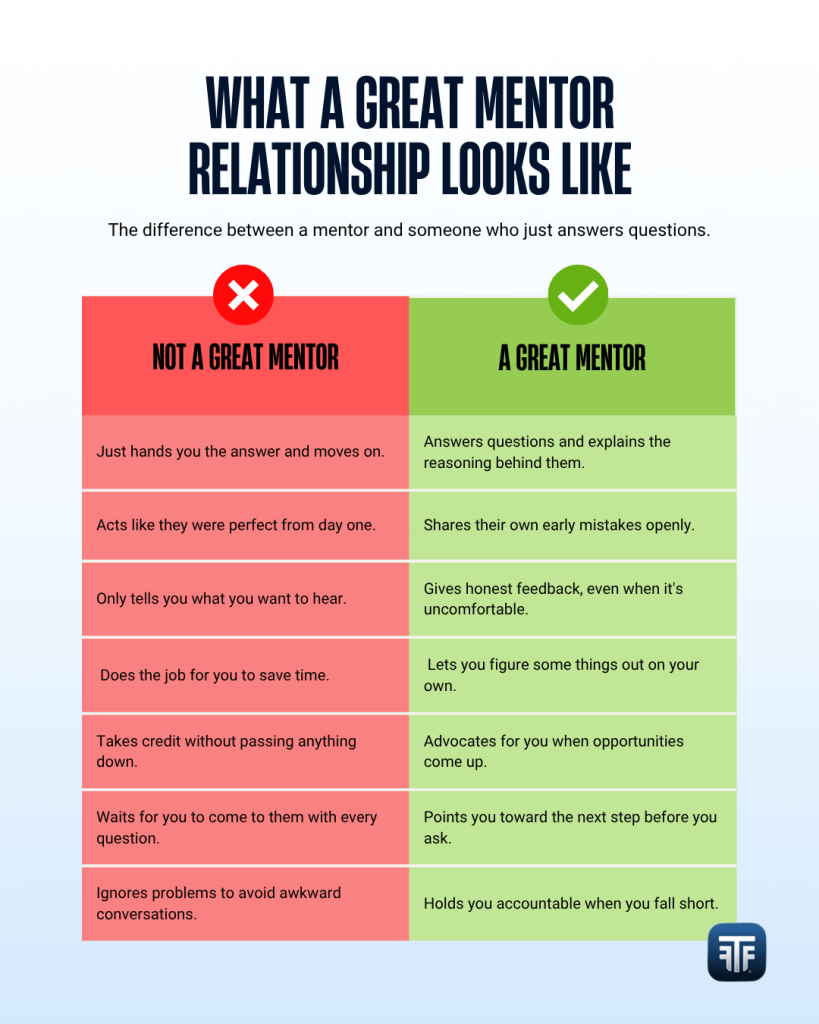
Mentorship in the trades isn’t a formal program (though it can be). Most often it’s an organic relationship that develops between a new tech and an experienced one who takes an interest in their growth. A good mentor in the skilled trades typically:
- Answers technical questions – and explains the reasoning, not just the answer
- Shares their own mistakes and what they learned from them
- Gives honest feedback on your work, including the parts that need improvement
- Advocates for you when opportunities come up – a good shift, a training spot, more complex work
- Helps you navigate shop culture, interpersonal dynamics, and professional norms
- Points you toward the next step in your development before you know to ask for it
What a good mentor does not do is carry you. The relationship is developmental, not dependent. The goal is to make you better at the work – not to do it for you.
How to Find a Mentor in Your Shop
Most new techs wait for mentorship to find them. The ones who advance fastest go looking for it. Here’s how to identify and approach a potential mentor in your shop:
Look for the Tech Who Likes to Teach
Not every experienced tech is a mentor by temperament. Some are heads-down, focused on their own work, and don’t enjoy being interrupted. Others genuinely enjoy explaining things and watching newer techs develop. Pay attention to who answers questions patiently, who takes time to explain rather than just demonstrate, and who talks positively about new people in the shop.
Start Small Before Asking for Big
Don’t walk up to a master tech on day one and ask them to mentor you. Build the relationship incrementally. Ask a specific question about a job you’re working on. Say thank you when they help. Return the favor in small ways – grab a tool, help clean up a bay, be available when they need an extra pair of hands. The formal mentor relationship often grows out of those smaller interactions.
Be a Student Worth Teaching
Mentors invest in people who show up, pay attention, and apply what they’re taught. If you ask someone to explain something and then don’t use the information, they’ll stop explaining. Show that their investment in you is producing results – ask better questions over time, demonstrate what you’ve learned, and be honest about what you still don’t understand.
What to Say: Starting the Mentorship Conversation
For many new techs, the hardest part is knowing how to approach an experienced tech without it feeling awkward. The table below offers specific openers that work – and why each one lands the way it does:
| What to Say | Why It Works |
| “Can I ask you a question about this repair?” | Low-stakes, specific, and respectful of their time. A great first step with any experienced tech. |
| “How did you learn to diagnose this kind of problem?” | Invites them to share their process, not just their answer. Techs who like to teach respond well to this. |
| “I’m trying to get better at electrical diagnosis. Would you be willing to let me watch next time you have a tough one?” | Direct, specific, and shows initiative. Much easier to say yes to than a vague request for help. |
| “I want to be doing more complex work in the next year. What would you tell someone in my position to focus on?” | Strategic and forward-looking. Shows you’re thinking about your career, not just the next job. |
| “Is there anything I could help you with this week?” | Offering value first. Mentorship relationships that start with mutual benefit tend to last longer. |
Finding Mentors Beyond Your Shop
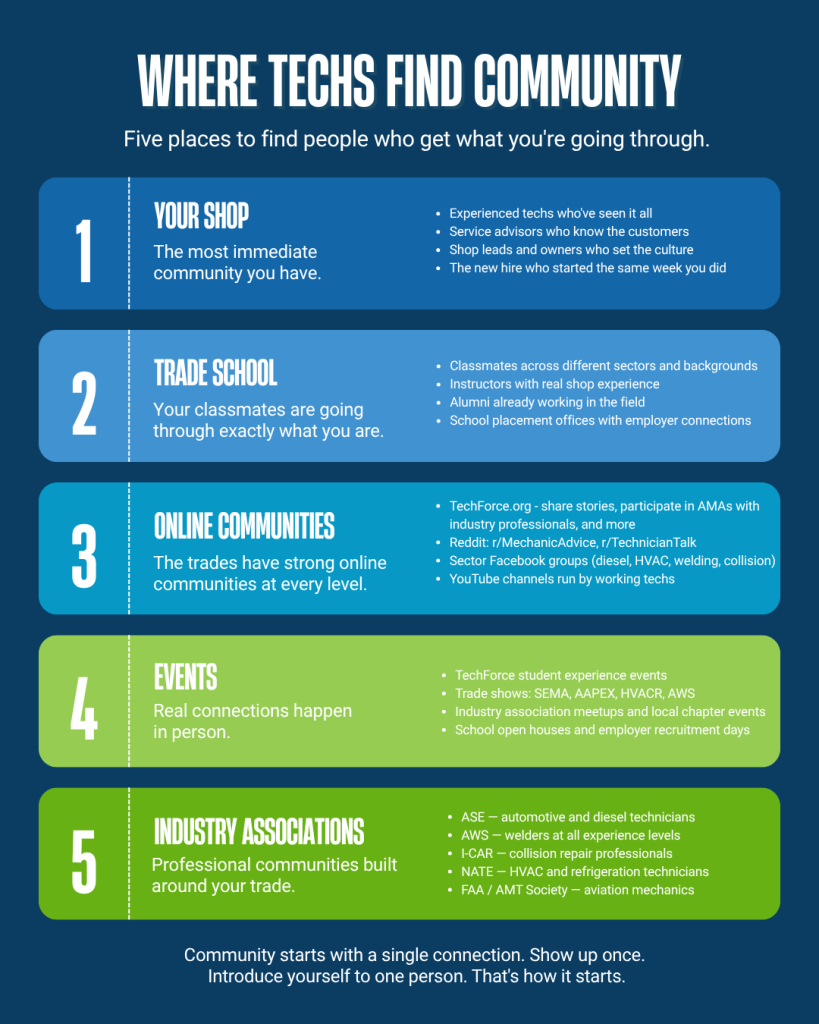
Your shop is the most immediate source of mentorship – but it’s not the only one. TechForce Foundation connects students to mentors outside their immediate workplace through the platform’s community and network of industry professionals.
- TechForce AMA sessions give students a direct line to master techs, shop owners, and industry leaders. Students post questions on the TechForce platform over a two-month window, and the AMA host responds by video – answering real questions from real students. For techs without an experienced mentor in their corner, these sessions can be the next best thing.
- TechForce events give students the opportunity to meet industry professionals in person – school trips, industry events, and networking events where real mentorship relationships have started.
Beyond TechForce, industry associations like ASE, iATN, AWS, and I-CAR all have communities where students and newer techs can connect with experienced professionals in their sector.
When You’re Ready: Becoming a Mentor
The trades have a culture of passing knowledge forward. It’s one of the things that makes skilled trade careers different from most other professional paths – the expectation that as you advance, you bring others along with you.
You don’t have to be a master tech to be a mentor. You just have to be further along than the person you’re helping. If you’re a second-year tech and a first-year is struggling with something you’ve already figured out, you have something valuable to offer. Sharing it doesn’t diminish what you know – it strengthens it.
The techs who are most respected in any shop are rarely the ones who hoarded their knowledge. They’re the ones who made the people around them better. That reputation follows you through an entire career.
TechForce Mentorship and Community Resources
TechForce Foundation’s platform connects students to a network of mentors, industry professionals, and peers across multiple major skilled trade sectors. Whether you’re looking for technical guidance, career advice, or simply someone who understands what you’re going through, TechForce’s community is built to support that connection.
The Bottom Line
A career in the skilled trades is built on knowledge, skill, and relationships. Mentorship is where all three come together. Find someone who is further along the path than you are. Ask good questions. Apply what you learn. And when the time comes, reach back and bring someone else along.
That’s how this industry has always worked. And it’s one of the best things about it.
Sources & Further Reading
For more information on the topics covered in this article, we recommend the following resources:
- TechForce Foundation: TechForce.org – AMA sessions, mentorship connections, and wraparound support services for students in skilled technical careers
- National Institute for Automotive Service Excellence (ASE): ase.com – professional development resources and community for automotive and diesel technicians at all experience levels
- iATN (International Automotive Technicians Network): iatn.net – professional community where experienced technicians share knowledge and mentor newer techs through real-world case studies
- American Welding Society (AWS): aws.org – mentorship programs and professional community for welders across all experience levels