
Imposter syndrome is real, but it doesn’t have to run your career. Here’s how to build genuine self-esteem in the shop from day one.
The Feeling Nobody Talks About
You passed your courses. You landed the apprenticeship. You’re standing in the shop, and suddenly you feel like everyone can tell you have no idea what you’re doing.
That feeling has a name: imposter syndrome. Nearly every technician, from first-year apprentices to master techs, has felt it at some point.
The difference between the techs who stick it out and the ones who walk away isn’t talent. It’s what they do with that feeling.
“When you were in a bad spot mentally, how did you overcome that?” – A frequently asked question TechForce students submitted to a master tech during a live AMA.
You Are Not Starting From Scratch
TechForce Foundation currently supports thousands of students on its career-readiness platform. Here’s who those students actually are:
- 42% are the first in their family to pursue postsecondary technical training
- 23% report learning differences such as ADHD or dyslexia
- 59% identify as people of color or multiethnic
- 8% are veterans making a career transition into the skilled trades
Those numbers matter. You are not alone, and you never were. The automotive technician shortage is real – America needs nearly 1 million new entry-level technicians by 2028 – and that means the industry needs you. Every one of you.
What Is Imposter Syndrome, and Why Do Techs Get It?
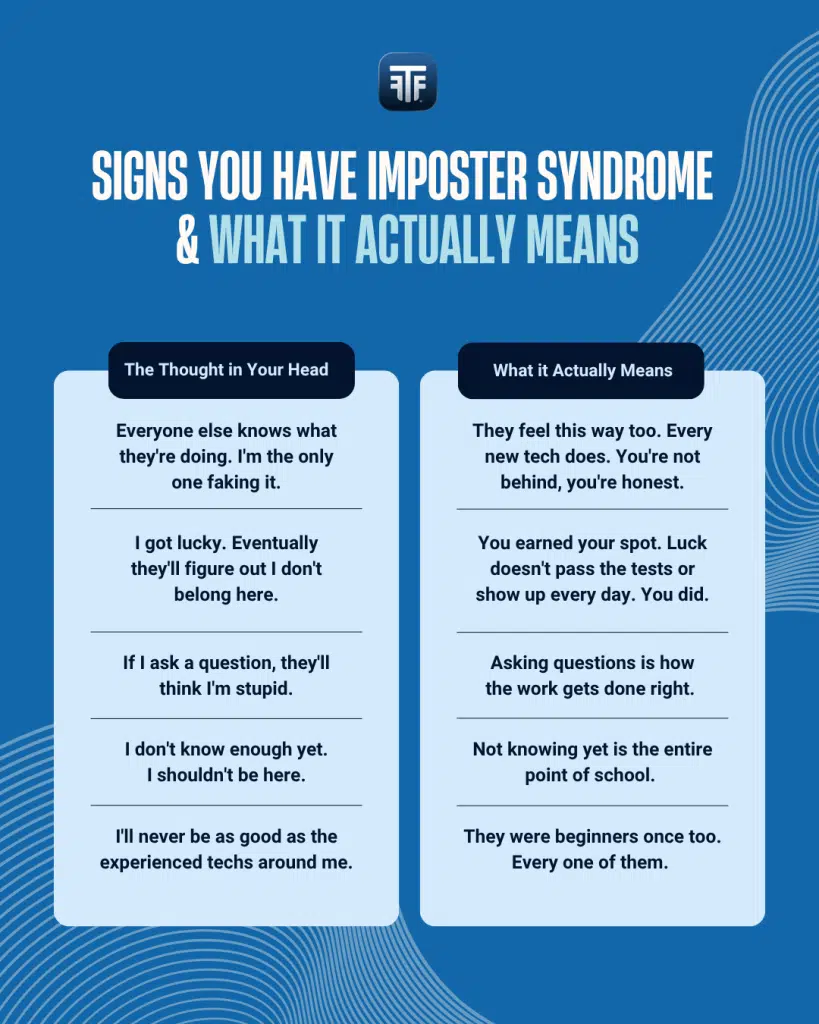
Imposter syndrome is the internal experience of believing you’re not as competent as others perceive you to be. In a skilled career, it often sounds like:
- “Everyone else knows what they’re doing. I’m the only one faking it.”
- “I got lucky. Eventually they’ll figure out I don’t belong here.”
- “If I ask a question, they’ll think I’m stupid.”
Sound familiar? This is especially common for:
- First-generation students who didn’t grow up around cars, diesel, or aviation
- Techs from underrepresented groups who rarely see people like themselves in the shop
- Apprentices who’ve only seen the textbook version, not the real-world chaos of a busy bay
- Career changers who are used to being the expert in their previous field
The Truth About Being a Beginner
Here’s what the master techs don’t always say out loud: everybody starts at zero. The tech who’s been turning wrenches for 20 years once stared at an engine and had no clue where to begin.
The skilled trades are built on a progression. There’s a reason it’s called an apprenticeship: you are supposed to be learning. Asking questions isn’t weakness. It’s how the work gets done right.
“My dream is to become a level 3, master diesel technician. I wish to make good money and provide great service to my customers.” – TechForce student
That dream is valid. And it starts exactly where you are right now. Skilled careers in automotive technology, diesel mechanics, aviation, and collision repair offer strong wages and real long-term stability. The path forward exists. You just have to stay on it.
5 Ways to Build Real Confidence in the Shop
1. Document Your Wins, Even the Small Ones
Confidence is built on evidence. Start keeping a simple log of things you did right: a repair you completed without help, a customer who thanked you, a question you answered correctly. When imposter syndrome flares up, look at the list.
2. Get Comfortable Saying ‘I Don’t Know Yet’
The most dangerous tech in a shop is the one who pretends to know things they don’t. A confident tech can say, “I haven’t seen that before, let me check” or “Can you walk me through that?” That’s professionalism, not ignorance.
3. Find Your People
Community matters enormously in technical careers. When you’re surrounded by people who understand what you’re going through (other students, women in the skilled trades, veterans making a career change), the loneliness of imposter syndrome shrinks fast. TechForce connects students to like-minded circles across automotive, diesel, aviation, and more.
4. Replace Comparison with Curiosity
Instead of watching another tech and thinking “I’ll never be that good,” try: “What would I need to learn to get there?” Comparison is a dead end. Curiosity is a career path.
5. Talk to a Tech Who Struggled Early
Nothing cuts through imposter syndrome like hearing a master tech say, “Yeah, I had no idea what I was doing my first year either.” Find a mentor. Ask the question. You’ll be surprised what they share.
Rewiring Your Inner Voice
Self-esteem isn’t about fake positivity. It’s about accurate thinking. Here’s a practical reframe for the most common negative self-talk patterns techs experience:
| Instead of thinking… | Try thinking… |
| “I’m not good enough.” | “I’m building skills every single day.” |
| “Everyone else gets it but me.” | “They’ve had more time. I’ll get there too.” |
| “I shouldn’t have gotten this opportunity.” | “I earned this chance. Now I’ll make the most of it.” |
| “If I fail at this, it’s all over.” | “One mistake doesn’t define my career.” |
When It Goes Deeper Than Confidence
Sometimes what feels like imposter syndrome is something more. If you’re experiencing persistent anxiety, depression, or thoughts of self-harm, that’s not a mindset problem. It’s a health issue, and you deserve real support.
- Talk to a counselor at your school – most programs have resources available
- Contact the 988 Suicide and Crisis Lifeline (call or text 988) for immediate support
- Reach out to TechForce – we can connect you to wraparound support services
There’s no weakness in asking for help. The best techs know when to call in backup.
TechForce Resources for Students in Skilled Careers
TechForce Foundation offers far more than automotive scholarships and grants. Our Wraparound Services are built around what students actually need to make it through technical education and into a skilled career:
- Mentorship connections through the TechForce platform, linking students with working techs
- AMA sessions with master techs and industry leaders, on topics you actually care about
- 350+ life skills trainings available on the platform and ranked by students
Thousands of students are already on the platform. Scholarships for technical schools, career readiness tools, job connections, and community are all waiting for you at TechForce.org.
The Bottom Line
Self-esteem in the shop isn’t built overnight. It’s built one completed repair at a time. One question asked. One skill learned. One moment where you realize: I can actually do this.
You chose a skilled career that keeps the world moving. That matters. You matter. And you belong here, not someday, but right now.

Sources & Further Reading
For more information on the topics covered in this article, we recommend the following resources:
- 988 Suicide and Crisis Lifeline: 988lifeline.org – free, confidential mental health crisis support available 24/7 by call or text
- National Alliance on Mental Illness (NAMI): nami.org – mental health education, support groups, and resources for individuals and families
- American Psychological Association (APA): apa.org – research and resources on imposter syndrome, self-esteem, and workplace mental health