
Being a parent and a trade student at the same time is genuinely hard. Here’s where to find support, and how to build a family balance that holds.

The Reality of Being a Student Parent in the Skilled Trades
TechForce students are not the average college student. The average TechForce student is in their early-to-mid 20s, often working part-time or full-time alongside school, and a significant portion are supporting families: partners, children, or both.
Student parents in technical education face a specific and compounding set of pressures: tuition, tools, childcare, commute, and the relentless physical and mental demands of a technical program, all at the same time. Financial stress around childcare is one of the most common reasons students leave technical school before finishing.
This article does not minimize how hard that is. It also does not pretend there is an easy solution. What it does is lay out the resources that exist, the strategies that work, and the mindset that makes both possible at once.
“I have to work to cover rent, tuition, food for myself, my girlfriend, and our 1-year-old son.” – TechForce student, describing a reality that is far more common than most people realize.
Childcare: Finding and Funding It
Start with Your School
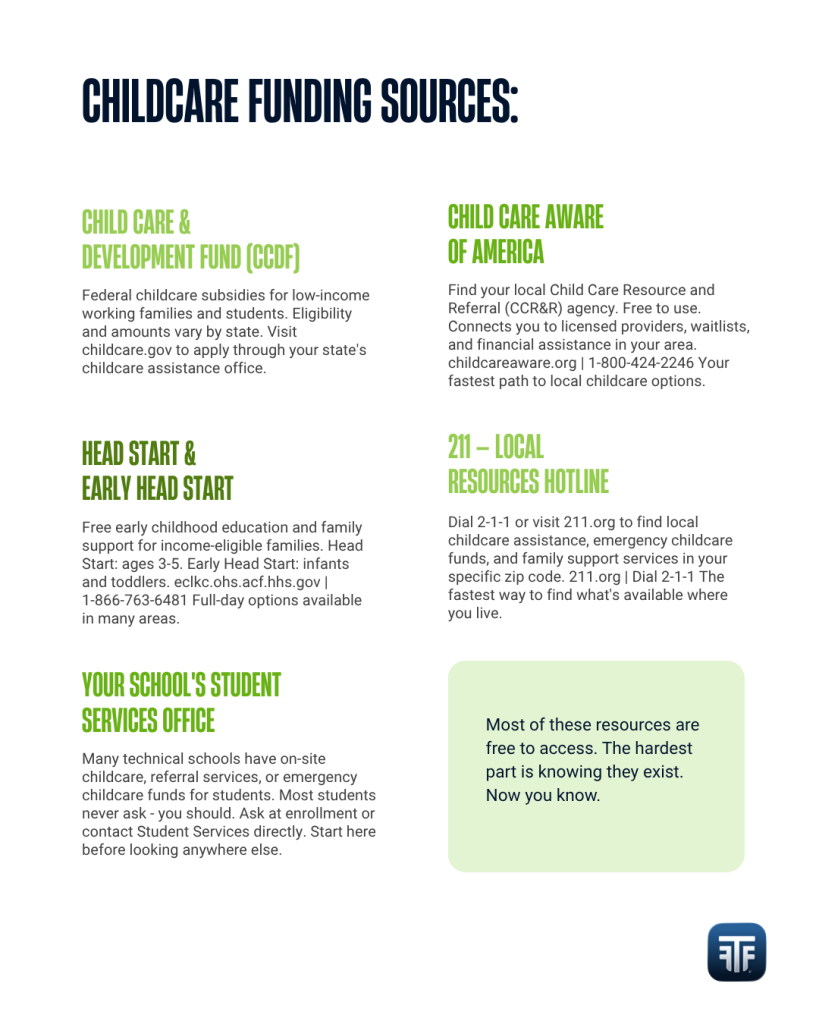
Many accredited technical schools and community colleges have childcare resources on campus or through affiliated programs – including on-site childcare centers, childcare referral services, and emergency childcare funds for students in crisis. These resources are often underutilized simply because students don’t know they exist.
Before looking anywhere else, contact your school’s Student Services office and ask directly: what childcare support is available to enrolled students? The answer may surprise you.
Child Care and Development Fund (CCDF)
The federal Child Care and Development Fund provides childcare subsidies to low-income working families and students. Eligibility and benefit levels vary significantly by state, but students in technical programs who meet income requirements may qualify for substantial assistance. Apply through your state’s childcare assistance office.
Find your state’s program at childcare.gov – the federal portal for all CCDF-related programs and state contacts.
Head Start and Early Head Start
Head Start provides free early childhood education, health, and family support services to income-eligible families with children up to age 5. Early Head Start serves infants and toddlers. Both programs are free to qualifying families and include full-day options in many areas.
Find a Head Start program near you at eclkc.ohs.acf.hhs.gov or call 1-866-763-6481.
Child Care Resource and Referral Agencies (CCR&Rs)
Every state has a network of Child Care Resource and Referral agencies that help families find licensed childcare providers, understand costs, and access subsidy programs. CCR&Rs are free to use and can connect you with local providers, waitlist information, and financial assistance options.
Find your local CCR&R at childcareaware.org or call 1-800-424-2246.
211.org
Dialing 2-1-1 or visiting 211.org connects you to a local specialist who can identify childcare resources, subsidy programs, emergency childcare assistance, and family support services in your specific area. This is often the fastest way to find what’s available locally.
Financial Support for Student Parents
SNAP (Food Assistance)
The Supplemental Nutrition Assistance Program (SNAP) provides monthly food assistance to eligible low-income households, including student families. Eligibility rules for students have specific requirements, but students who are working 20 or more hours per week, or who have dependent children, are often eligible regardless of student status. Apply through your state’s SNAP office or at fns.usda.gov/snap.
WIC (Women, Infants, and Children)
WIC provides food assistance, nutrition counseling, and healthcare referrals for pregnant women, new mothers, and children under age 5 who meet income guidelines. If you have a young child or a partner who is pregnant, WIC is worth applying for regardless of your income level – the cutoff is higher than many people expect. Apply through your local health department or at fns.usda.gov/wic.
Temporary Assistance for Needy Families (TANF)
TANF provides cash assistance and support services to low-income families with children. Many states allow TANF recipients to count technical school enrollment as an approved work activity, which can make student parents in technical programs eligible while they complete their training. Rules vary significantly by state. Apply through your state’s social services office.
Earned Income Tax Credit (EITC)
The EITC is a refundable federal tax credit for low-to-moderate income working individuals and families, particularly those with children. Many working student parents qualify and don’t claim it. Filing your taxes and claiming the EITC can result in a significant refund that helps cover childcare and family costs. Visit irs.gov/eitc for eligibility information and free filing resources.
Family Balance: Strategies That Actually Work
No strategy eliminates the pressure of being a student parent. But the student parents who finish technical school tend to share a few approaches in common.
Communicate Your Schedule in Advance
Your family, your employer, and your school all need to know when you’re unavailable and when you’re available. Get your school schedule as early as possible each term and build everything else around it. Surprises are where the system breaks down.
Identify Your Non-Negotiables – and Protect Them
Decide in advance what cannot be missed: a child’s medical appointment, a school performance, a family commitment that matters. Put these in your schedule the same way you put in a class. Everything else gets worked around them. Student parents who try to accommodate everything tend to end up protecting nothing.
Build a Backup Childcare Plan
Every working parent needs at least one backup childcare option: a family member, a trusted neighbor, a reciprocal arrangement with another parent. When your primary childcare falls through (and it will), having a backup means a stressful morning instead of a missed day of school or work.
Ask Your School About Flexibility
Many technical programs have more flexibility than students realize. If a family emergency affects your attendance or performance, communicating proactively with your instructor almost always produces a better outcome than going silent. Schools that understand the reality of their students’ lives exist, and the ones that don’t, are worth knowing about before you enroll.
Let Your Partner or Support System In
If you have a partner, family member, or close friend who is part of your support system, be honest with them about what the next 12-24 months will require. Students who try to manage everything without asking for help tend to burn out faster. The people around you cannot support what they don’t understand.
A Note on TechForce Resources
TechForce Foundation’s wraparound services are designed to help students stay enrolled and finish what they started, including students who are navigating family obligations alongside their technical education. While TechForce does not currently offer direct childcare funding, the platform connects students to scholarship support, emergency financial assistance (at select schools), and a range of life skills trainings that address the real challenges of being a student in the skilled trades.
If financial pressure related to family obligations is threatening your ability to stay enrolled, visit TechForce.org and look into the Life Happens Grant (available at select schools) and the General Scholarship Application. Both exist specifically for students who are doing everything right and still need a hand.
The Bottom Line
Being a student parent in the skilled trades is one of the hardest things a person can do. The demands are real, the margin for error is thin, and the support systems are not always easy to find.
But the career on the other side is real too. The earning potential, the job security, the sense of doing work that matters – all of it is available to student parents who finish the program. The resources in this article exist to help you get there. Use them.
Sources & Further Reading
For more information on the topics covered in this article, we recommend the following resources:
- Child Care and Development Fund (CCDF): childcare.gov – federal portal for childcare subsidies, state program contacts, and eligibility information
- Child Care Aware of America: childcareaware.org – find your local Child Care Resource and Referral agency and access childcare cost and availability data
- Head Start / Early Head Start: eclkc.ohs.acf.hhs.gov – free early childhood education and family support for income-eligible families
- SNAP (Food Assistance): fns.usda.gov/snap – eligibility information and state application portals
- WIC: fns.usda.gov/wic – nutrition and food assistance for pregnant women, new mothers, and children under 5
- Earned Income Tax Credit (EITC): irs.gov/eitc – eligibility information and free filing resources for working families
- 211.org: 211.org – dial 2-1-1 or search online to find local childcare, family support, and financial assistance resources
- TechForce Foundation: TechForce.org – scholarships, Life Happens Grant (select schools), wraparound support services, and life skills trainings for students in skilled technical careers