
Not all shops are created equal. Here’s how to evaluate employers, understand different shop cultures, and find the kind of workplace where your career can actually grow.

Why Employer Quality Matters as Much as the Job Offer
In a market with 3 to 7 job openings per graduate across skilled trade sectors, new technicians have more options than they often realize. The question is not just whether you can get a job – it’s whether you get the right one.
The shop you start in shapes your first years in the trade more than almost any other factor. A great employer invests in your training, gives you a clear path to advance, pays fairly, and treats you like a professional. A poor employer burns through new techs, offers no growth, and can erode enthusiasm for a career that took real effort to enter.
Knowing what to look for – and what to walk away from – is one of the most important skills a new technician can develop.
What makes a great employer in the skilled trades is not complicated: fair pay, real training, honest communication, and a culture where people are treated with respect. The shops that get all four tend to have the same techs for 10 to 20 years.
What Makes a Great Employer in the Skilled Trades?
TechForce evaluates employer quality using criteria informed by the Good Jobs Institute framework, which defines a good job as one that provides economic stability, growth opportunity, and a sense of dignity and purpose at work. In the skilled trades, that translates to:
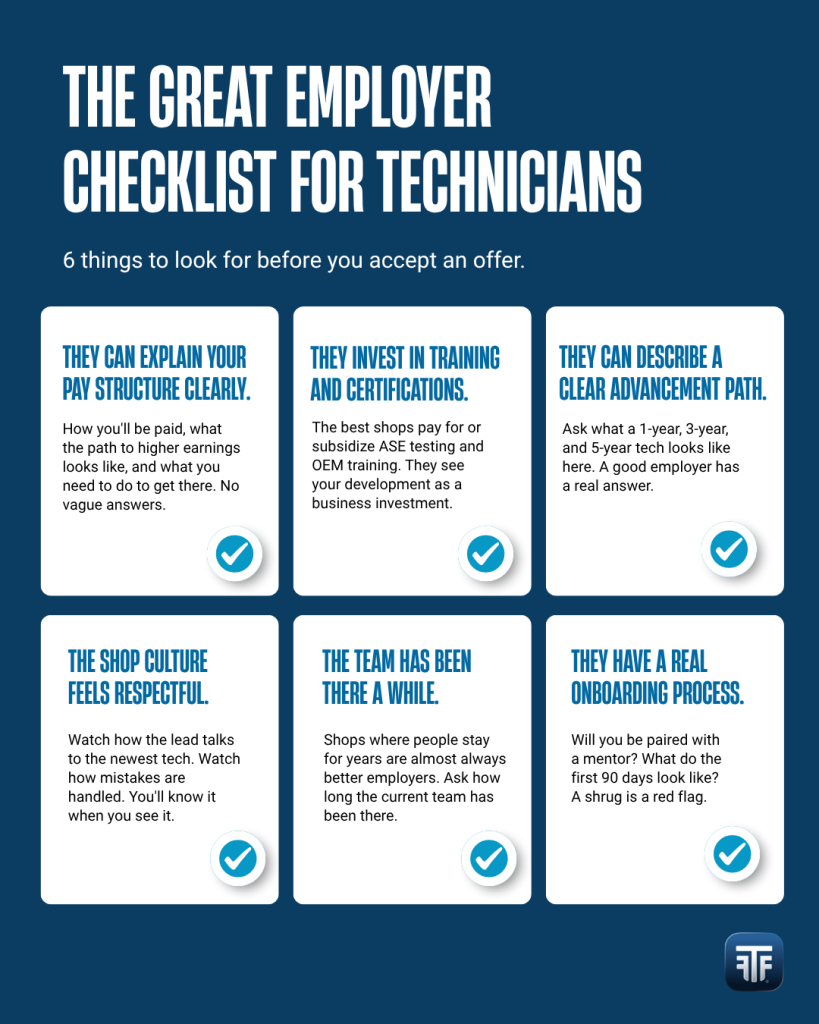
- Fair and transparent pay. A great employer can explain clearly how you’ll be compensated, what the path to higher earnings looks like, and what you need to do to get there. Vague or evasive answers about pay are a warning sign.
- Investment in training and certifications. The best shops pay for or subsidize ASE testing, OEM training, and continuing education. They see technician development as a business investment, not a cost.
- Clear advancement pathways. Good employers can tell you what a 1-year, 3-year, and 5-year tech looks like at their shop – in terms of responsibility, title, and pay. If there’s no answer to that question, there may be no path.
- A culture of respect. This is harder to measure but easy to observe. Watch how the shop lead talks to the newest tech. Watch how mistakes are handled. Watch whether people seem genuinely engaged or just counting the hours.
- Low voluntary turnover. Shops where people stay for years are almost always better employers than shops with constant turnover. Ask how long the current team has been there.
Understanding Different Shop Types and Cultures
The skilled trades offer employment across several different shop environments, each with its own culture, structure, and trade-offs. Here’s how they compare:
| Shop Type | Strengths | Considerations |
| Franchise Dealership | Structured training, OEM certifications, consistent workflow, benefits packages | Higher volume pressure, less flexibility, corporate culture may not suit everyone |
| Independent Shop | More autonomy, broader repair variety, closer team relationships | Benefits and training support vary widely – vet carefully before accepting an offer |
| Fleet Operation | Consistent hours, predictable work, often strong benefits and union representation | Less variety, may be brand or system specific, less customer interaction |
| Specialty Shop | Deep expertise in a niche (performance, diesel, European imports, EV), passionate team culture | Smaller teams, fewer advancement layers, business stability depends on niche demand |
None of these shop types is universally better than the others. The right fit depends on what you value at each stage of your career – structured training early on, autonomy and variety later, or depth of specialization in a niche you’re passionate about.
How to Evaluate a Job Offer
A job offer is more than a number. Here’s what to look at before you accept:
Total Compensation, Not Just Base Pay
Factor in health insurance, paid time off, tool allowances, uniform programs, and any training reimbursement. A shop offering $18/hour with full benefits may be worth more than $22/hour with nothing else – depending on the cost of benefits in your area.
The Pay Progression Timeline
Ask what the path from your starting rate to flat rate or senior tech pay looks like – and over what timeline. Get specific. “We’ll see how it goes” is not an answer. A shop with a clear answer to this question has thought about retaining its people.
The Training Commitment
Ask directly: does the shop pay for ASE testing? Are there OEM training programs available? Is there time built into the schedule for continuing education? These answers tell you how serious the employer is about your long-term development.
The First 90 Days
Ask what onboarding looks like. Will you be paired with a mentor or senior tech? What will your first months of work actually involve? A shop with a real answer to this has a real onboarding process. A shop that shrugs probably doesn’t.
Red Flags That Are Worth Walking Away From
The technician shortage means you have leverage. Use it to avoid situations that will hurt your career:
- High turnover with no explanation. If multiple techs have left in the past year and nobody will tell you why, assume the worst and keep looking.
- Pressure to skip the onboarding process. “We need you to start immediately” combined with no structured introduction to the shop is a sign of disorganization that will affect your daily experience.
- Vague or shifting answers about compensation. If the pay structure keeps changing through the interview process, expect the same pattern after you’re hired.
- No answer on advancement. If a shop cannot tell you what growth looks like for a tech who performs well, there is no growth path. That’s a ceiling, not a starting point.
- A dismissive attitude toward training. Shops that view certifications as unnecessary or “something you do on your own time” are telling you exactly how much they value your professional development.
TechForce Tools for Finding the Right Employer
TechForce Foundation’s platform connects students to employers through a job board with tens of thousands of positions, direct employer partnerships, and events where students and hiring managers meet in person. The platform also provides career path maps and salary data that help students evaluate offers with real information rather than guesswork.
With the technician shortage at historically high levels, the right employer is out there. The tools to find them are at TechForce.org.
The Bottom Line
The trade you choose is only half the decision. The employer you choose shapes everything that comes after – your training, your advancement speed, your daily experience, and your long-term earning potential. Take the evaluation seriously.
A great shop and a skilled technician who shows up every day ready to work is one of the most productive relationships in the skilled trades. That relationship starts with choosing well on both sides.

Sources & Further Reading
For more information on the topics covered in this article, we recommend the following resources:
- Good Jobs Institute: goodjobsinstitute.org – research and criteria defining high-quality employment, used as a framework for evaluating employer quality in the skilled trades
- U.S. Bureau of Labor Statistics (BLS): bls.gov – wage data, benefits information, and labor market conditions for skilled trade occupations
- National Institute for Automotive Service Excellence (ASE): ase.com – employer training investment standards and certification programs used to evaluate technician development