
Electric vehicles, smart buildings, autonomous systems, and advanced materials are changing every skilled trade. Here’s what’s coming, what it means for your career, and how to stay ahead of it.
Are the Skilled Trades Being Replaced by Technology?
This is the question a lot of students ask, and it deserves a direct answer: no. Technology is changing the skilled trades – dramatically, in some sectors – but it is not replacing the technicians who understand it. If anything, the gap between what technology can do and what humans are needed to install, maintain, diagnose, and repair it is growing faster than the workforce can keep up.
America already needs nearly 1 million new entry-level technicians by 2028. That shortage exists right now, before the full wave of EV adoption, smart building automation, and autonomous systems hits the mainstream. The techs who combine foundational trade skills with knowledge of emerging technology will be among the most valuable workers in the country.
This article breaks down the most important trends in each of the six major skilled trade sectors – and what they mean for your career trajectory.
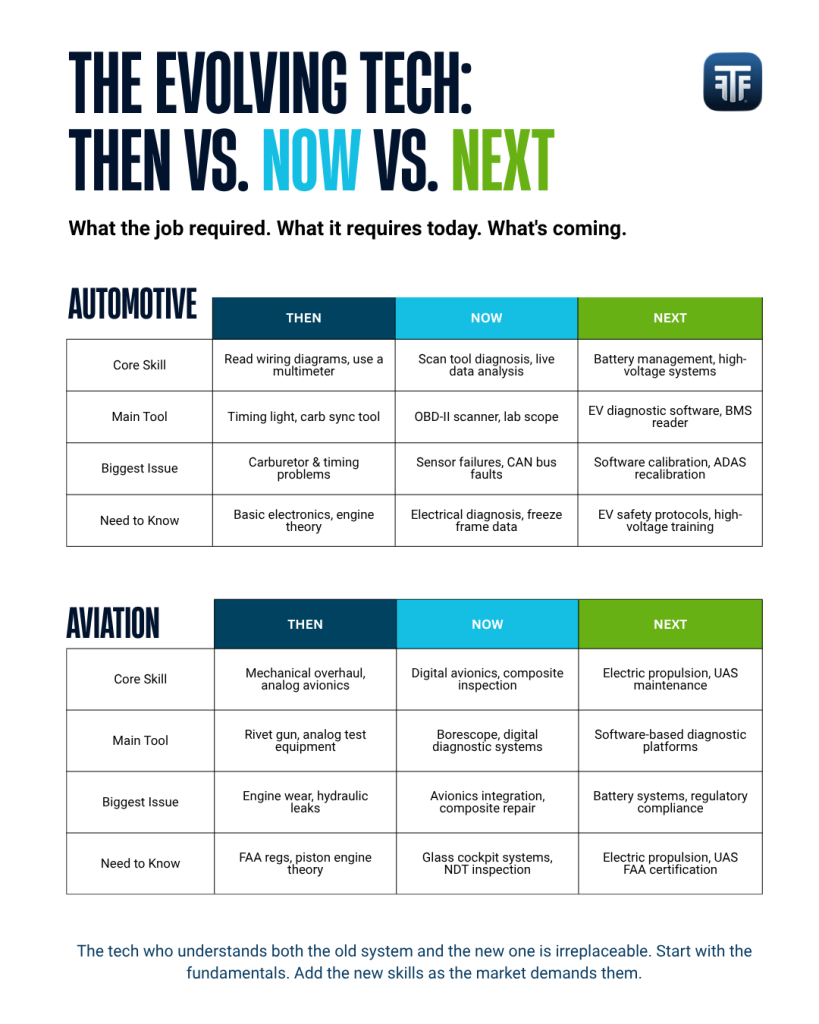
The skilled trades are not disappearing. They are evolving. The technician who understands both the old system and the new one is irreplaceable.
Key Trends by Sector
Here’s a sector-by-sector overview of the technologies and trends shaping the future of skilled technical work:
| Sector | Key Technologies and Trends to Watch |
| Automotive | EV and hybrid systems, ADAS calibration, over-the-air software updates, connected vehicle diagnostics |
| Diesel | Emissions technology (DEF, DPF, EGR), alternative fuels (hydrogen, CNG), telematics and fleet management software |
| Aviation | Advanced composite materials, unmanned aerial systems (UAS/drones), electric aircraft propulsion, digital avionics |
| Collision | ADAS recalibration after every structural repair, OEM-certified repair procedures, aluminum and mixed-material construction |
| HVAC | Smart building automation, heat pump technology, low-GWP refrigerants, energy efficiency compliance |
| Welding | Robotic welding integration, laser and friction stir welding, advanced alloys (titanium, Inconel), NDT inspection |
Electric Vehicles and What They Mean for Automotive Techs
EV and hybrid technology is the biggest shift the automotive sector has seen since the introduction of electronic fuel injection. It does not eliminate the need for automotive technicians – but it changes the skills required and creates a significant premium for techs who have high-voltage system training.
- High-voltage safety is non-negotiable. Working on HV systems without proper training is genuinely dangerous. OEM certification programs and courses through organizations like the Electric Vehicle Infrastructure Training Program (EVITP) are increasingly valuable.
- Diagnostics are shifting toward software. EV diagnostics rely heavily on software tools, data logging, and battery management system analysis rather than traditional mechanical inspection. Techs comfortable with digital tools have a significant advantage.
- ICE vehicles aren’t going away immediately. The existing fleet of internal combustion engine vehicles will need service and repair for decades. Hybrid competency bridges both worlds and is the most practical near-term investment for most automotive techs.
- ADAS is already here. Advanced driver assistance systems – lane keep assist, automatic emergency braking, adaptive cruise control – are on vehicles in service right now and require calibration after any structural or windshield repair. Every automotive and collision tech needs to understand them.
Diesel and the Future of Heavy Equipment
Diesel is not going away – but it is getting cleaner and smarter. Emissions regulations are driving significant changes in engine technology, and fleet operators are increasingly relying on telematics data to predict maintenance needs before failures occur.
- Emissions systems are complex and require specialized knowledge. DEF (diesel exhaust fluid), DPF (diesel particulate filter), and EGR (exhaust gas recirculation) systems are now standard on commercial diesel engines and are a major source of diagnostic work.
- Alternative fuels are gaining ground. Compressed natural gas (CNG), liquefied natural gas (LNG), and hydrogen fuel cell technology are growing in fleet applications. Diesel techs with alternative fuel training have expanding opportunities in transportation and logistics.
- Telematics creates new diagnostic workflows. Fleet management software now provides real-time data on vehicle performance, fault codes, and maintenance intervals. Diesel techs who can interpret this data and act on it proactively are valuable to fleet operators.
Aviation: Digital Systems and New Aircraft Technology
Aviation maintenance is already one of the most technology-intensive skilled trades, and the pace of change is accelerating. Two trends stand out as particularly significant for students entering the field now:
- Unmanned Aerial Systems (UAS/drones) are creating new career paths. Commercial drone operations require FAA-licensed maintenance technicians. This is a growing sector within aviation maintenance that didn’t meaningfully exist a decade ago.
- Electric aircraft propulsion is moving from concept to reality. Short-haul electric aircraft are in development and early deployment at several manufacturers. A&P mechanics with high-voltage and electric propulsion training will be positioned at the front of a major industry shift.
Collision Repair and the ADAS Calibration Requirement
ADAS calibration is the single biggest change to collision repair in the past decade. Virtually every modern vehicle with advanced safety systems requires camera and sensor recalibration after any repair that affects the vehicle’s geometry – including windshield replacement, wheel alignment, and structural work.
Shops that cannot perform ADAS calibration in-house are already turning away work or subcontracting it out. Collision techs with calibration training and equipment access are among the most in-demand workers in the sector right now.
HVAC: Smart Buildings and the Refrigerant Transition
Two regulatory shifts are reshaping the HVAC industry simultaneously. First, the phasedown of high-global-warming-potential (GWP) refrigerants under EPA regulations is forcing equipment manufacturers to transition to new refrigerant blends – requiring updated training and handling procedures. Second, smart building automation systems are becoming standard in commercial construction, creating demand for HVAC techs who understand building controls and IoT integration.
Heat pump technology is also growing rapidly as a more energy-efficient alternative to traditional heating systems in residential and light commercial applications. Techs with heat pump expertise are seeing strong demand across much of the country.
Welding: Robotics, Advanced Materials, and NDT
Robotic welding has been part of manufacturing for decades – but the role of human welders alongside robotic systems is evolving, not disappearing. Humans are needed to program, maintain, and quality-check robotic systems, and to perform the complex, non-repetitive welds that robots still cannot reliably execute.
The fastest-growing specializations in welding involve advanced alloys (titanium, Inconel, duplex stainless steel) used in aerospace, energy, and chemical processing – sectors where precision is non-negotiable and certified welders command significant pay premiums. Non-destructive testing (NDT) skills complement welding expertise and open additional career pathways.
How to Stay Relevant and Keep Learning
The common thread across every sector is this: the skilled trades reward people who keep learning. Here’s how to build a habit of staying current:
- Pursue certifications proactively. Don’t wait for your employer to send you to training. Research the certifications that are gaining value in your sector and pursue them on your own timeline.
- Follow the industry publications. Automotive Body Repair News (ABRN), Fleet Owner, Aviation Week, ACHR News, and the American Welding Society all publish free industry updates. Spending 15 minutes a week with relevant publications keeps you ahead of most of your peers.
- Pay attention to what OEMs are investing in. The technology priorities of major manufacturers – Ford, GM, Boeing, Carrier, Lincoln Electric – signal where the skilled trades are heading. What they’re building today is what techs will be servicing in 5 years.
- Engage with the TechForce community. TechForce AMA sessions regularly feature industry professionals discussing where their sectors are heading. These conversations are among the most direct ways to hear what skills will be in demand from the people doing the hiring.
TechForce and Career Readiness for the Future
TechForce Foundation supports students across multiple sectors of the skilled trades – not just in getting started, but in staying current as the industry evolves. The platform includes continuing education resources, industry trend content, and connections to employers who are actively investing in technology training for their teams.
Scholarships, grants, and other financial support through TechForce help students invest in the advanced training that emerging technology requires. Visit TechForce.org to explore what’s available in your sector.
The Bottom Line
The future of the skilled trades is not a threat to the people who do this work. It’s an opportunity. Every new technology that enters a shop, a fleet, a building, or an aircraft creates demand for a human being who understands it – how it works, what it needs, and what to do when it fails.
Start with the fundamentals. Build the certifications. Pay attention to where your sector is heading. The techs who do those three things will never struggle to find work.

Sources & Further Reading
For more information on the topics covered in this article, we recommend the following resources:
- U.S. Bureau of Labor Statistics (BLS) Occupational Outlook Handbook: bls.gov – job outlook and skills projections for automotive technicians, diesel mechanics, HVAC technicians, welders, and aircraft mechanics
- U.S. Department of Energy (DOE) Alternative Fuels Data Center: afdc.energy.gov – data and trends on EV adoption, alternative fuels, and fleet electrification
- Federal Aviation Administration (FAA): faa.gov – UAS regulations, electric aircraft developments, and aviation maintenance certification updates
- U.S. Environmental Protection Agency (EPA): epa.gov – refrigerant phasedown regulations and HVAC compliance information
- American Welding Society (AWS): aws.org – welding technology trends, certification updates, and workforce development resources
- I-CAR (Inter-Industry Conference on Auto Collision Repair): i-car.com – ADAS calibration training, OEM repair procedures, and collision industry technology updates