
The technician shortage means jobs are available. The skill is finding the right one and making a strong first impression. Here’s how to do both.

How to Find Skilled Trade Jobs
There are currently tens of thousands of job locations loading through TechForce alone – and the broader market has 3 to 7 open positions for every technical school graduate across automotive, diesel, aviation, and collision sectors. Finding a job in the skilled trades is not the hard part right now. Finding the right job, and presenting yourself well, is where the real work is.
For students coming out of technical education, job search resources include:
- TechForce job board: Tens of thousands of positions available at TechForce.org, directly connected to employers actively seeking graduates
- School placement offices: Many technical schools have employer relationships and can connect students directly with hiring shops
- Dealer group career pages: Large dealer groups post frequently and often have structured apprenticeship programs for new techs
- Industry job boards: iATN, Indeed, and sector-specific boards post automotive technician, diesel mechanic, and aviation tech openings regularly
Writing a Resume as a New Tech
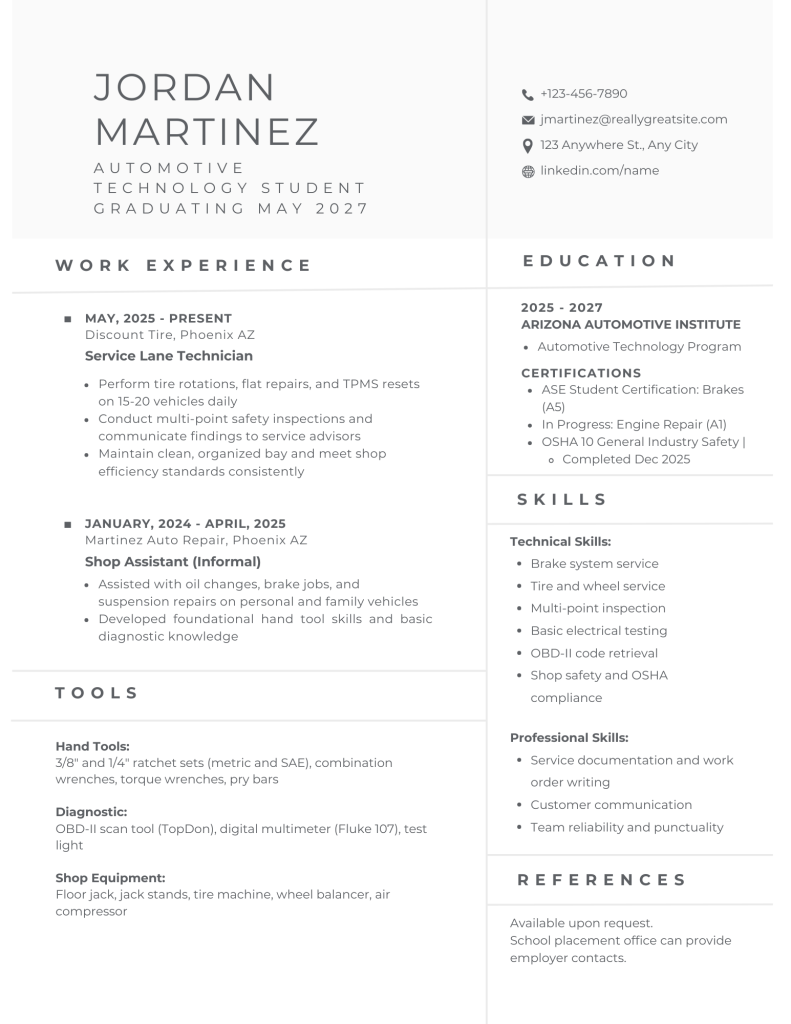
Most hiring managers in the skilled trades spend about 30 seconds on a resume before deciding whether to call someone in. Here’s what they’re looking for from a new tech or recent graduate:
Keep It to One Page
You’re early in your career. One clean, scannable page beats two pages of padding. Use clear headings, consistent formatting, and plenty of white space.
Lead with Your Training and Certifications
Your technical education and any certifications (ASE, OEM, manufacturer-specific) go near the top. Include the program name, school, and graduation date or expected completion. If you have any certifications in progress, list them with an expected date.
Include Relevant Experience – Even If It’s Informal
Worked on your own vehicles? Helped a family member with repairs? Completed school projects that involved real diagnostics or repair work? Include it. Frame it specifically: what you did, what tools you used, what result you achieved.
List Your Tools
Many automotive and diesel shops want to know what you’re coming in with. A brief line noting your current toolset shows you’re serious about the trade and have made an investment.
How to Prepare for a Shop Interview
A shop interview is different from a corporate job interview. It’s often informal, sometimes happening right in the bay, and heavily focused on what you actually know and how you carry yourself.
Research the Shop Before You Go
Know whether it’s a dealership, independent, fleet, or specialty shop. Know what brands or sectors they focus on. Look at their reviews – both customer reviews and any employee reviews you can find. Showing up informed tells the interviewer you’re serious.
Be Ready to Talk Through a Repair
Many shop interviews include a technical question or a walk-through scenario. You don’t need to know everything – but be prepared to think out loud. Walk through your diagnostic process clearly: gather information, identify possibilities, test systematically, confirm the fix. The 3 C’s (Concern, Cause, Correction) are a clean framework to fall back on.
Show Up on Time and Dressed Right
Dress for the position you are applying for. Clean clothes, punctuality, and a firm handshake still matter in a shop interview. You don’t need a suit – but you do need to look like someone who takes the opportunity seriously. Shop-appropriate means clean and professional, not formal.
Questions to Ask the Employer
An interview is not one-sided. The questions you ask an employer reveal as much about you as your answers do – and they help you avoid landing in a shop that’s wrong for your career. Here are seven questions worth asking, and why each one matters:
| Question to Ask | Why It Matters |
| What does a typical first-year tech’s schedule look like here? | Shows you’re realistic about starting at the bottom and planning ahead. |
| How are technicians evaluated and how often? | Tells you how feedback and advancement actually work in this shop. |
| What does the tool situation look like for new techs – is there any support? | Practical and shows awareness of what the job actually requires. |
| How would you describe the culture in the shop? | Opens the door for them to reveal red flags voluntarily. |
| What does the path to flat rate or to a lead tech role look like here? | Shows ambition and long-term thinking without being pushy. |
| Why do technicians typically leave this shop? | A direct question that good employers answer confidently and bad ones dodge. |
| Is there support for continuing education or ASE certifications? | Shows you’re invested in growing your skills – which good shops want. |
Pay attention to how these questions are answered, not just what is said. Hesitation, vague answers, or dismissiveness on questions about culture and retention are worth noting.
Red Flags to Watch for in a Shop
Not every employer in the skilled trades is worth working for. The technician shortage means you have more leverage than you might think – use it. Here are warning signs worth taking seriously:
- High turnover with no clear explanation. If a shop has had 6 techs in 3 years, find out why before accepting an offer.
- Vague or evasive answers about pay structure. A legitimate shop can tell you clearly how you’ll be paid and what the path to higher earnings looks like.
- No answer on training or advancement. Shops that don’t invest in their techs’ growth tend to use them up and move on.
- Pressure to start immediately without a clear offer. Urgency that skips proper onboarding is a sign of disorganization at best.
- A shop culture that feels dismissive or hostile in the interview. If they treat you poorly when they’re trying to hire you, it doesn’t improve after you start.
Negotiating Pay and Benefits
Many new techs accept the first number they’re offered because they don’t know it can be negotiable. In most cases, it is – especially when the market has 3 to 7 openings for every graduate.
- Know the market rate. Research what entry-level techs earn in your sector and region before negotiating. TechForce career path maps include pay progression data by sector.
- Consider the total package. Base pay, flat rate potential, tool allowances, training reimbursement, health benefits, and paid time off all have real dollar value. A lower base with strong benefits may outperform a higher base without them.
- Ask about the path, not just the starting point. “What does pay typically look like at 1 year and 3 years for a tech who performs well?” gives you more useful information than haggling over your starting hourly rate.
How TechForce Connects Students to Jobs
TechForce Foundation connects students in technical education directly to employers through the platform’s job board, apprenticeship listings, and employer partner network. With tens of thousands of job locations available and direct relationships with employers who are actively hiring, TechForce is one of the most direct paths from technical school to a skilled career.
Students can also access career readiness tools, resume guidance, and job search support through the platform. Log in to TechForce.org to access the job board and connect with employers in your sector.
The Bottom Line
The technician shortage is real and the demand for skilled techs is at an all-time high. You have more options than you might think coming out of technical school. The goal isn’t to take any job – it’s to find the right shop, negotiate fairly, and start building a career that has real runway.
Prepare for the interview like you’d prepare for a difficult diagnostic. Do your research, know your process, ask the right questions, and trust what you find.

Sources & Further Reading
For more information on the topics covered in this article, we recommend the following resources:
- U.S. Bureau of Labor Statistics (BLS) Occupational Outlook Handbook: bls.gov – job outlook, median wages, and hiring data for automotive technicians, diesel mechanics, and other skilled trade occupations
- National Institute for Automotive Service Excellence (ASE): ase.com – certification information and professional standards used by employers when evaluating technician candidates
- Good Jobs Institute: goodjobsinstitute.org – research and criteria for evaluating employer quality, job stability, and workplace culture