
The techs who make it aren’t the ones who had it easy. They’re the ones who figured out how to keep going. Here’s how to build that kind of resilience.

What Does Resilience Mean in a Technical Career?
Resilience in a skilled trade isn’t about being tough or never breaking down. It’s the ability to take a hit – a failed test, a rough shift, a setback you didn’t see coming – and keep moving forward anyway. It’s a skill, not a personality trait. And like every skill in a technical career, it can be learned and built over time.
The students who finish technical school and go on to build strong careers in automotive, diesel, collision repair, and HVAC are not the ones who had it easy. They’re the ones who developed the ability to get back up. Every single time.
“Pressure makes diamonds.” – A phrase that shows up again and again when TechForce students and working techs talk about what got them through the hardest parts of their training.
Why the Skilled Trades Test Your Resilience
A career in the skilled trades puts you in situations designed to push your limits. That’s not an accident – it’s how technical competency gets built. But it also means the road has real obstacles:
- The learning curve is steep, especially in the first year of technical education
- Mistakes have consequences – a wrong diagnosis, a missed step, a failed inspection
- Physical fatigue compounds mental fatigue over long shifts and semesters
- Financial pressure from tuition, tools, and living on an apprentice wage
- Shop culture that doesn’t always reward vulnerability or asking for help
- The gap between textbook learning and the real-world chaos of a busy bay
None of this means you’re in the wrong place. It means you’re in the right place, doing something hard. And hard is where growth lives.
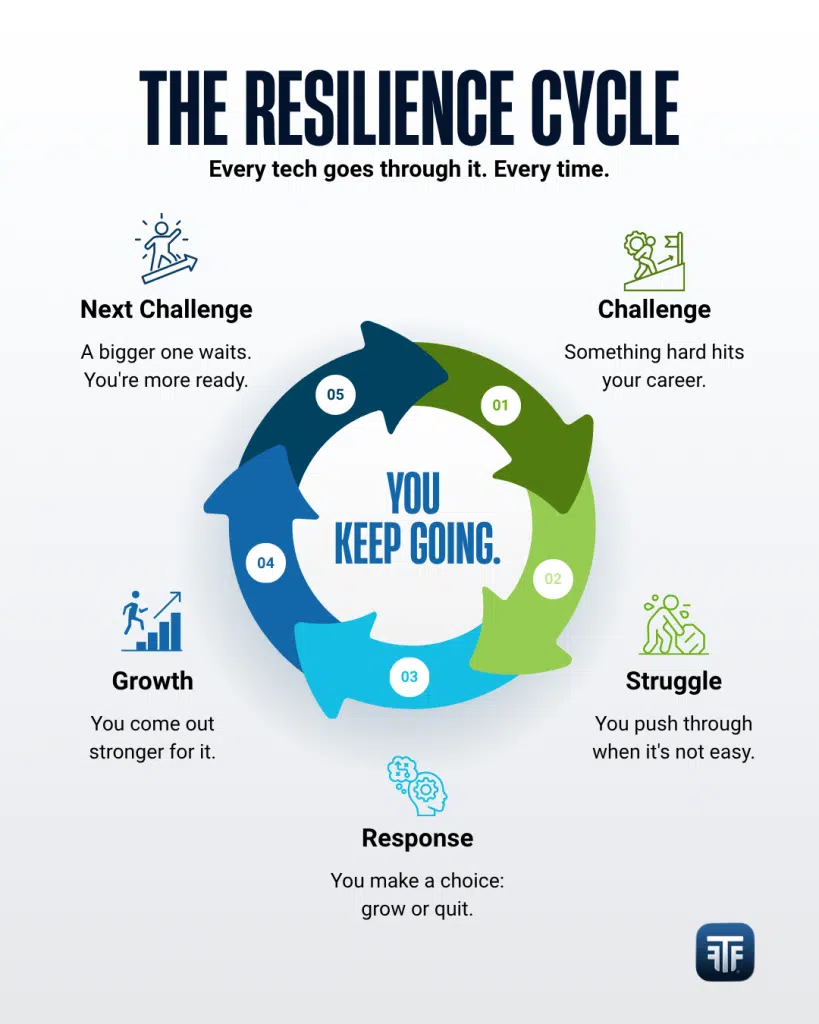
How to Respond to Common Setbacks
Resilience isn’t just a buzzword. It’s a series of choices made in specific moments. Here’s how to respond to the setbacks most techs and trade students face:
| The Setback | The Resilient Response |
| Failed a test or course | This is data, not destiny. Find out what went wrong and address that specific thing. Every master tech has a failure story. |
| Got passed over for a raise or promotion | Ask directly what it would take to get there. Turn the disappointment into a roadmap. |
| Made a costly mistake on the job | Own it, learn from it, move forward. The techs who grow fastest are the ones who can face their mistakes honestly. |
| Got negative feedback from an instructor or shop lead | Feedback is free coaching. It stings. Use it anyway. |
| Thought about quitting | Almost every tech has been there. The ones who stayed usually say the hardest stretch was right before it started clicking. |
How to Build Perseverance for the Long Game
Technical careers are not sprints. Becoming a master technician in automotive, aviation, motorsports, or any skilled trade takes years. The students who get there are the ones who figured out how to play the long game. Here’s how:
Know Your Why
When things get hard – and they will – the clearest path through is knowing exactly why you started. Write it down. A specific reason (“I want to provide for my family,” “I want to be the best diesel tech in my state,” “I want to prove it’s possible”) is more powerful than a vague one. Come back to it on the hard days.
Reframe Failure as Data
In technical diagnostics, a wrong first guess isn’t failure – it’s information. You eliminated one possibility and moved closer to the answer. Approach setbacks in your career the same way. What did you learn? What do you eliminate next time? What gets you closer to the diagnosis?
Build a Short Memory for Setbacks
Resilient techs don’t dwell. They debrief – understand what happened and why – and then they move on. Carrying the weight of every mistake slows you down. Process it, extract the lesson, and put it down.
Set Small Targets Inside the Big Goal
A 2-year technical program is hard to see to the end when you’re in month three. Break it into quarters, months, weeks. Celebrate passing a certification. Celebrate completing a repair you’ve never done before. Small wins compound into big careers.
Surround Yourself with People Who Are Still Going
Your environment shapes your persistence. Find the students who are still showing up, the techs who are still growing, the mentors who still love the trade after 20 years. Their energy is contagious in the best way.
Overcoming Adversity: Stories from Real Techs
The most powerful evidence that resilience is learnable comes from the people who’ve done it. TechForce connects students to working techs through AMA sessions and mentorship programs – and the stories of struggle and recovery are consistent across every sector.
The pattern is almost always the same: a point where quitting felt like the only reasonable option, a decision to stay anyway, and a turning point that came shortly after. Not always because things got easier – but because the tech got better at handling hard things.
“The hardest stretch was right before it started clicking. I almost left two weeks before everything changed.” – A sentiment shared by multiple TechForce-connected technicians when talking to students about perseverance.
You don’t know where your turning point is. The only way to find it is to stay in the game.
How to Deal with Failure and Setbacks Without Losing Momentum
Failure is part of every skilled career. The goal isn’t to avoid it – it’s to process it faster and use it better. Here’s a simple framework:
- Step back. Give yourself a moment before reacting. Knee-jerk responses to failure are rarely useful.
- Get honest. What actually happened? Not the story you’re telling yourself – the facts. What went wrong and why?
- Separate the mistake from your identity. You made an error. YOU are NOT an error. These are different things.
- Ask one person you trust. Getting an outside perspective cuts through the distorted thinking that follows a setback.
- Make one concrete change. Take one specific action based on what you learned. That action transforms failure into progress.
TechForce Helps You Stay in the Game
TechForce Foundation’s Wraparound Services exist because the data is clear: the students who leave technical education often don’t leave because they lack talent. They leave because of compounding pressure with no support system in place. Here’s how TechForce helps you build resilience:
- Mentorship: Direct connections to techs who stayed in the game and built careers worth having
- Financial support: Scholarships, emergency grants, and other financial resources that reduce the financial pressure driving dropout
- AMA sessions: Open, honest conversations with industry professionals about the real challenges of a technical career
- Career readiness tools: Job connections, career path maps, and life skills trainings that keep the finish line visible
Thousands of students are on the TechForce platform. You are not doing this alone. Visit TechForce.org to connect.
The Bottom Line
Resilience is not a personality type. It is a practice. Every challenge you work through in technical school is building the muscle you’ll use for the rest of your career – the ability to face a problem, stay in it, and find the answer.Pressure makes diamonds. You are in the pressure. Keep going.
Sources & Further Reading
For more information on the topics covered in this article, we recommend the following resources:
- American Psychological Association (APA): apa.org – research on resilience, perseverance, and psychological hardiness in high-demand careers
- National Institute for Occupational Safety and Health (NIOSH): cdc.gov/niosh – workplace stress and resilience resources for skilled trade workers