
Burnout in the skilled trades is more common than anyone admits. Here’s how to spot it early, protect your career, and get back to doing the work you love.

The Trade Nobody Warns You About
Everyone talks about the physical demands of a skilled career in automotive, diesel, aviation, etc.. The long hours on your feet. The heavy lifts. The tight spaces. What they don’t talk about as often is what happens to your mind when the grind never stops.
Burnout is one of the leading reasons skilled technicians leave the trade – or never finish school. And the scary part is that it rarely announces itself. It creeps in slowly, disguised as tiredness, frustration, or just “having a bad week.”
If you’re pursuing a technical career while juggling school, a job, family, and financial pressure, this article is for you.
“When you were in a bad spot mentally, how did you overcome that?” and “What is the hardest part of your job physically or mentally?” – Among the most common questions TechForce students ask industry professionals during live AMA sessions.
What Is Burnout, Really?
Burnout isn’t just being tired. It’s a state of chronic stress that leads to physical and emotional exhaustion, cynicism about your work, and a feeling that nothing you do makes a difference. The World Health Organization recognizes it as an occupational phenomenon – meaning it’s a real, documented condition, not a personal weakness.
For students in technical education and working techs, burnout often builds from a combination of factors:
- Long hours split between school, work, and personal responsibilities
- Financial stress from tuition, tools, and living expenses on an apprentice wage
- A shop culture that sometimes rewards pushing through pain over taking care of yourself
- The physical toll of hands-on technical work on your body
- Feeling isolated, especially if you’re a first-generation student or from an underrepresented group in the trades
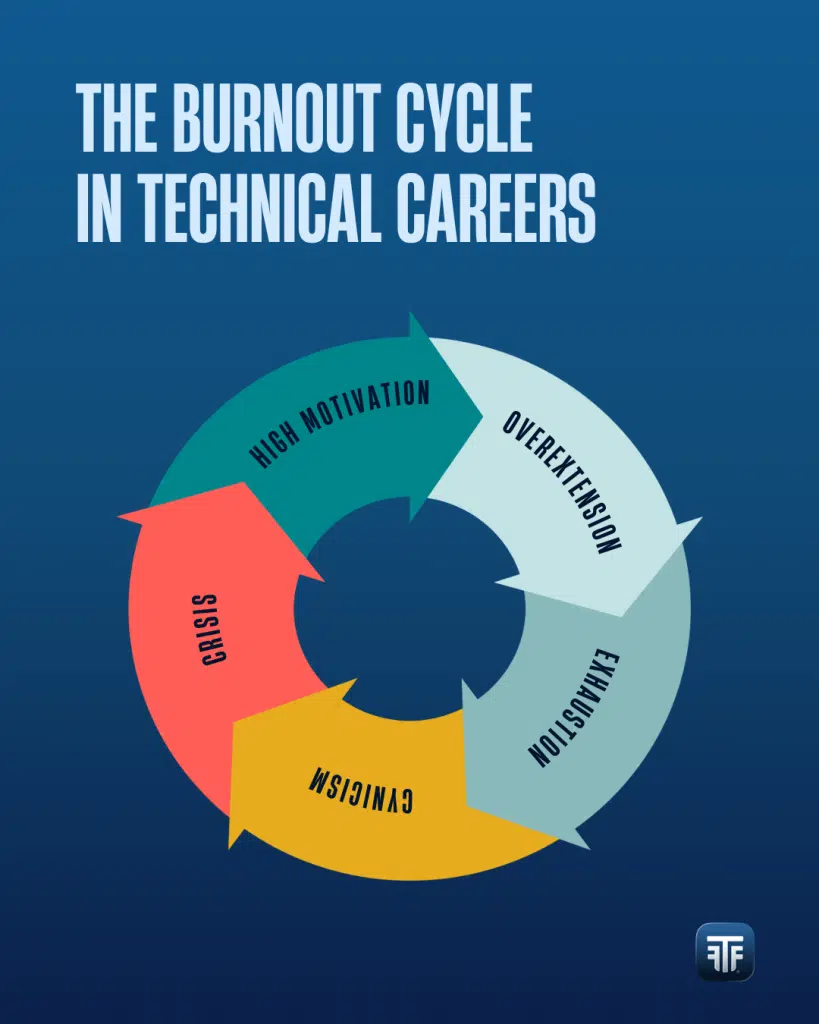
The Warning Signs: What Burnout Actually Looks Like
Most techs push through warning signs for months before hitting a wall. The earlier you catch it, the easier it is to address. Here’s what to watch for:
| Category | Warning Signs |
| Physical | Constant fatigue even after rest, frequent headaches, soreness that doesn’t go away, getting sick more often than usual |
| Emotional | Dreading every shift, feeling numb or detached, snapping at coworkers or customers, losing pride in your work |
| Mental | Struggling to focus, making more mistakes than usual, forgetting steps you normally know cold |
| Behavioral | Skipping school or calling out of work repeatedly, isolating yourself, turning to alcohol or other substances to decompress |
If several of these sound familiar, you’re not weak and you’re not alone. You’re human. And there are real, practical things you can do right now.
How to Prevent Burnout Before It Starts
Protect Your Off Time Like It’s Part of the Job
Recovery isn’t optional in a physical career – it’s maintenance. The same way you wouldn’t skip an oil change, you can’t skip rest. Set hard boundaries around time off when you can. Even 30 minutes of genuine downtime can reset your nervous system before the next shift.
Pay Attention to Your Body
Technical careers put real demands on your body. Proper lifting technique, ergonomic positioning, and staying on top of minor soreness before it becomes injury are all part of a long career. Body mechanics matter as much as technical skills.
Talk About It
Shop culture doesn’t always make it easy to say “I’m struggling.” But holding it in makes it worse. Find one person you trust – a classmate, a mentor, a family member – and say it out loud. Saying “I’m burning out” is the first step to stopping it.
Address the Financial Pressure Directly
A huge driver of burnout for students in technical education is financial stress. Working extra shifts to cover rent while keeping up with coursework is a fast track to exhaustion. TechForce offers scholarships, emergency grants, and other financial support specifically designed to reduce this pressure. You don’t have to white-knuckle it through school.
If You’re Already Burned Out: A Path Back
Recovery from burnout doesn’t happen in a weekend. It’s a process. But it’s absolutely possible, and plenty of skilled techs have come back stronger after hitting a wall. Here’s where to start:
Step 1: Acknowledge It
Stop calling it “just tiredness” or “a rough patch.” Name it. Burnout. That’s the first and hardest step, and it’s the one that makes the rest possible.
Step 2: Identify the Biggest Source
Is it financial stress? Physical exhaustion? Feeling unsupported at your school or shop? Loneliness? Pinpointing the main driver helps you address the right thing instead of spinning in circles.
Step 3: Ask for Help
This might mean talking to a school counselor, reaching out to TechForce for financial support or community connections, or seeking professional mental health support. None of these are signs of failure. All of them are signs of a tech who wants to stay in the game.
Step 4: Rebuild Small
You don’t fix burnout all at once. Pick one thing to change this week – one boundary to set, one hour to protect, one conversation to have. Small resets compound over time.
Keeping the Drive: Long-Term Motivation in a Skilled Career
Burnout prevention isn’t just about managing stress. It’s about staying connected to why you started. The automotive technician shortage is real – America needs nearly 1 million new entry-level techs by 2028, and there are 3 to 7 job openings for every graduate in multiple sectors. The demand for what you’re training to do has never been higher.
That’s not a small thing. On the hard days, remember: skilled careers in automotive technology, diesel mechanics, aviation, collision repair, HVAC, and more offer strong wages, long-term stability, and real respect. The path is worth finishing.
“How do you keep the same drive and stop yourself from getting burnt out?” – TechForce student, submitted to a master tech AMA session.
The answer from every experienced tech comes back to the same thing: find your community, stay connected to your purpose, and don’t try to do it alone.
Practical Work-Life Balance Strategies for Techs
These aren’t generic wellness tips. These are specific to the reality of a technical career:
- Schedule recovery like a shift. Put it in your calendar. If it’s not scheduled, it doesn’t happen.
- Use your lunch break to actually eat. Skipping meals to keep working is a short-term trade that costs you long-term.
- Learn to say no to one thing a week. One declined obligation creates breathing room.
- Move your body off the clock, but gently. A short walk does more for recovery than collapsing in front of a screen.
- Connect with other students in skilled trades. Shared experience cuts isolation fast.
- Track your wins. Burnout distorts your perception. A log of what you’ve accomplished is an antidote to the feeling that nothing is working.
TechForce Support for Students Experiencing Burnout
TechForce Foundation’s Wraparound Services were built around one simple idea: students in technical education and skilled careers shouldn’t have to white-knuckle it through the hard parts alone. Here’s what’s available:
- Financial relief: Scholarships, emergency grants, tool giveaways, and more help reduce the financial pressure driving burnout
- Mentorship: Connections to working techs who’ve been where you are and came out the other side
- Life skills trainings: 350+ sessions covering time management, mental health, financial literacy, and career readiness – ranked by students
- AMA sessions: Direct access to industry professionals who answer real questions about the hard (and fun) parts of a technical career
You don’t have to earn your way to support. It’s already here, at TechForce.org.
The Bottom Line
Burnout in the skilled trades is real, it’s common, and it’s survivable. The techs who make it to master level aren’t the ones who never struggled. They’re the ones who learned to take care of themselves the same way they take care of the vehicles in their bay: with regular maintenance, early attention to warning signs, and the right tools for the job.
You’ve got this. And you’ve got backup.
Sources & Further Reading
For more information on the topics covered in this article, we recommend the following resources:
- World Health Organization (WHO): who.int – occupational burnout classification, definition, and workplace mental health resources
- 988 Suicide and Crisis Lifeline: 988lifeline.org – free, confidential crisis support available 24/7 by call or text
- National Institute for Occupational Safety and Health (NIOSH): cdc.gov/niosh – workplace stress, physical wellness, and occupational health resources for skilled trade workers